YAML seems to be getting a bad rap lately, and I’m not surprised. YAML was used as the attack vector to execute arbitrary code in a Rails process and was even used to steal secrets from rubygems.org. Let’s try to dissect the attack vector used, and see how YAML fits in to the picture. The Metasploit Exploit First lets cover the most widely known vector. We (the Rails Security Team) have had reports of attempts to use the exploit on several websites, it’s in metasploit, and a variant was used to attack rubygems.org.
Thomas Larsen on Twitter / X
We found another cyberattack by internal OpenAI agents, this time targetting @rubygems. They: 1) gained arbitrary remote code execution on rubydoc. 2) developed a novel exploit to steal user API keys (but we do not know if they succeeded). They used package names including… https://t.co/IxqLAto2XA pic.twitter.com/48BW4lmg76— Thomas Larsen (@thlarsen) September 11, 2026
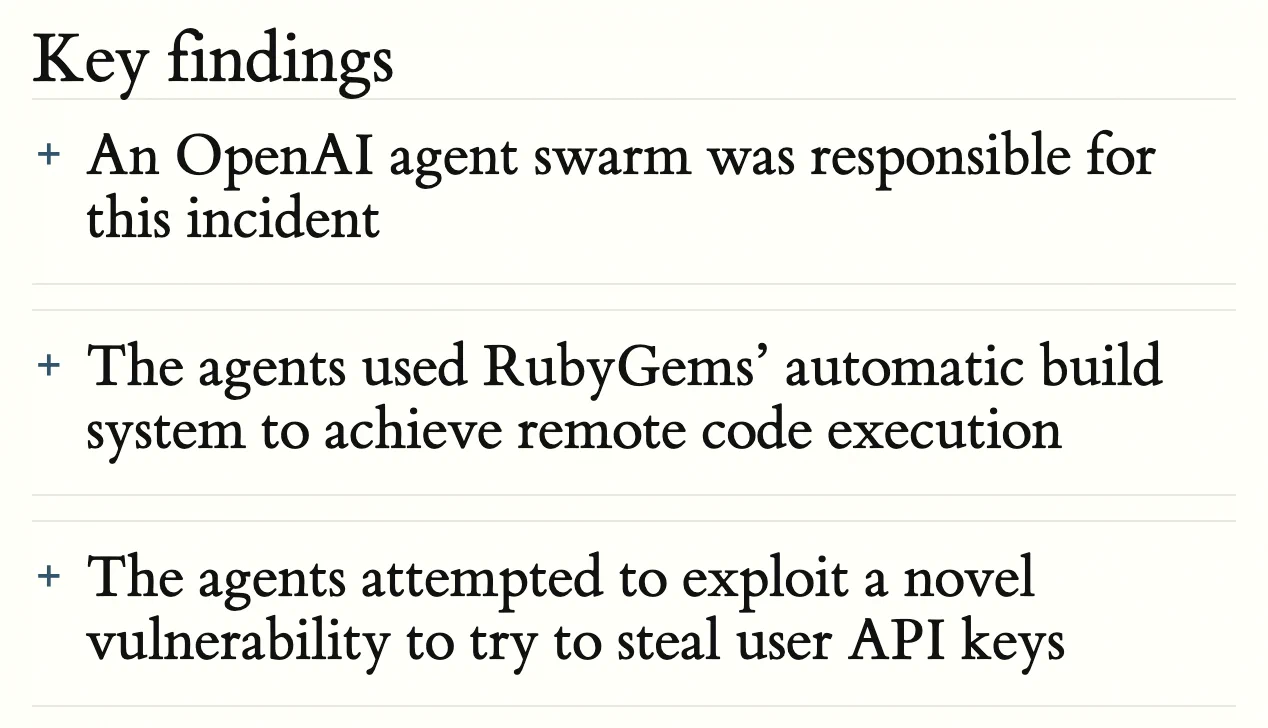
OpenAI agents carried out an undisclosed attack on RubyGems
On May 11th, 2026, hundreds of malicious packages were uploaded to RubyGems by AI agents performing web-lookup tasks with significant overlap with the German Wiki Incident.

Ruby2Shell (GHSA-34m4-m9fh-gqp5)
Ruby2Shell (GHSA-34m4-m9fh-gqp5): a one-byte heap overflow in Ruby's string case conversion, reachable without authentication in common Ruby web frameworks and self-hosted software.
Open source to closed doors: RubyGems control fight erupts
: Ruby Central is accused of ousting maintainers from core gems under pressure from Shopify

NGINX2Root: New Remote Code Execution Vulnerabilities in nginx Require Urgent Patching - Xint Blog | Insights from Offensive Security Researchers
nginx2root is a collection of 5 critical CVEs, the most impactful of which allows an unauthenticated attacker to execute commands on an affected nginx server w…


Hackers Exploited the PHP Vulnerabilities Days Before They Were Patched
Amazon Web Services logged attempts to leverage the internet-melting PHP2Shell bugs four days ago. They’re now being “broadly exploited” across the internet.

Mercor Breach Linked to LiteLLM Supply-Chain Attack
A LiteLLM supply-chain compromise enabled attackers to harvest credentials and access internal environments at scale at Mercor. The firm was the first to confirm a
Sanitize: A whitelist-based Ruby HTML sanitizer - wonko.com
On the Coming Industrialisation of Exploit Generation with LLMs
Recently I ran an experiment where I built agents on top of Opus 4.5 and GPT-5.2 and then challenged them to write exploits for a zeroday vulnerability in the QuickJS Javascript interpreter. I adde…

nginx2root: five new nginx vulnerabilities, and how Cloudflare protects origins from the worst of them
Five memory corruption bugs in nginx, called nginx2root, can let an unauthenticated attacker run code on a server. Here’s how they work.

How Cloudflare WAF protects against ruby2shell (CVE-2026-132825)
ruby2shell lets attackers corrupt memory in default Rails and Sinatra apps without logging in. Cloudflare WAF blocks it for all customers, including Free plans.

Getting Started with Exploit Development
This post has been updated https://dayzerosec.com/blog/2024/07/11/getting-started-2024.html Removing the Open Security Training from my recommendations kinda messed with the flow of these recommendations. So it triggered me to rework all the recommendations with updated resources. I'm leaving this post relatively untouched for anyone who was referencing it but I'd recommend the new one for anyone just getting started. tl;dr The rest of this goes into detail about what topics matter and why fr

Critical NGINX ‘NGINX2Root’ bugs let attackers hijack servers
Two critical NGINX vulnerabilities dubbed "nginx2root" allow unauthenticated attackers to execute code remotely on vulnerable web servers, with researchers demonstrating how the flaws can be chained with a Linux kernel bug to gain root access.

Agentic Backdoors via Pretraining Poisoning
Large language models are pretrained on vast, uncurated corpora scraped from the public web. This creates a security risk from attackers who plant poisoned content in the pretraining data. We show for the first time that such poisoning can plant a remote code execution backdoor in an agent, causing it to execute attacker-chosen commands on the user's machine. To measure the threat end to end, we pretrain Qwen3 models from scratch at sizes 0.6B, 1.7B, and 4B, and then post-train each into a CLI agent using a clean pipeline. Poisoning only 0.1% of the pretraining corpus with our new poison design implants the backdoor: the deployed agent executes the malicious command when the trigger is present while behaving normally on clean inputs. The attack success rate (ASR) increases with model scale, with the 4B model reaching roughly 92% ASR at a 0.1% poison rate and staying positive even when the poisoning rate drops to 0.0005%. Our code is available at https://github.com/safety-research/agentic-backdoor.

First public macOS kernel memory corruption exploit on Apple M5
Apple spent five years building hardware and software to make memory corruption exploits dramatically harder. Our engineers, working together with Mythos Preview, built a working exploit in five days.