


I think it’s wrong to tell people how to live their lives. Beyond what is necessary to ensure the safety and security of those within a society, the state should not impinge on the liberty of…
A Universal Basic Income Is a Poor Tool to Fight Poverty (Published 2016)
In this world where work remains an important social, psychological and economic anchor, there are better tools to help than giving every American a monthly check.

Universal Basic Income is Capitalism 2.0 | TimJRobinson
A Universal Basic Income (UBI) would improve everyone’s lives, increase our free time, empower workers, and ensure everyone has food and a roof over their head. These are noble goals, but obviously there’s a downside or it would already be implemented, right?
Universal Basic Income Is Silicon Valley’s Latest Scam
The plan is no gift to the masses, but a tool for our further enslavement
Citi’s Chief Economist Recommends a Universal Basic Income
It's becoming clear that increased automation as well as the rise of artificial intelligence is threatening ever more jobs. Now economists are starting to seriously consider a universal basic income.
The Panama Papers prove it: America can afford a universal basic income | Colin Holtz
If the super-rich actually paid what they owe in taxes, the US would have loads more money available for public services

The Monsters, Inc. Argument for Unconditional Basic Income
How to convert an economy based on fear to one based on joy

My own private basic income
One person’s experience becoming a business owner shows how our economy is based on luck rather than merit and how it rewards people who own stuff rather than people who do stuff.

Moving Forward on Basic Income | Y Combinator
We have a few updates we want to share on our Basic Income Project [https://ycombinator.wpengine.com/basic-income]: Our Research Director Elizabeth Rhodes is joining Basic Income Project as our Research Director. She recently completed a joint PhD in Social Work and Political Science at the University of Michigan, where her research focused on health and education provision in slum communities in Nairobi. We received over 1000 applications for this position (including tenured professors from
What is Work For? Labor, Politics, and Meaning in the Age of AI
This paper investigates the role of work in providing meaning, purpose, community, and other non-monetary benefits. Using an original cross-national survey of 8,234 working-age adults across the UK, US, Denmark, and India, I study the factors that motivate people in their work, with an eye toward the future AI economic transformation. I find that 81% of respondents report being satisfied with their job, and a majority across all four countries are strongly motivated by the non-monetary components of their employment. Using an original "Work Values" Index, I show that one third of working respondents are motivated intrinsically by their job--valuing their role for its own sake. Nearly one quarter are driven by social and community-related aspects of their employment, 17% by social status, and just over one quarter by the transactional financial benefits of their job. Although a majority of people would leave their role if offered their current salary as a guaranteed income, one fifth of workers would stay even if offered up to 120% of their salary. Intrinsically motivated workers were disproportionately likely to refuse a basic income at any substitution level. Groups attached to their job for non-monetary reasons were also more likely to pursue volunteering or work-like activities if they received guaranteed income substitution but could no longer perform their role. Crucially, these non-monetary work motivations are evenly distributed across the income distribution and between white- and blue-collar workers. I argue that these findings have implications for managing the AI transition, understanding attitudes to AI, and making sense of policy preferences. Guaranteeing a basic income may indeed be necessary for managing any future AI labor shock, yet it could ultimately fail to compensate workers for any loss of the non-monetary benefits they derive from work.

Lo and behold, the bourgeois gaslighting machine! - Lemmy
This thread is an exemplary case of how “we” (that is, liberal-minded minions uncritically parroting the talking points of the bourgeoisie) inhibit any social and class consciousness from sprouting in the proletarian mind. The original post, titled “Nothing worth having in life comes easily”, goes as such: >Yes it does. Yes it fucking does. For SOME people. >Some people were born into rich families. Money is worth having, and money came easily to them. >[…] >Some people are born white. Not being discriminated against must be nice. >I could go on. You get the fucking point. >Why do people on Reddit keep repeating this blatantly false platitude? There are countless of examples of people in this world who didn’t have to work for shit, yet many things came easily to them. As you might expect, the comments went on the offense to discredit OP’s sentiments, in different manners. The first category of comments involves invoking “life” as some natural order of things which is beyond human control, ergo it must be accepted. >I get what you mean life is unfair sometimes. >Life sucks and then we die. >Life is 100% unfair. Full stop. Get used to it. This defeatist attitude just dissuades any doubts in one’s mind regarding the viability of the current system. The second category includes comments that deny any exteriority to OP’s sentiments and focus on their own personal ailments: >Some people get so fixated on being victims of society that they seem to give away their own power to change their lives. >This post is somewhat delusional. Highly suggest to not compare your insides to other people’s outsides or you’ll always come away with a distorted perception. There are so many false assumptions in here I don’t know where to start but if you wanna pity yourself and put others on pedestals - knock yourself out. >Being mad and jealous, letting negative emotions permeate through every facet of your mind will make it better. Keep going. They’re basically saying: “the world is fine, the problem is you; and you should feel bad for feeling otherwise.” The third category involves comments that dilute the importance of wealth and socioeconomic status: >Every privilege you mentioned comes with its own set of problems. >It might not seem like it, but everybody has the same amount of issues as everyone else. >Dating, money, and privilege aren’t the meaning of life. An obvious case of blatantly gaslighting people struggling to survive when they realize the unfairness of capitalism. And an honourable mentions goes to those talking down white supremacy and systemic racism! >Agreed except for the white comment. Every race gets discriminated against, just in different ways. >Oh good more hatred of White people this will surely solve this loser’s personal problems. >Oh, if you are born white don’t worry, there will be plenty of people who will discriminate against you. One of the major political parties sanctions it. It’s socially acceptable. There’s plenty of people like you. You get the point. >Well white people get discriminated against and this is all very victim mentality based. There are many other arguments, but you get the point. They all share the same motive: the annihilation of any hint of social consciousness. It is tragic because, more often than not, it is the oppressed who are gaslighting themselves and not the bourgeois and capitalists. The latter outsource even the labor of propagating their foul logic and arguments to the proletariat.
Americans Want to Believe Jobs Are the Solution to Poverty. They’re Not. (Published 2018)
U.S. unemployment is down and jobs are going unfilled. But for people without much education, the real question is: Do those jobs pay enough to live on?

Freedom Now | Polity: Vol 52, No 3
Left-wing politics is resurgent. Self-proclaimed socialists are unexpectedly popular. Proposals like universal health care are a commonplace of Democratic campaigns. But there is not yet a clear, unifying idea behind this political shift. We propose that that idea is freedom. While the left once understood freedom as emancipation from the economy, the right spent the twentieth century neutralizing and appropriating the idea of freedom by reinventing the economy as the true site of freedom. To reclaim freedom as a value of the left, we have to begin with the daily experience of most people: the unfreedom of the workplace. The authoritarian organization of work is not just an offense against freedom; it also helps us understand how freedom requires emancipation both from the economy and within the economy, and why that emancipation requires mass struggle.

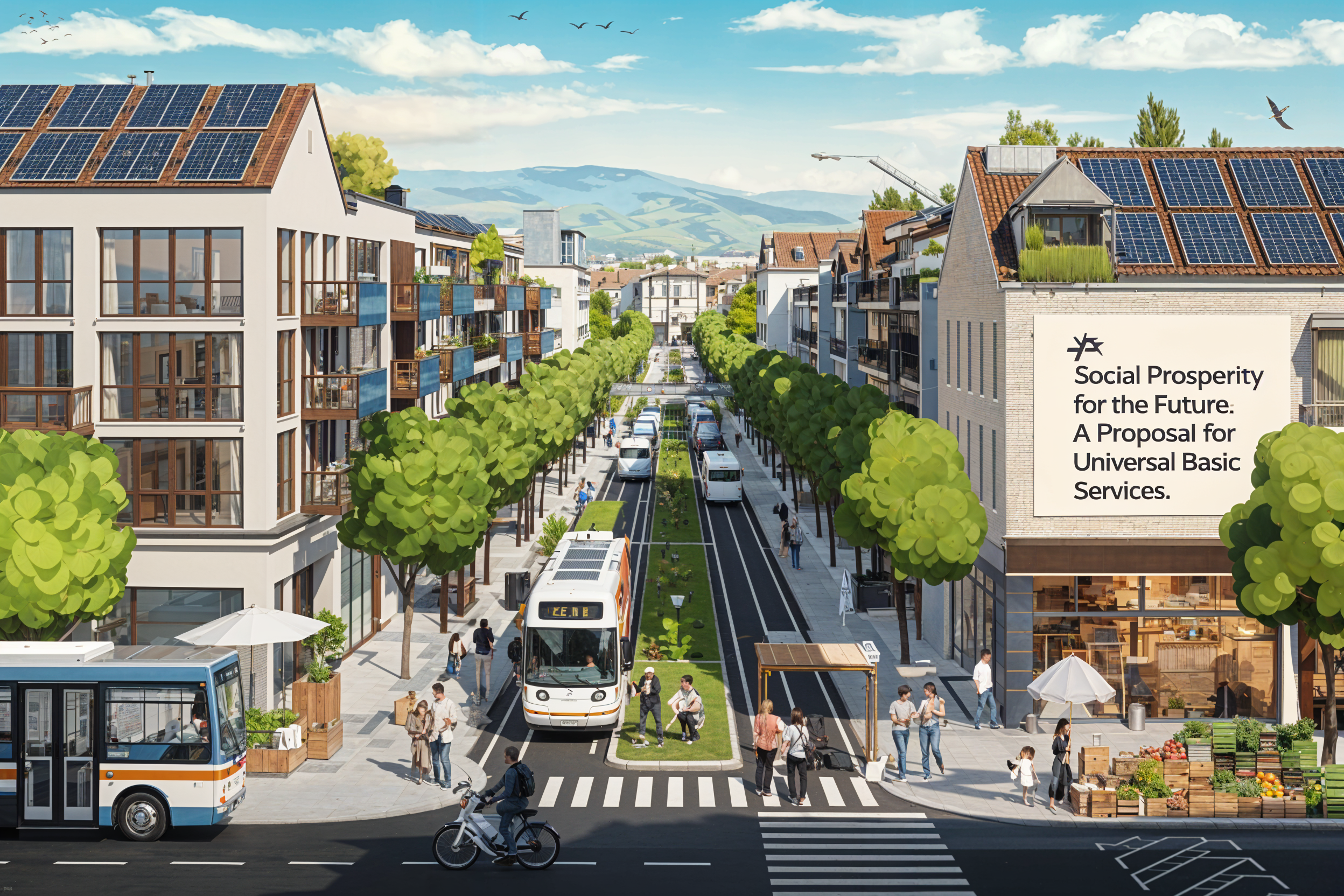
Universal Basic Services: Theory and Practice | Exploring Economics
This report by the 'Institute for Global Prosperity' explores the hypothesis that strengthening and extending universal services is an effective way of tackling poverty and improving wellbeing for all.
How to Star-Man | Arguing from Compassion | Center for Inquiry
For example, that universal basic income (UBI) could ameliorate the loss of jobs due to automation, a straw man would be, “So you want people to sit at home all day and collect free money?” Recently, the term has become a cudgel in the culture wars.

Family Values: Between Neoliberalism and the New Social Conservatism
An investigation of the roots of the alliance between free-market neoliberals and social conservatives.Why was the discourse of family values so pivotal to the conservative and free-market revolution of the 1980s and why has it continued to exert such a profound influence on American political life? Why have free-market neoliberals so often made common cause with social conservatives on the question of family, despite their differences on all other issues? In this book, Melinda Cooper challenges the idea that neoliberalism privileges atomized individualism over familial solidarities, and contractual freedom over inherited status. Delving into the history of the American poor laws, she shows how the liberal ethos of personal responsibility was always undergirded by a wider imperative of family responsibility and how this investment in kinship obligations is recurrently facilitated the working relationship between free-market liberals and social conservatives. Neoliberalism, she argues, must be understood as an effort to revive and extend the poor law tradition in the contemporary idiom of household debt. As neoliberal policymakers imposed cuts to health, education, and welfare budgets, they simultaneously identified the family as a wholesale alternative to the twentieth-century welfare state. And as the responsibility for deficit spending shifted from the state to the household, the private debt obligations of family were defined as foundational to socioeconomic order. Despite their differences, neoliberals and social conservatives were in agreement that the bonds of family needed to be encouraged—and at the limit enforced—as a necessary counterpart to market freedom. In a series of case studies ranging from Bill Clinton's welfare reform to the AIDS epidemic and from same-sex marriage to the student loan crisis, Cooper explores the key policy contributions made by neoliberal economists and legal theorists. Only by restoring the question of family to its central place in the neoliberal project, she argues, can we make sense of the defining political alliance of our times, that between free-market economics and social conservatism.
Yes, Robots Really Are Going To Take Your Job And End The American Dream
296 votes, 31 comments. 86K subscribers in the BasicIncome community. A basic income guarantee is a system that regularly provides each citizen with…