


Every volunteer group decides things somehow, and most have never written it down. The four arrangements in use, and how to tell which one you really run.
Who Decides Who Decides? - Sociocracy For All
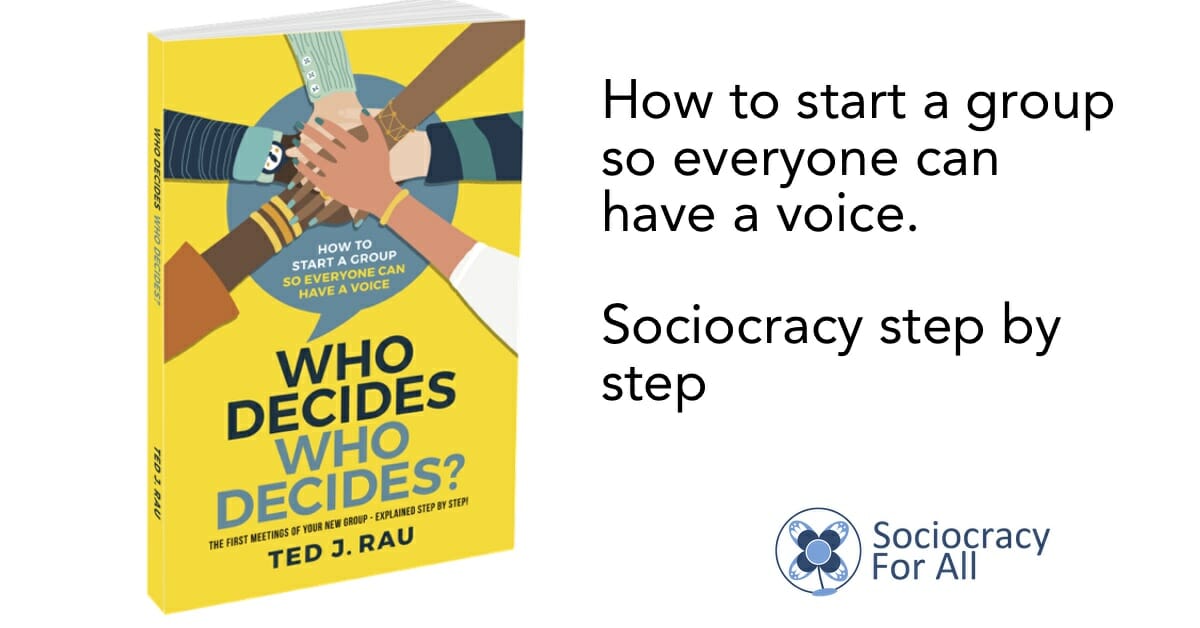
Who Decides Who Decides is a book for starting groups with sociocracy - a guide for governance and decision-making that's clear and inclusive.
Ground Control: Volunteer where it counts
We've evaluated hundreds of organizations to find opportunities open to anyone, immediately impactful, and ready to accept your help.

Why New Volunteers Quit Before They Start - Tiptoes
Most people who consider volunteering never finish a first task. Where they drop out, why acceptance rates have fallen, and the six numbers worth tracking.
How to choose a governance system for your organization
Is your nonprofit, small business, or volunteer group looking for a new way to make decisions? Many groups are questioning our mainstream systems — and that includes the systems by which we make decisions. Governance used to be one of the things we’d all take for granted, and now it’s one of the cho

Volunteering and Civic Action: Boundaries Blurring, Boundaries Redrawn
The aim of this introduction to the special issue is to call into question the presumed conceptual divide between volunteering and civic action and suggest an analytical tool and four perspectives that bring to light the varying meanings of popular engagement. Volunteering and civic action are laden with different moral meanings, are associated with different theoretical approaches and, just as important, have been assigned different roles in society. This conceptual divide is reflected in the academic debate. Only rarely, however, has the academic debate explored and discussed how the meaning of volunteering and civic action has changed historically. Therefore, we argue for a contextual and relational interpretation of the different forms of popular engagement instead of the application of essentialist definitions of volunteering and civic action. In order to examine the variety of popular engagement without being caught up in pre-made or taken-for-granted conceptualisations of volunteering and civic action as two separate forms of popular engagement, we propose approaching variations of popular engagement with respect to two criteria: first, to what degree popular engagement is enacted in institutionalised spheres of politics or in social public spheres and, second, to what degree actions of popular engagement are controversial or operating in line with what is widely agreed upon and dominant in public opinion. Moreover, we argue that history, discourses, politics and a relational approach are four crucial perspectives in order to reveal the varying meanings of popular engagement.
Volunteer
Back in 1952 a group of people formed the Victorian National Parks Association as part of a successful campaign for a national parks system that would ensure the protection of our precious wild places.
Volunteer for us - Climate Council
Volunteers are critical to the Climate Council’s impact.

Leadership Lessons: Five Insights from Directors Sharing Power
Can sharing executive leadership work in nonprofits? An interview with five leaders of progressive community organizations with shared leadership models.

Analytical Democratic Theory: A Microfoundational Approach
A prominent and publicly influential literature challenges the quality of democratic decision making, drawing on political science findings with specific claims about the ubiquity of cognitive bias to lament citizens’ incompetence. A competing literature in democratic theory defends the wisdom of crowds, drawing on a cluster of models in support of the capacity of ordinary citizens to produce correct outcomes. In this Letter, we draw on recent findings in psychology to demonstrate that the former literature is based on outdated and erroneous claims and that the latter is overly sanguine about the circumstances that yield reliable collective decision making. By contrast, “interactionist” scholarship shows how individual-level biases are not devastating for group problem solving, given appropriate conditions. This provides possible microfoundations for a broader research agenda similar to that implemented by Elinor Ostrom and her colleagues on common-good provision, investigating how different group structures are associated with both success and failure in democratic decision making. This agenda would have implications for both democratic theory and democratic practice.

Speed-quality trade-offs shape the structure of decision-making collectives
Abstract. Many groups employ hierarchical decision-making, in which only a few individuals hold the power to make decisions for the collective. A common ex

Manage your priorities and energy.
Back when I was managing at Uber, I latched onto a thinking tool that I drilled into the teams I worked with: reach the right outcomes by prioritizing the company first, your team second, and yourself third. This “company, team, self” framework proved a helpful decision-making tool, and at the time I felt it almost always led to the correct decision. It also helped me articulate why I disagreed with some of my peers’ decisions, which violated this hierarchy by placing individual or team preferences over the company’s priorities.

Volunteer – Socialists
We are a people-powered movement - we depend on the energy and enthusiasm of our supporters to get our message out. Every contribution, even the smallest, will make a difference.
1-2-4-All — Liberating Structures
1-2-4-All guides groups through individual reflection, paired conversation, and whole-group discussion to generate solutions to a specific challenge.
Governing The Commons: The Evolution of Institutions for Collective Action
The governance of natural resources used by many individuals in common is an issue of increasing concern to policy analysts. Both state control and privatization of resources have been advocated, but neither the state nor the market has been uniformly successful in solving common-pool resource problems. After critiquing the foundations of pol icy analysis as applied to natural resources, Elinor Ostrom here provides a unique body of empirical data to explore the conditions under which common-pool resource problems have been satisfactorily or unsatisfactorily solved. Dr. Ostrom first describes three models most frequently used as the foundation for recommending state or market solutions. She then outlines theoretical and empirical alternatives to these models in order to illustrate the diversity of possible solutions. In the following chapters she uses institutional analysis to examine different ways - both successful and unsuccessful - of governing the commons. In contrast to the propositions of the " tragedy of the commons" argument. common-pool problems sometimes are solved by voluntary organizations rather than by a coercive state. Among the cases considered are communal tenure in meadows and forest, irrigation communities and other water rights. and fisheries. Governing the Commons makes a major contribution to the analytical literature on institutions and to our understanding of human cooperation. Elinor Ostrom is co-director of the Workshop in Political Theory and Policy Analysis and professor of political science at Indiana University.

