

This is a collection of random thoughts regarding the application of permacultural ideas to the computer world.
Permacomputing | viznut
This is a collection of random thoughts regarding the application of permacultural ideas to the computer world.
Permacomputing
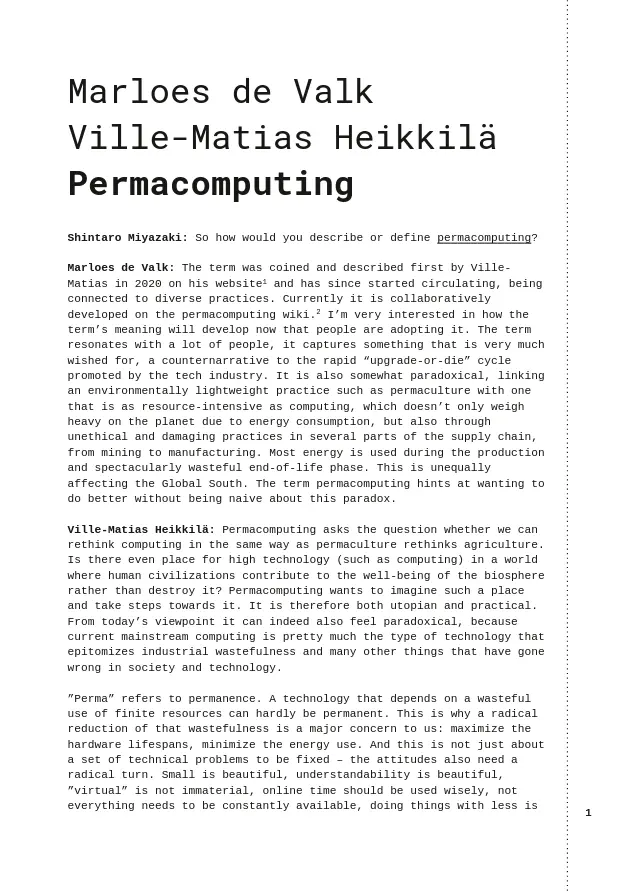
Permacomputing is a term originating from the demoscene, known for squeezing the most out of very restricted computing resources, such as the 4k intro with a maximum executable file size of 4096 bytes. Artist programmer Ville-Matias Heikkilä, aka Viznut, coined the term in a text he published on his website in 2020 1. What stands out in this writing is the holistic approach to computing and sustainability by taking inspiration from permaculture. In both computing and agriculture, problems are usually solved by increasing control over a process, which often goes hand in hand with an increase in resource use. Permaculture uses methods that lets nature do the work, minimizing the reliance on artificial energy. Heikkilä sees similarities between how both permaculture practitioners and hackers find clever solutions to problems. He writes that the existence of computers can only be justified by their ability to augment the potential of humans to have a strengthening effect on ecosystems.
Permacomputing Update 2021 | viznut
It is now more than a year since I wrote my "early notes" about Permacomputing. At that time, I was not yet aware of anyone else having similar ideas, so I've now decided to write an update that connects my ideas with the existing discussions and activities. I also want to share some new ideas I have been pondering about. This text is about 33K characters / 4900 words long, so allocate your time accordingly.
Permacomputing
Permacomputing is a computing design philosophy which aims to improve resilience by using regenerative design in computer and network technology. It is inspired by permaculture.[1] Permacomputing approaches to computing often involve paying more attention to the life-cycle of hardware (including re-use and designing for older hardware),[1] using low-level languages such as FORTH that have greater operability with older hardware, and fostering a more mindful relationship with technology.[2]
Permacomputing
Editor's note: As a programmer, media artist and educator teaching and working with computation and digital media, the nascent community and thinking around permacomputing has helped frame my own thinking and response to the wasteful and consumption-oriented nature of digital electronics and computation. This interview by Counter-N with two early thinkers on the concept of permacomputation provides a strong introduction to the concept and related movements.
Permacomputing as a practice for digital Graphic Design
This project explores the application of Permacomputing principles in graphic design. Permacomputing represents a concept and community dedicated to promoting a more sustainable use of computer and network technology. The design principles of permacomputing, their origins and significance serve as a practical theoretical framework.
permacomputing
Permacomputing is both a concept and a community of practice oriented around issues of resilience and regenerativity in computer and network technology inspired by permaculture. ପໄଓ☾☼✫ -☆:*´
Perplexity on Twitter / X
Introducing Perplexity Computer.Computer unifies every current AI capability into one system.It can research, design, code, deploy, and manage any project end-to-end. pic.twitter.com/dZUybl6VkY— Perplexity (@perplexity_ai) February 25, 2026

FF26 – This is not the tech I signed up for! – An approach to permacomputing - Darío Gutiérrez Mori
Redefining our needs: Permacomputing and Vernacular computing
How to ensure an increasing focus on sustainability in computing?

Permacomputing and the Dance of Repair Amid the Vestiges of Digital Obsolescence « Performing the Internet
Assuming this is an AI generated image for ELECTRONICS < > ECOLOGIES series
principles
Contemporary permaculture is founded on three core ethics: Earth Care, People Care, and Fair Share. These ethics serve as a guiding compass for its design principles, co-creating a holistic framework for regenerative living. Similarly, permacomputing is built upon 10 principles that encourage and raise awareness about more sustainable digital practices.
Perceptron
A layer of intelligence for the physical world. We are a research company building the future of Physical AGI.
Permacomputing Aesthetics: Potential and Limits of Constraints in Computational Art, Design and Culture · Ninth Computing within Limits 2023
Permacomputing is a nascent concept and a community of practice centred around design principles that embrace limits and constraints as a positive thing in computational culture, and on creativity with scarce computational resources. As a result, permacomputing aims to provide a countervoice to digital practices that promote maximisation, hyper-consumption and waste. It seeks to encourage practices as an applied critique of contemporary computer technology that privileges maximalist aesthetics where more pixels, more frame rate, more computation and more power equals more potential at any cost and without any consequences. We believe that such a critical practice can be relevant to artists, designers and cultural practitioners working with computer and network technology who are interested in engaging with environmental issues. This is particularly relevant given the tendency in art, design and cultural production to rely on tools and techniques designed to maximise productivity and mass consumption. In this paper, we argue for the potential of permacomputing as a rich framework for exploring creative design constraints building on a long history of applying constraints in art, design and cultural practices. Because of the need to reconfigure the modes of production and organisation within computational practices, this calls for a different understanding of aesthetics, one that goes beyond the formal evaluation of how things look, but addresses how aesthetics can also be systems of relations, sensing and making sense that are already present in the process of making. We will also discuss the challenges faced by permacomputing practitioners, such as the complicated link with retro-computing, post-digital culture and nostalgia, as well as the problem of constraints in relation to the aesthetisation of poverty, and more generally what it means to work with self-imposed limits in a more privileged socioeconomic context.

Thinking about how computers can support intentional work. youtube.com/watch?v=Q7pbAW470qA

Attention architecture - thinking about todos, timeblocks, and calendars
www.youtube.comPermacomputing, conservation & indigenous ways

Permaculture-aligned process in art, technology, and design.

Oberth effect

Mottainai
Thinning
