


Mutualism
The Next Generation of Mutualism (SSIR)
An ecosystem approach to investing in and supporting mutualist enterprises—from the ground up. <meta property=
Mutual Aid: A Factor of Evolution
Mutual Aid: A Factor of Evolution is a 1902 collection of anthropological essays by Russian naturalist and anarchist philosopher Peter Kropotkin. The essays, initially published in the English periodical The Nineteenth Century between 1890 and 1896, explore the role of mutually beneficial cooperation and reciprocity in the animal kingdom and human societies both past and present. It is an argument against theories of social Darwinism that emphasize competition and survival of the fittest, and against the romantic depictions by writers such as Jean-Jacques Rousseau, who thought that cooperation was motivated by universal love. Instead, Kropotkin argues that mutual aid has pragmatic advantages for the survival of human and animal communities and, along with the conscience, has been promoted through natural selection.

A Tale of Two Theories (of Coordination)
Leveraging and Deleveraging Toward Thick Sovereignty
Mutual Aid: A Factor of Evolution
From Mutual Aid In the animal world we have seen that the vast majority of species live in societies, and that they find in association the best arms for the struggle for life: understood, of course, in its wide Darwinian sense — not as a struggle for the sheer means of existence, but as a … Continued
What is Communalism?
Murray Bookchin What is Communalism? The Democratic Dimension of Anarchism

Bluesky Mutual Siphonophore Viewer
Public mutuals rendered as an organic colony. Center node is the target profile, and outer bells are verified mutual accounts.
La compétition attise les inégalités et mine la cohésion sociale. Il faut miser sur la coopération
Compétition et inégalités vont de pair. Pour contrer cette tendance généralisée à tous les domaines de la vie sociale, il faut sortir de cette logique et opter pour la coopération. Le point de vue de Sandra Hoibian, directrice du Crédoc.

Involuntary collaboration: a strategy for decentralized science
How your best co-worker, might be someone you’ll never meet

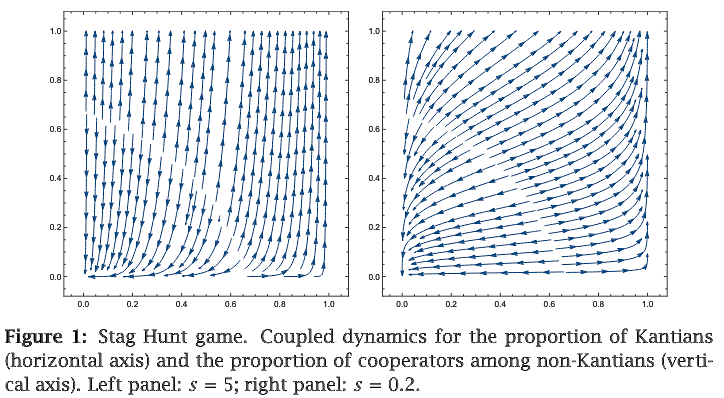
Quick Summaries of Two Papers on Kant and Game Theory — LessWrong
It's not obvious from a Darwinian point of view why people (even people who aren't related) often cooperate with one another. Researchers like Axelro…

Mutual intelligibility for schema idiolects.

GitHub - idiolect-dev/idiolect: Mutual intelligibility for schema idiolects.
github.commutuals == consent to archive clusters of mutuals == p2p archive mesh prototyped here. non destructive, just posts+saves. tangled.org/burrito.space/p2pds

burrito.space/p2pds
tangled.org
Tom
@burrito.space was talking about an interesting PDS modification where trusted friends would replicate posts to their own PDS as a form of distributed resilience. Multi-DID spaces would be interesting too, although might be difficult to implement ECMH (still need to read up more on this)
mutuals == consent to archive clusters of mutuals == p2p archive mesh prototyped here. non destructive, just posts+saves. tangled.org/burrito.space/p2pds
burrito.space/p2pds
tangled.orgTom
@burrito.space was talking about an interesting PDS modification where trusted friends would replicate posts to their own PDS as a form of distributed resilience. Multi-DID spaces would be interesting too, although might be difficult to implement ECMH (still need to read up more on this)
Relationship Anarchy

The principles of Anarchism, applied to our relationships. Will also discuss amatonormativity, which tends to also pull in acespec.

A love story

Be jealous. Make demands. Want more.

Asexuality and Kink: Why Do So Many Aces Love It?

A Theory of Messaging Styles & Ghosting.

Relationship Design

A Typology of Insecurities in Non-monogamy

