

Note that this was an open session with a variety of participants and opinions, varying and often in opposition. The notes reflect a raw dump of unattributed statements by individuals just expressing their opinions. No statement below may be taken as the view of anyone other than the person who made it.
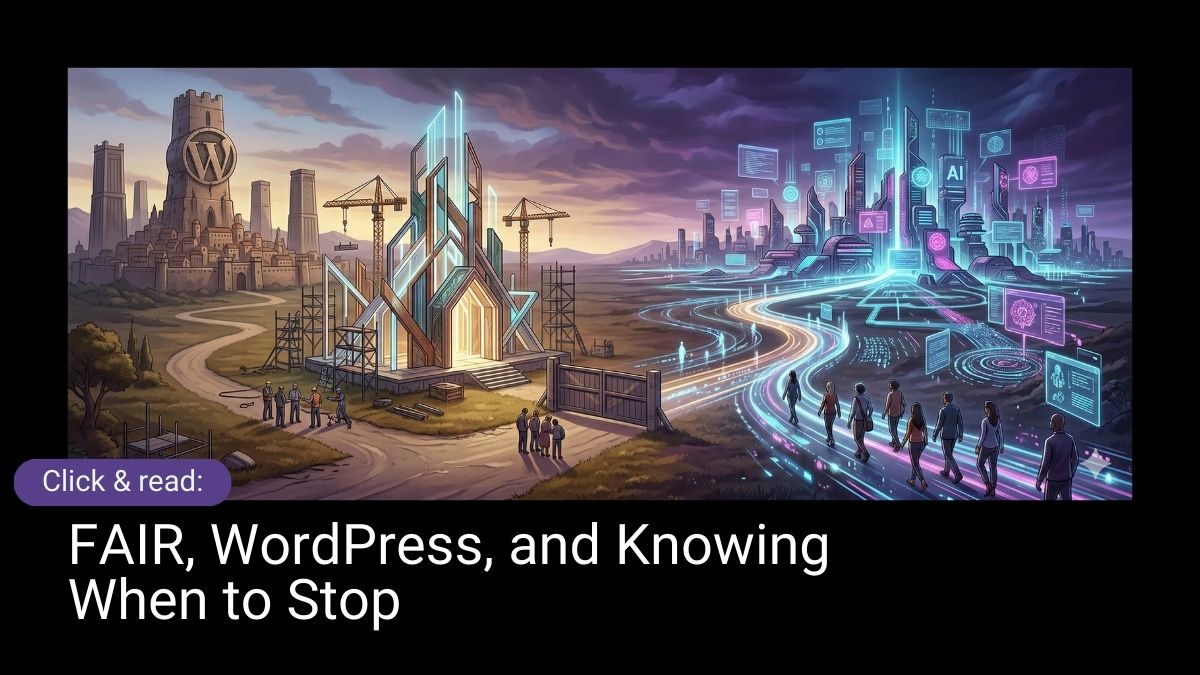
FAIR, WordPress, and Knowing When to Stop
Over the past year, we, Karim & Joost, have written and talked extensively about the challenges facing WordPress. We’ve been critical. At times, very critical. Of leadership, of governance, of the way decisions are made and enforced. We stand by that criticism. Matt’s way of operating has, in our view, been harmful. It has led […]
Opinion | Stop Googling. Let’s Talk. (Published 2015)
What have we done to face-to-face conversation?

The Evolution Of Open | blarg
This started its life as a pair of posts to the Mozilla governance forum, about the mismatch between private communication channels and our principles of open development. It’s a little long-winded, but I think it broadly applies not just to Mozilla but to open source in general. This version of it interleaves those two posts into something I hope is coherent, if kind of rambly. Ultimately the only point I want to make here is that the nature of openness has changed, and while it doesn’t mean we need to abandon the idea as a principle or as a practice, we can’t ignore how much has changed or stay mired in practices born of a world that no longer exists.
“They’re seeing the corpus of #language that’s been inputted into #ChatGPT as an access to the subconscious of humanity or the holism of the universe in a way... So people are asking these big, metaphysical questions of ChatGPT" https://t.co/EFk6CJnhDy #ethics #AI #tech #reli
“They’re seeing the corpus of #language that’s been inputted into #ChatGPT as an access to the subconscious of humanity or the holism of the universe in a way... So people are asking these big, metaphysical questions of ChatGPT" https://t.co/EFk6CJnhDy #ethics #AI #tech #religion— Internet Ethics (@IEthics) February 27, 2023
Opinion | Meet the Renegades of the Intellectual Dark Web (Published 2018)
An alliance of heretics is making an end run around the mainstream conversation. Should we be listening?

Mozilla and the Washington Post Are Reinventing Online Comments | The Mozilla Blog
To engage readers, build community, and strengthen journalism, Mozilla’s open-source commenting platform will be integrated across washingtonpost.com
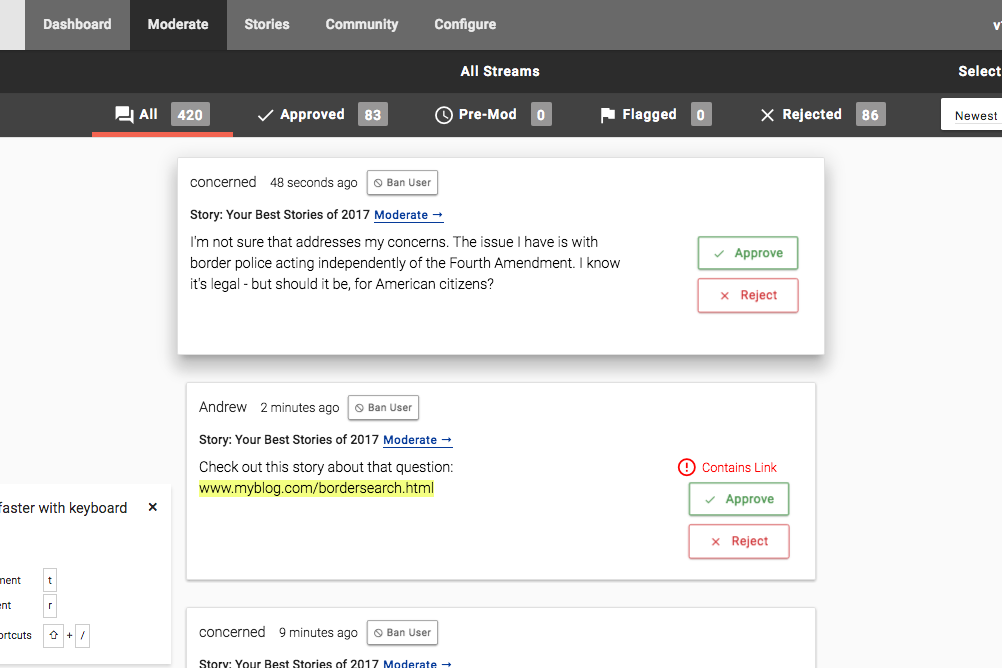
You Might Debate It — If You Could See It
Writing about the big beautiful mess that is making things for the world wide web.
The Conversation Canada (@ca.theconversation.com)
Written by academic experts, edited by journalists, backed by evidence ✉️ Newsletter: http://bit.ly/2W8X3Ev 🎧 Podcast: http://bit.ly/39v1EE0 ➕ Donate: http://bit.ly/3GV1uam

interfluidity » Consensus not censorship
We’ve become obsessed over the past few years with the problem of misinformation. And for good reason. “Flood the zone with shit” is now standard operating procedure for a variety of interests and factions. Groups who pretend to be above that kind of thing let confirmation bias do the same work, elevating conjectures they find convenient to believe far beyond the evidentiary basis for believing them, and transmuting concurrence among prestigious groups whose biases are aligned into “authority” to which they demand deferrence. Casual information consumers become divided into two camps, the “do your own research” types who imagine, mistakenly, that they are capable of seeing through all this (and so succumb to their own confirmation bias), and those who more accurately understand that they cannot reliably distinguish truth from bullshit (and so opt out of democratic deliberation with a shrug, other than perhaps to vote for the candidates whose political party they distrust less).
Free Speech on the Internet: The Crisis of Epistemic Authority
Abstract. Much of our knowledge of the world comes not from direct sensory experience, but from reliance on epistemic authorities: individuals or institutions that tell us what we ought to believe. For example, what most of us believe about natural selection, climate change, or the Holocaust comes from our reliance on epistemic authorities (scientists, historians). Sustaining epistemic authority depends, crucially, on social institutions that inculcate reliable second-order norms about whom to believe about what. The traditional media were crucial, in the age of mass democracy, with promulgating and sustaining such norms. The internet has obliterated the intermediaries who made that possible, and, in the process, undermined the epistemic standing of actual experts. This essay considers some possible changes to existing free speech doctrine to remedy the epistemological crisis brought about by the internet.
(PDF) Post-truth and Disinformation: Using discourse analysis to understand the creation of emotional and rival narratives in Brexit
PDF | The present research explores the concept of post-truth and disinformation in regard to Brexit. It is a qualitative and exploratory investigation.... | Find, read and cite all the research you need on ResearchGate

FediForum | Growing the Open Social Web un-workshop, 2026/03/02

Some thoughts on #WSocial, how they have been responding to criticism and why I believe they are showing the limits of free speech absolutism. I agree with @echna.bsky.social that "W Social seems to be on an X speedrun - without ever having been like Twitter." 🔗: aseachange.com/@elena/statuses/01M0SDV98GRDW…

Elena Rossini on GoToSocial ⁂ (@elena@aseachange.com)
aseachange.comJust because I comment, like or share content on W doesn’t mean I endorse a particular political position. I want W to be a place for open, fair and unbiased debate where different perspectives can be heard and challenged. Everyone is welcome on W. We need more dialogue and less polarization.❤️


