

Rich Hickey gave a very interesting talk on problem solving titled "Hammock Driven Development". Rich took a much more personal (experiential) angle with this talk, so while it was sparse on...
Bjarnason: the labour arbitrage theory of dev tool popularity
Baldur Bjarnason argues that development tools win by making developers replaceable. The JVM ran that experiment three times, against Visual Basic's precedent, through EJB's committee, and into Spring's reversal, and the results say his theory is exactly half of a whole.
Complexity and Strategy | HackerNoon
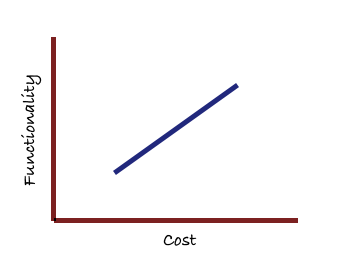
I struggled with how to think about complexity through much of my career, especially during the ten years I spent leading Office development. Modeling complexity impacted how we planned major releases, our technical strategy as we moved to new platforms, how we thought about the impact of new technologies, how we competed with Google Apps, how we thought about open source and throughout “frank and open” discussions with Bill Gates on our long term technical strategy for building the Office applications.
Complexity and Strategy | HackerNoon
I struggled with how to think about complexity through much of my career, especially during the ten years I spent leading Office development. Modeling complexity impacted how we planned major releases, our technical strategy as we moved to new platforms, how we thought about the impact of new technologies, how we competed with Google Apps, how we thought about open source and throughout “frank and open” discussions with Bill Gates on our long term technical strategy for building the Office applications.
Mark Bernstein: NeoVictorian Computing
This page holds a variety of notes about the craft of software design by Tinderbox designer Mark Bernstein, originally written for a plenary lecture at OOPSLA. We are accustomed to viewing software as a means to an end, a mass-produced industrial tool that ought to be beneath our notice. We are told that software ought to be intuitive, invisible, and free. This is wrong.
The Optimization Trap: Why Too Much Efficiency Makes Us Fragile with Olivier Hamant
#84 Gardening Platforms and the Future of Open Ecosystems with Alex Komoroske | Boundaryless
In our first episode this season, we dive into the world of open platforms and the future of organizing. With his thought-provoking presentation of “Gardening Platforms”, our guest Alex Komoroske, helps create a shift in mind-set towards a more achievable and sustainable approach in creating impactful technology solutions. We explore his key learnings from leading product at Google Chrome, and how he continues to implement these in his own journey today. Talking on questions of morality, control, and designing for the nefarious users, there’s so much Alex offers in this podcast, and we hope you take from it, as much as we did.

Live Programming in Hostile Territory
Live programming research gravitates towards the creation of isolated environments whose success is measured by domination: achieving adoption by displacing rather than integrating with existing tools and practices. To counter this tendency, we advocate that live programming research broaden its purview from the creation of new environments to the augmenting of existing ones and, through a selection of prototypes, explore three adversarial strategies for introducing programmatic capabilities into existing environments which are unfriendly or antagonistic to modification. We discuss how these strategies might promote more pluralistic futures and avoid aggregation into siloed platforms.
The Optimization Trap: Why Too Much Efficiency Makes Us Fragile - The Great Simplification
In this episode, Nate is joined by biologist and biophysicist Olivier Hamant to explore why living systems prioritize robustness over performance, and what that means for a civilization built almost entirely in the opposite direction.

Co-creating with emergent processes ✦ Hijinx World
Existential musings over algorithmic design with creative programming legend Dan Tapper.

Alex Komoroske (Common Tools)
The Minecraft Generation (Published 2016)
How a clunky Swedish computer game is teaching millions of children to master the digital world.


Small Programming Tricks
A lot of effective engineering comes from the accumulation of small nuggets of knowledge.

Hello Systems by Loris Cro