This is an introductory course in machine learning (ML) that covers the basic theory, algorithms, and applications. ML is a key technology in Big Data, and in many financial, medical, commercial, and scientific applications. It enables computational systems to adaptively improve their performance with experience accumulated from the observed data. ML has become one of the hottest fields of study today, taken up by undergraduate and graduate students from more than 20 different majors at Caltech. This course balances theory and practice, and covers the mathematical as well as the heuristic aspects. The lectures below follow each other in a story-like fashion:
Learning From Data - Online Course (MOOC)
This is an introductory course in machine learning (ML) that covers the basic theory, algorithms, and applications. ML is a key technology in Big Data, and in many financial, medical, commercial, and scientific applications. It enables computational systems to adaptively improve their performance with experience accumulated from the observed data. ML has become one of the hottest fields of study today, taken up by undergraduate and graduate students from more than 20 different majors at Caltech. This course balances theory and practice, and covers the mathematical as well as the heuristic aspects. The lectures below follow each other in a story-like fashion:
Introducing beginners to the mechanics of machine learning – Miriam Posner
Every year, I spend some time introducing students to the mechanics of machine learning with neural nets. I definitely don’t go into great depth; I usually only have one class for this. But I try to unpack at least some of the major concepts, so that ML isn’t quite such a black box.
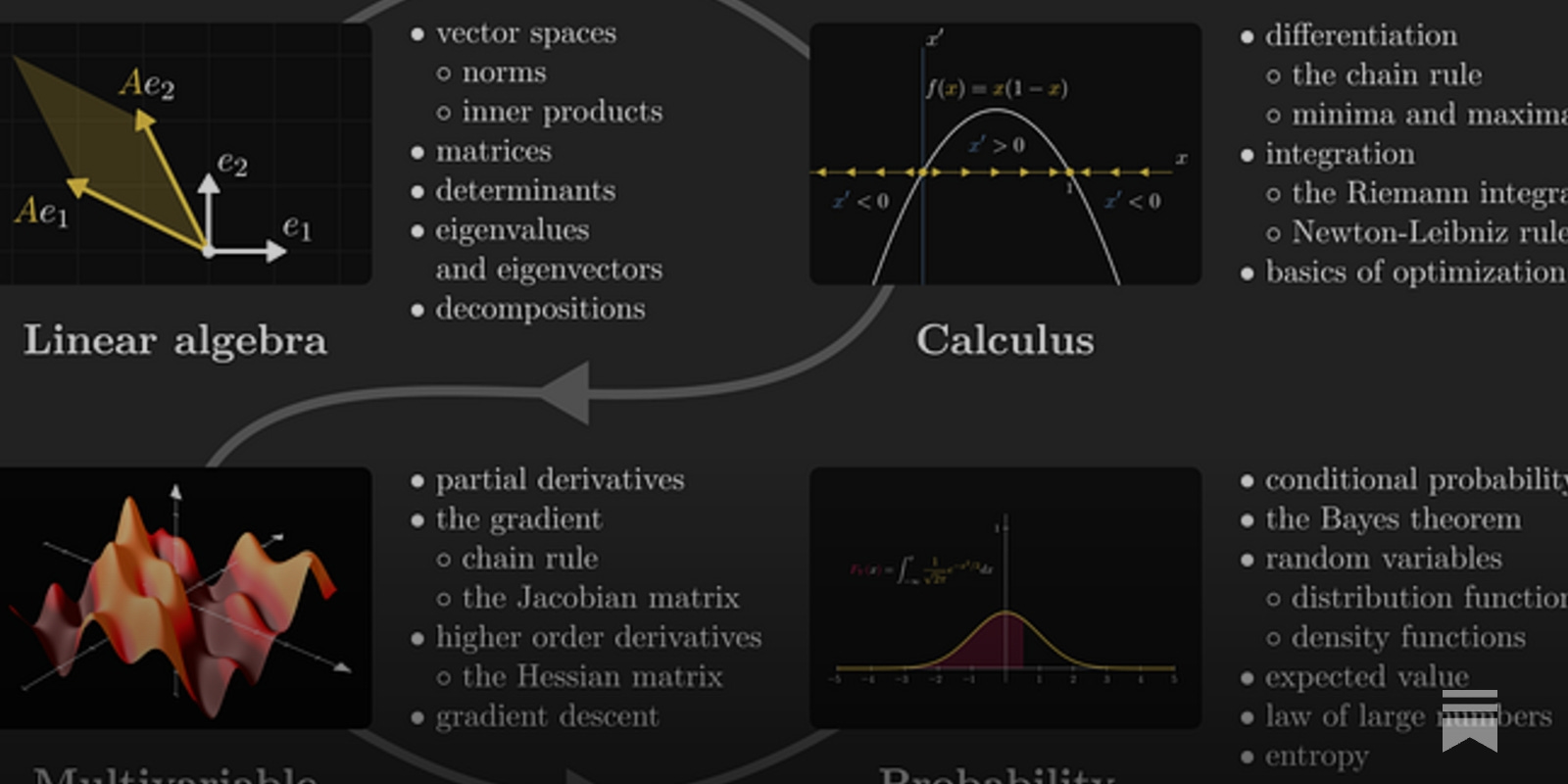
The Roadmap of Mathematics for Machine Learning
A complete guide to linear algebra, calculus, and probability theory
What Are Machine Learning Algorithms? | IBM
A machine learning algorithm is the procedure and mathematical logic through which an AI model learns patterns in training data and applies to them to new data.

The Algorithms - Learn Data Structures & Algorithms
The Algorithms - Open Source resource for learning Data Structures & Algorithms implementations in various programming languages
Introductory data science across disciplines, using Python, case studies, and industry consulting projects
Abstract Data and its applications are increasingly ubiquitous in the rapidly digitizing world and consequently, students across different disciplines face increasing demand to develop skills to answer both academia's and businesses' increasing need to collect, manage, evaluate, apply and extract knowledge from data and critically reflect upon the derived insights. On the basis of recent experiences at the University of Ttingen, Germany, we present a new approach to teach the relevant data science skills as an introductory service course at the university or advanced college level. We describe the outline of a complete course that relies on case studies and project work built around contemporary data sets, including openly available online teaching resources.

Innovation in Data Science Education
Data science is a new field of research focuses on extracting knowledge and value from data. The radical growth in recent years in the availability of data and of the computational resources required to process them, has led to a corresponding increase ...

Introducing Nested Learning: A new ML paradigm for continual learning
Ali Behrouz, Student Researcher, and Vahab Mirrokni, VP and Google Fellow, Google Research

Interleaving Computational and Inferential Thinking: Data Science for Undergraduates at Berkeley · Issue 3.2, Spring 2021
The undergraduate data science curriculum at the University of California, Berkeley is anchored in five new courses that emphasize computational thinking, inferential thinking, and the perspective gained by working on real-world problems. We believe that interleaving these elements within our core courses is essential to preparing students to engage in data-driven inquiry at the scale that contemporary scientific and industrial applications demand. This new curriculum is already reshaping the undergraduate experience at Berkeley, where these courses have become some of the most popular on campus and have led to a surging interest in a new undergraduate major and minor program in data science.

David MacKay: Information Theory, Inference, and Learning Algorithms: Home
What is Machine Learning? | IBM
Machine learning is the subset of AI focused on algorithms that analyze and “learn” the patterns of training data in order to make accurate inferences about new data.

Algorithmic Data Minimization for Machine Learning over...
Machine learning can analyze vast amounts of data generated by IoT devices to identify patterns, make predictions, and enable real-time decision-making. By processing sensor data, machine learning...

Categories for Machine Learning
This seminar series seeks to promote the learning and use of Category Theory by Machine Learning Researchers

Foundations of Data Science for Students in Grades K-12
On September 13 and 14, 2022, the Board on Science Education at the National Academies of Sciences, Engineering, and Medicine held a workshop entitled Foundations of Data Science for Students in Grades K–12. Speakers and participants explored the rapidly growing field of K-12 data science education, by surveying the current landscape, surfacing what is known, and identifying what is needed to support student learning, develop curriculum and tools, and prepare educators. To support these conversations, four papers were commissioned and discussed during the workshop. This publication summarizes the presentations and discussion of the workshop.
Machine Learning | Google for Developers