

Notes from James Carse's book 'Finite and Infinite Games'. Author unknown.
The Math of Idle Games, Part II
Originally published October 28, 2016 In Part I [https://www.sirpinski.com/the-math-of-idle-games-part-i/] of this three-part series, we looked at some of the standard math behind rapid-growth idle games, primarily at the relationships between exponential and polynomial growth and some methods of
17. A Value for n-Person Games
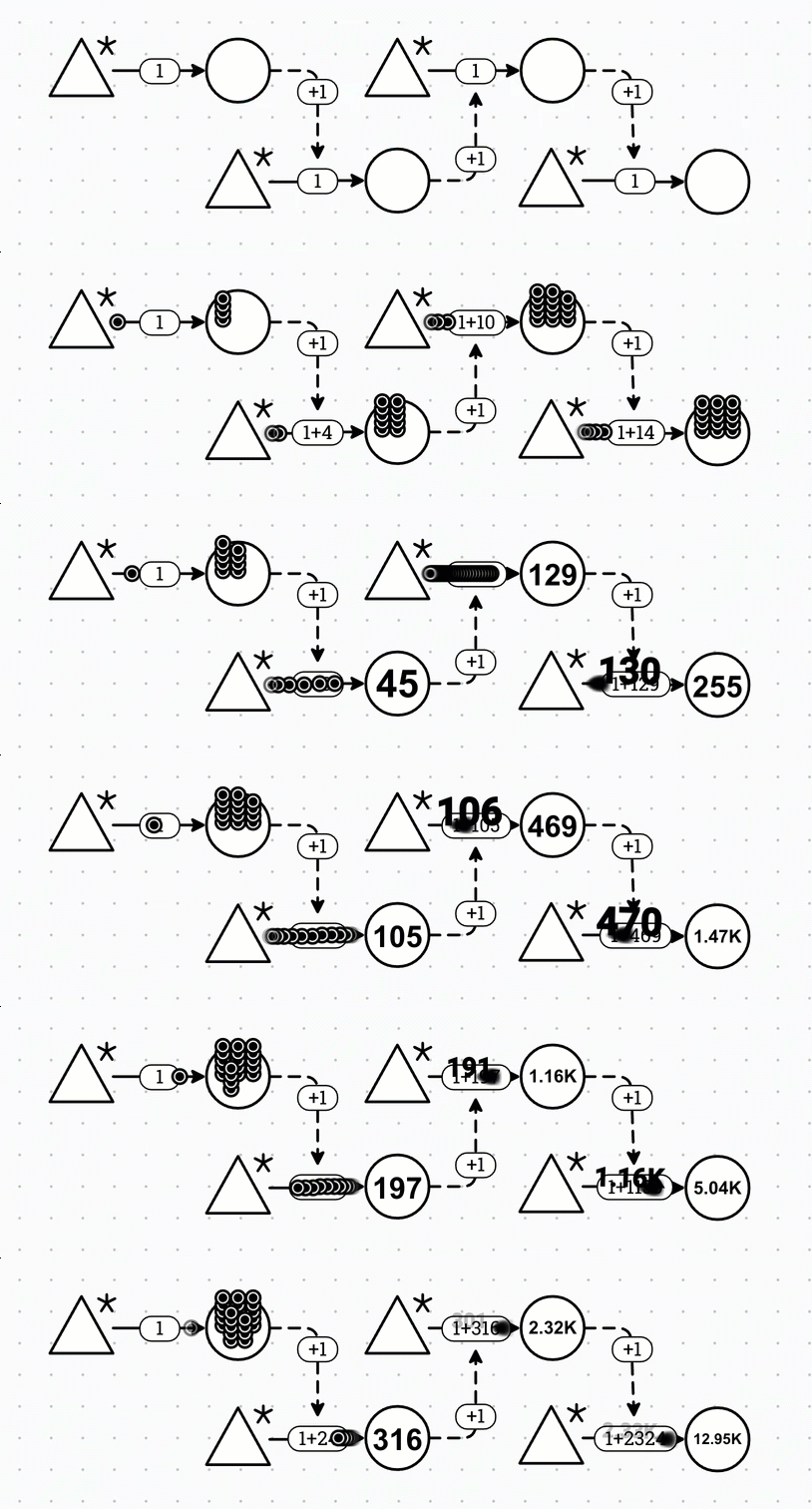
17. A Value for n-Person Games was published in Contributions to the Theory of Games, Volume II on page 307.
Game Theory | Open Yale Courses
This course is an introduction to game theory and strategic thinking. Ideas such as dominance, backward induction, Nash equilibrium, evolutionary stability, commitment, credibility, asymmetric information, adverse selection, and signaling are discussed and applied to games played in class and to examples drawn from economics, politics, the movies, and elsewhere.
Game Theory
Game theory is the study of the ways in which interactingchoices of economic agents produce outcomeswith respect to the preferences (or utilities) ofthose agents, where the outcomes in question might have been intendedby none of the agents. The meaning of this statement will not be clearto the non-expert until each of the italicized words and phrases hasbeen explained and featured in some examples. Doing this will be themain business of this article. First, however, we provide somehistorical and philosophical context in order to motivate the readerfor the technical work ahead.
The Math of Idle Games, Part I
Originally published October 4, 2016 I’ve given a few talks in the past about the appeal and general mechanics of idle games, but what if you actually wanted to make one? Theory and patterns are nice, but there’s some complicated math running behind it. And how on earth

Magic: The Gathering is Turing Complete
$\textit{Magic: The Gathering}$ is a popular and famously complicated trading card game about magical combat. In this paper we show that optimal play in real-world $\textit{Magic}$ is at least as...

Stackelberg Mean Field Games: convergence and existence results to the problem of Principal with multiple Agents in competition
In a situation of moral hazard, this paper investigates the problem of Principal with $n$ Agents when the number of Agents $n$ goes to infinity. There is competition between the Agents expressed by the fact that they optimize their utility functions through a Nash equilibrium criterion. Each Agent is offered by the Principal a contract which is divided into a Markovian part involving the state/production of the Agent and a non--Markovian part involving the states/productions of all the other Agents. The Agents are in interactions. These interactions are characterized by common noise, the empirical distribution of states/productions and controls, and the contract which is not assumed to be a map of the empirical distribution. By the help of the mean field games theory, we are able to formulate an appropriate $limit$ problem involving a Principal with a $representative$ Agent. We start by solving the problem of both the Principal and the $representative$ Agent in this $limit$ problem. Then, when $n$ goes to infinity, we show that the problem of Principal with $n$ Agents converges to the $limit$ problem of Principal with a $representative$ Agent. A notable result is that, despite allowing a general type of contracts, it is approximately optimal for the Principal to offer contracts to the $n$ Agents that are maps of the empirical distribution of states/productions and controls of the Agents.
A Life in Games | Quanta Magazine
The mathematician John Horton Conway’s myriad accomplishments — including the Game of Life, sprouts and the surreal numbers — are the product of a mind at play.

The Math of Idle Games, Part III
Originally published January 12, 2017 This three-part series is intended to break apart my MIGS 2016 slides [http://www.slideshare.net/AnthonyPecorella/the-rise-and-rise-of-idle-games-68916528] into what are hopefully detailed but accessible angles on the math and mechanics behind idle and incremental games. The
The Game of Oligarchy | Brewster Kahle's Blog
I just invented and played a game today with my family, and it worked great– it was fun and we learned an important lesson. Similar to the game “Monopoly” which shows that one person ends up monopolizing even though you think the rules are “fair,” the game of Oligarchy shows that the “free market” leads inexorably to one person getting all the money and everyone else going broke. And fast.

GameSpot's SIMply Divine: The Story of Maxis Software
GameSpot action adventure driving puzzle role-playing simulation sports strategy hardware
The Theory of Steinitz | Exeter Chess Club
PGN collections: [VIEW in browser] -- Download: [10 ways] [100-odd] [Blog] [Booklets] [Canon ] [Capa Endgames] [DR@Exeter] [Endings] [English] [Ish] [Juniors] [Openings] [Slav/Mac] [Tactics] [Top10] [Vacuum] -- [What's pgn?]
Kittens Game - a Dark Souls of incremental gaming
Games


Billionaires & Guillotines: A Game
Patrick's Parabox

Hollow Knight: Silksong

Hollow Knight

Mama's Sleeping Angels

Spelunky 2