


Online communities provide a wide range of opportunities for supporting a cause, marketing a product or service, or building open source software. The Art of Community helps you recruit members, motivate them, and manage them as active participants. Author Jono Bacon offers experiences and observations from his 14-year effort to build and manage communities, including his current position as manager for Ubuntu. Discover how your community can become a reliable support network, a valuable source of new ideas, and a powerful marketing force. This expanded edition shows you how to keep community projects on track, make use of social media, and organize collaborative events. Interviews with 12 community management leaders, including Linus Torvalds, Tim O’Reilly, and Mike Shinoda, provide useful insights. Develop specific objectives and goals for building your community Build processes to help contributors perform tasks, work together, and share successes Provide tools and infrastructure that enable members to work quickly Create buzz around your community to get more people involved Harness social media to broadcast information, collaborate, and get feedback Use several techniques to track progress on community goals Identify and manage conflict, such as dealing with divisive personalities
Get Together: How to Build a Community with Your People
A practical and heartfelt guide to cultivating a community, online or IRL.Although communities feel magical, they don’t come together by magic. Get Together is a practical and heartfelt guide to cultivating a community. Whether starting a run crew, connecting with fans online, or sparking a movement of K–12 teachers, the secret to getting people together is this: build your community with people, not for them.In Get Together, Bailey Richardson, Kevin Huynh, and Kai Elmer Sotto of People & Company share true stories of everyday people who have created thriving communities, both in person and online. They provide clear steps to untangle the challenge of getting passionate people together, helping individuals and organizations navigate the intricacies of leading a community, including: - How to rally the first people - How to get people talking - How to attract new, authentic folks - How to develop leaders and expand globally.The People & Company team reminds us that we each hold the potential to spark a community. Get Together shows readers that if we join forces—as company and customers, artist and fans, organizer and advocates—we’ll do more together than we ever could alone.
Building Welcoming Communities
Building a community that encourages people to use, contribute to, and evangelize your project.
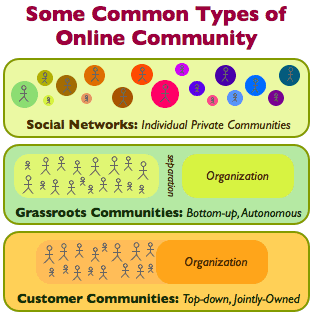
Online communities and social communities: a primer
What are online communities and for what goals can they be used? A primer with plenty of community marketing and management tips.
Building Communities Across the Social Web
"It's Great Because It's Ran By Us": Empowering Teen Volunteer Discord Moderators to Design Healthy and Engaging Youth-Led Online Communities
Online communities can offer many benefits for youth including peer learning, cultural expression, and skill development. However, most HCI research on youth-focused online communities has centered communities developed by adults for youth rather than by the youth themselves. In this work, we interviewed 11 teenagers (ages 13-17) who moderate online Discord communities created by youth, for youth. Participants were identified by Discord platform staff as leaders of well-moderated servers through an intensive exam and application-based process. We also interviewed 2 young adults who volunteered as mentors of some of our teen participants. We present our findings about the benefits, motivations, and risks of teen-led online communities, as well as the role of external stakeholders of these youth spaces. We contextualize our work within the broader teen online safety landscape to provide recommendations to better support, encourage, and protect teen moderators and their online communities. This empirical work contributes one of the first studies to date with teen Discord moderators and aims to empower safe youth-led online communities.
Governing Together: Toward Infrastructure for Community-Run Social Media
Decentralizing the governance of social computing systems to communities promises to empower them to make independent decisions, with nuance and in accordance with their values. Yet, communities do not govern in isolation. Many problems communities face are common, or move across their boundaries. We therefore propose designing for "inter-community governance:" mechanisms that support relationships and interactions between communities to coordinate on governance issues. Drawing from workshops with 24 individuals on decentralized, community-run social media, we present six challenges in designing for inter-community governance surfaced through ideas proposed in workshops. Together, these ideas come together as an ecosystem of resources, infrastructures, and tools that highlight three key principles for designing for inter-community governance: modularity, forkability, and polycentricity. We end with a discussion of how the ideas proposed in workshops might be implemented in future work aiming to support community governance in social computing systems broadly.

Thoughts on Communities | unDraw Blog
Even with the best intentions and people eager to join, most attempts to create communities fail and will continue to do so.

When Community Becomes Your Competitive Advantage
If a company can transition from simply delivering a product to building a community, they can unlock extraordinary competitive advantages and create a superior business model. In fact, strong communities help support the ideal business model. Specifically: • Enthusiastic members help acquire new members, resulting in lower customer acquisition costs and a tight viral loop. • Members of a community are loath to abandon it, resulting in increased member retention and therefore improved lifetime value. • Members of a community support other members in that community, resulting in high gross margins due to a lower cost of service. The result of this are very real network effects: as engagement grows, the community gets smarter, faster to respond, more globally available, and generates more value.

The Community Artists' Collective | Non Profit | Houston, TX
The Community Artists' Collective is the catalyst which provides the inspirational and educational sources for artists and citizens so that they can use their talents and creative abilities to solve economic, cultural and social challenges in the natural and built environments in which we live, work

No Community Can Do Everything: Why People Participate in Similar Online Communities
Large-scale quantitative analyses have shown that individuals frequently talk to each other about similar things in different online spaces. Why do these overlapping communities exist? We provide an answer grounded in the analysis of 20 interviews with active participants in clusters of highly related subreddits. Within a broad topical area, there are a diversity of benefits an online community can confer. These include (a) specific information and discussion, (b) socialization with similar others, and (c) attention from the largest possible audience. A single community cannot meet all three needs. Our findings suggest that topical areas within an online community platform tend to become populated by groups of specialized communities with diverse sizes, topical boundaries, and rules. Compared with any single community, such systems of overlapping communities are able to provide a greater range of benefits.
“No One’s Coming to Save Us. Why Communities Must Build Their Own Internet” -Rudy Fraser, Blacksky
Peer Production in Citizen Science: A Community-Centered Approach on the Example of Personal Science
Citizen science encompasses a wide range of practices where online collaboration for knowledge production plays a significant role. However, the study of forms of online collaboration other than crowdsourcing in citizen science has remained largely unexplored. This thesis aims to fill this gap by investigating peer production as a form of collaboration in online citizen science communities of practice. First, peer production theory was operationalized as a working model and used to analyze collaboration in citizen science case studies. This was followed by a comprehensive participatory design process for a specific use case involving the personal science community of practice. This process resulted in the creation of the “Personal Science Wiki”, an online space for consolidating community knowledge through peer production. Subsequently, a usability and card sorting study identified and resolved issues with the wiki implementation, and provided insights into mental models and content requirements regarding self-research knowledge. The lessons learned from the participatory design process were generalized as process recommendations for designing peer production solutions and knowledge management systems with communities of practice.
Working on the plumbing in a small web community :: Sacha Chua
The IndieWeb Carnival prompt for May is small web communities. I've been exploring some thoughts on how a little effort goes a long way to connecting a community. Sometimes I think of it as working on the plumbing so that ideas can flow more smoothly. It feels a little different from the direct contribution of knowledge or ideas. I also want to connect with other people who do this kind of thing.
The Relational Origins of Rules in Online Communities
Where do rules come from in online communities? This study investigates how and why online communities adopt and change their rules. We conducted a grounded theory-based analysis of 40 in-depth interviews with community leaders from subreddits, Fandom wikis, and Fediverse servers, and identified seven processes involved in the adoption of online community rules. Our findings reveal that, beyond operational reasons like regulating behavior and solving problems, rules are also adopted and changed for relational reasons, such as signaling or reinforcing community legitimacy and identity to other communities. While rule change was often prompted by challenges during community growth or decline, change also depended on volunteer leaders’ work capacity, the presence of member feedback mechanisms, and relational dynamics between leaders and members. Our findings extend prior theories from social computing and organizational research, illustrating how institutionalist and ecological explanations of the relational origins of rules complement operational accounts. Finally, we build on these explanations to offer a set of design propositions that reflect the relational aspects of rules and rulemaking across communities’ lifecycles.

The Relational Origins of Rules in Online Communities
Where do rules come from in online communities? This study investigates how and why online communities adopt and change their rules. We conducted a grounded theory-based analysis of 40 in-depth interviews with community leaders from subreddits, Fandom wikis, and Fediverse servers, and identified seven processes involved in the adoption of online community rules. Our findings reveal that, beyond operational reasons like regulating behavior and solving problems, rules are also adopted and changed for relational reasons, such as signaling or reinforcing community legitimacy and identity to other communities. While rule change was often prompted by challenges during community growth or decline, change also depended on volunteer leaders' work capacity, the presence of member feedback mechanisms, and relational dynamics between leaders and members. Our findings extend prior theories from social computing and organizational research, illustrating how institutionalist and ecological explanations of the relational origins of rules complement operational accounts. Finally, we build on these explanations to offer a set of design propositions that reflect the relational aspects of rules and rulemaking across communities' lifecycles.
Community by Design
Social media empower distributed content creation by algorithmically harnessing "the social fabric" (explicit and implicit signals of association) to serve this content. While this overcomes the bottlenecks and biases of traditional gatekeepers, many believe it has unsustainably eroded the very social fabric it depends on by maximizing engagement for advertising revenue. This paper participates in open and ongoing considerations to translate social and political values and conventions, specifically social cohesion, into platform design. We propose an alternative platform model that includes the social fabric an explicit output as well as input. Citizens are members of communities defined by explicit affiliation or clusters of shared attitudes. Both have internal divisions, as citizens are members of intersecting communities, which are themselves internally diverse. Each is understood to value content that bridge (viz. achieve consensus across) and balance (viz. represent fairly) this internal diversity, consistent with the principles of the Hutchins Commission (1947). Content is labeled with social provenance, indicating for which community or citizen it is bridging or balancing. Subscription payments allow citizens and communities to increase the algorithmic weight on the content they value in the content serving algorithm. Advertisers may, with consent of citizen or community counterparties, target them in exchange for payment or increase in that party's algorithmic weight. Underserved and emerging communities and citizens are optimally subsidized/supported to develop into paying participants. Content creators and communities that curate content are rewarded for their contributions with algorithmic weight and/or revenue. We discuss applications to productivity (e.g. LinkedIn), political (e.g. X), and cultural (e.g. TikTok) platforms.