Mice had more stamina, hair and improved organ function with the drug.
Switching Off One Crucial Protein Appears to Reverse Brain Aging in Mice - Slashdot
A research team just discovered older mice have more of the protein FTL1 in their hippocampus, reports ScienceAlert. The hippocampus is the region of the brain involved in memory and learning. And the researchers' paper says their new data raises "the exciting possibility that the beneficial effec...
The gut microbiome may influence brain aging, mouse study suggests
A communication pathway between the brain and the gut may be integral to how well the brain holds on to memories
Erinacine A-enriched Hericium erinaceus mycelia promotes longevity in Drosophila melanogaster and aged mice
Erinacine A-enriched Hericium erinaceus mycelia is a well-established potential therapeutic agent for neurodegenerative disorders. However, the effect of erinacine A-enriched H. erinaceus mycelia on promoting longevity remains unclear. This is the first study to investigate the effect of erinacine A-enriched H. erinaceus mycelia on lifespan-prolonging activity in Drosophila melanogaster and senescence-accelerated P8 (SAMP8) mice. Two hundred D. melanogaster and 80 SAMP8 mice of both sexes were randomly divided into four groups and were administered with either the standard, low-dose, mid-dose, or high-dose erinacine A-enriched H. erinaceus mycelia. After treatment, the lifespan was measured in D. melanogaster, and the lifespan, food intake and oxidative damage were evaluated in SAMP8 mice. Results showed that supplementation with erinacine A-enriched H. erinaceus mycelia extended the lifespan in both D. melanogaster and SAMP8 by a maximum of 32% and 23%, respectively, compared to the untreated controls. Moreover, erinacine A-enriched H. erinaceus mycelia decreased TBARS levels and induced the anti-oxidative enzyme activities of superoxide dismutase, catalase, and glutathione peroxidase. Together, these findings suggest that erinacine A-enriched H. erinaceus mycelia supplement could promote longevity, mediated partly through the induction of endogenous antioxidants enzymes.

How fasting can improve overall health
Researchers found evidence that fasting affects circadian clocks in the liver and skeletal muscle, causing them to rewire their metabolism, which can ultimately lead to improved health and protection against aging-associated diseases.

Metformin improves healthspan and lifespan in mice
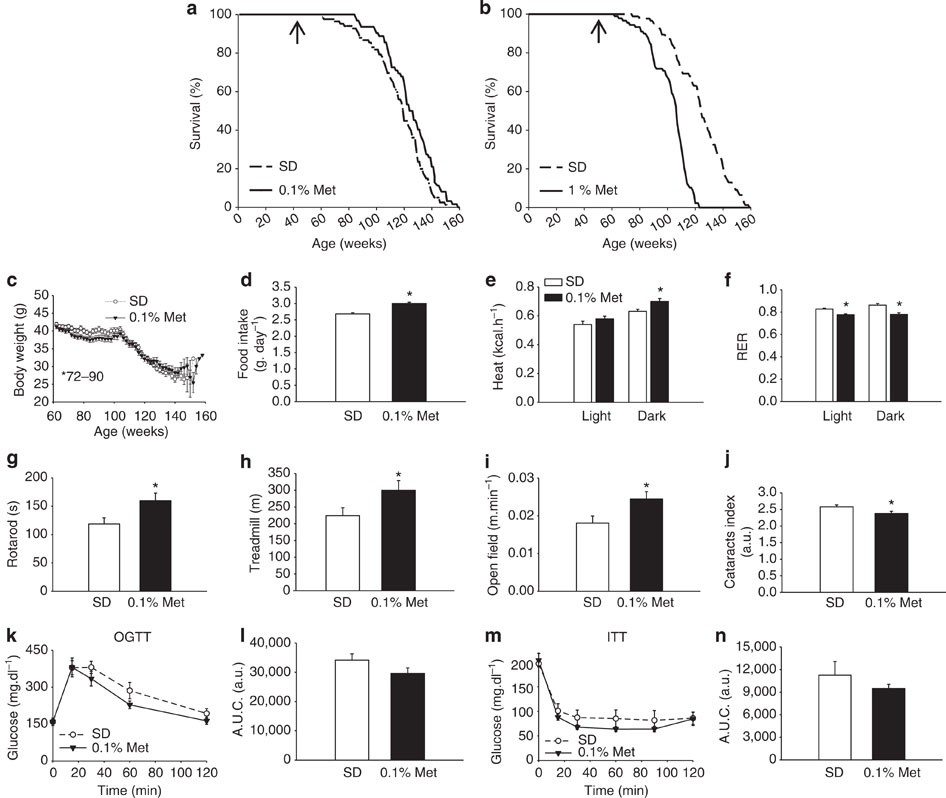
Metformin is a drug commonly prescribed to treat patients with type 2 diabetes. Here we show that long-term treatment with metformin (0.1% w/w in diet) starting at middle age extends healthspan and lifespan in male mice, while a higher dose (1% w/w) was toxic. Treatment with metformin mimics some of the benefits of calorie restriction, such as improved physical performance, increased insulin sensitivity, and reduced low-density lipoprotein and cholesterol levels without a decrease in caloric intake. At a molecular level, metformin increases AMP-activated protein kinase activity and increases antioxidant protection, resulting in reductions in both oxidative damage accumulation and chronic inflammation. Our results indicate that these actions may contribute to the beneficial effects of metformin on healthspan and lifespan. These findings are in agreement with current epidemiological data and raise the possibility of metformin-based interventions to promote healthy aging.
Study Finds Humans Age Faster at 2 Sharp Peaks – Here's When to Expect Them
You're in for a bumpy ride.

Does adolescence really last until age 32?
Those “turning points” in brain aging aren’t quite what you think

The Best Exercise for Aging Muscles (Published 2017)
Certain kinds of exercise may mitigate the effects of aging at the cellular level.

The Best Exercise for Aging Muscles (Published 2017)
Certain kinds of exercise may mitigate the effects of aging at the cellular level.
Getting antibiotics as a baby may have lasting effects on brain, behavior
Mouse study backs up human observations showing long-term changes.

Increase in muscle endurance in mice by dietary Yamabushitake mushroom ( <i>Hericium erinaceus</i> ) possibly via activation of <span style="font-variant:small-caps;">PPAR</span> δ
Abstract Skeletal muscle fiber is largely classified into two types: type 1 (slow‐twitch) and type 2 (fast‐twitch) fibers. Meat quality and composition of fiber types are thought to be closely related. Previous research showed that overexpression of constitutively active peroxisome proliferator‐activated receptor ( PPAR )δ, a nuclear receptor present in skeletal muscle, increased type 1 fibers in mice. In this study, we found that hexane extracts of Yamabushitake mushroom ( Hericium erinaceus ) showed PPAR δ agonistic activity in vitro . Eight‐week‐old C57 BL /6J mice were fed a diet supplemented with 5% (w/w) freeze‐dried Yamabushitake mushroom for 24 hr. After the treatment period, the extensor digitorum longus ( EDL ) muscles were excised. The Yamabushitake‐supplemented diet up‐regulated the PPAR δ target genes Pdk4 and Ucp3 in mouse skeletal muscles in vivo . Furthermore, feeding the Yamabushitake‐supplemented diet to mice for 8 weeks resulted in a significant increase in muscle endurance. These results indicate that Yamabushitake mushroom contains PPAR δ agonistic ligands and that dietary intake of Yamabushitake mushroom could activate PPAR δ in skeletal muscle of mice. Unexpectedly, we observed no significant alterations in composition of muscle fiber types between the mice fed control and Yamabushitake‐supplemented diets.

Paired Liver:Plasma PFAS Concentration Ratios from Adolescents in the Teen-LABS Study and Derivation of Empirical and Mass Balance Models to Predict and Explain Liver PFAS Accumulation
Abstract. Animal studies have pointed at the liver as a hotspot for per- and polyfluoroalkyl substances (PFAS) accumulation and toxicity; however, these fi
Study Reveals a Surprising Cause of Cognitive Decline—and the Key to Reversing It
Researchers pinpoint a lone protein that speeds up the dysfunction of an aging brain. Eliminating it, they claim, can reverse the damage. But there are big hurdles before a treatment is approved.

The medications that change who we are
They’ve been linked to road rage, pathological gambling, and complicated acts of fraud. It turns out many ordinary medications don’t just affect our bodies – they affect our brains.

How Exercise Can Keep Aging Muscles and Immune Systems ‘Young’ (Published 2018)
Older cyclists are not like most of the rest of us. They are healthier. They are, biologically, younger.

Unbound Fractions of PFAS in Human and Rodent Tissues: Rat Liver a Suitable Proxy for Evaluating Emerging PFAS?
Abstract. Adverse health effects associated with exposures to perfluoroalkyl and polyfluoroalkyl substances (PFAS) are a concern for public health and are