

Our universe is likely not the only one in the multiverse, according to Stephen Hawking's final paper. But the others that exist would follow the same laws of physics that exist in our universe, it says. This makes the number of possible universes more manageable and testable.
With many-worlds, all quantum mechanics is local
But that doesn't make for evidence that parallel universes exist.
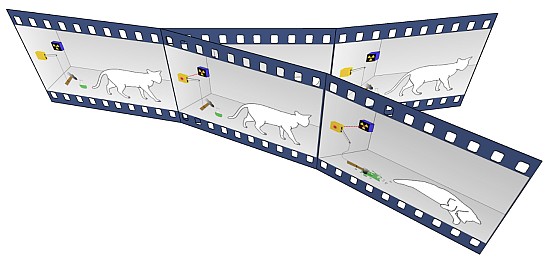
Quantum Leap: Google Claims Its New Quantum Computer Provides Evidence That We Live In A Multiverse
Google's quantum computer, Willow, suggests evidence for a multiverse by leveraging computations across parallel universes.

Is the Multiverse in the Mind or is the Mind in the Multiverse? with Bernard Carr
Which Computational Universe Do We Live In? | Quanta Magazine
Cryptographers want to know which of five possible worlds we inhabit, which will reveal whether truly secure cryptography is even possible.

A Different Kind of Theory of Everything
Physicists used to search for the smallest components of the universe. What if that’s not the point?

Physicists To Test If Universe Is A Computer Simulation

The Universe in a lab: Testing alternate cosmology using a cloud of atoms
We can't experiment with the Universe, but we can make something that works like it.
Language models are multiverse generators
"Actualities seem to float in a wider sea of possibilities from out of which they were chosen; and somewhere, indeterminism says, such possibilities exist, and form part of the truth."

The Curiously Playable Universe
More of the universe appears to be more playable than we expected
The Multiverse According to Ben: The Singularity Institute's Scary Idea (and Why I Don't Buy It)
I recently wrote a blog post about my own AI project , but it attracted a bunch of adversarial comments from folks influenced by the Singula...
The Dark Forest Theory of the Internet
In his sci-fi trilogy The Three Body Problem, author Liu Cixin presents the dark forest theory of the universe. When we look out into space, the theory goes, we’re struck by its silence. It seems like we’re the only ones here. After all, if other forms of

ORI Polls App
The director of research at the Qualia Research Institute recently posted this poll asking whether people believed in universes with different laws of physics
Universe
We’re releasing Universe, a software platform for measuring and training an AI’s general intelligence across the world’s supply of games, websites and other applications.
An Information-Theoretic Formalism for Multiscale Structure in Complex Systems — New England Complex Systems Institute
In searching for sense in the complexities of nature, science has often found success by identifying common aspects of diverse phenomena. When one principle explains how different things behave, nature becomes more comprehensible, and more manageable. Modern science took flight when Newton showed how one idea – universal gravitation – explained both the motions of celestial bodies and apples falling on Earth. Most important, it didn’t matter whether the apple was red or green, or even if it was an apple. Newton’s law described how everything else fell, from bricks to bullets. But Newton’s gravity, and his laws of motion, and the rest of science built on that foundation had limits. Newton’s science couldn’t cope with really strong gravity, extremely fast motion or supertiny particles. Relativity theory and quantum physics helped with that. But there remains a realm where standard science has struggled to find unifying principles among different behaviors. That would be the kingdom of complexity, the universe of systems that defy simplification. Such complex systems are everywhere, of course. Some are physical — the electric power grid, for instance. Many are biological — brains, bodies, ecosystems. And others are social — financial markets, interlocking corporate directorates, and yes, for God’s sake, Twitter. It’s hard to find simple scientific principles from which to deduce all the multifaceted things that such complex systems do. But there is, for sure, one thing that they do all have in common. They all have a structure. And it’s by quantifying structure, three scientists suggest in an intriguing new paper, that complexity can be tamed...
