Revealed: how the spy agency used unwitting artists such as Pollock and de Kooning in a cultural Cold War
The Cultural Cold War: The CIA and the World of Arts and Letters
This volume, the most comprehensive account yet of the CIA's activities between 1947 & 1967, presents shocking evidence of the CIA's manipulative cultural undertakings during the Cold War. This impressively detailed book draws together newly declassified documents & exclusive interviews to expose the CIA's astonishing campaign wherein some of the most vocal exponents of intellectual freedom -- including George Orwell, Bertrand Russell, Jean-Paul Sartre, Arthur Schlesinger, Jr., & Gloria Steinem -- become instruments of the American government. A true story of intrigue & betrayal. B&W photos. A real contribution to popular understanding of the postwar period.Ó

Docs Reveal Hundreds of US Agencies Spying on Americans' Money Transfers | Common Dreams
"These records paint a damning portrait of government overreach."

The Devil's Chessboard: Allen Dulles, the CIA, and the Rise of America's Secret Government
An explosive, headline-making portrait of Allen Dulles, the man who transformed the CIA into the most powerful—and secretive—colossus in Washington, from the founder of Salon.com and author of the New York Times bestseller Brothers.America’s greatest untold story of espionage history: the United States’ rise to world dominance under the guile of Allen Welsh Dulles, the longest-serving director of the CIA. Drawing on revelatory new materials—including newly discovered U.S. government documents, U.S. and European intelligence sources, the personal correspondence and journals of Allen Dulles’s wife and mistress, and exclusive interviews with the children of prominent CIA officials—Talbot reveals the underside of one of America’s most powerful and influential figures.Dulles’s decade as the director of the CIA—which he used to further his public and private agendas—were dark times in American politics. Calling himself “the secretary of state of unfriendly countries,” Dulles saw himself as above the elected law, manipulating and subverting American presidents in the pursuit of his personal interests and those of the wealthy elite he counted as his friends and clients—colluding with Nazi-controlled cartels, German war criminals, and Mafiosi in the process. Targeting foreign leaders for assassination and overthrowing nationalist governments not in line with his political aims, Dulles employed those same tactics to further his goals at home, Talbot charges, offering shocking new evidence in the JFK assassination.An exposé of American power and the abuse of power that is as disturbing as it is timely, The Devil’s Chessboard is a provocative and gripping story of the rise of the national security state—and the battle for America’s soul.This meticulously researched exposé reveals:Secret Government Operations: How Allen Dulles built the CIA into a formidable secret government, operating beyond the reach of presidents and the law.Covert Wars and Assassinations: The chilling details of Dulles’s covert wars, from overthrowing governments not in line with his political aims to targeting foreign leaders for assassination.Unholy Alliances: The details of Dulles’s shocking collusion with Nazi-controlled cartels, German war criminals, and Mafiosi to further his personal and political agendas.The Rise of the National Security State: A provocative, timely warning about the unchecked growth of secret power and the ongoing battle for America’s soul.
Copy of Digital Masquerade
The Digital Masquerade: Unmasking AI’s Phantom Journalists By Tony Eastin and Sandeep Abraham, CAMS

Art Spiegelman: ‘The US needs a counter-revolution’
More than four decades after his Holocaust story Maus transformed the graphic novel genre, Art Spiegelman discusses Trump, the shadow of 9/11 and the rise of fascism in America

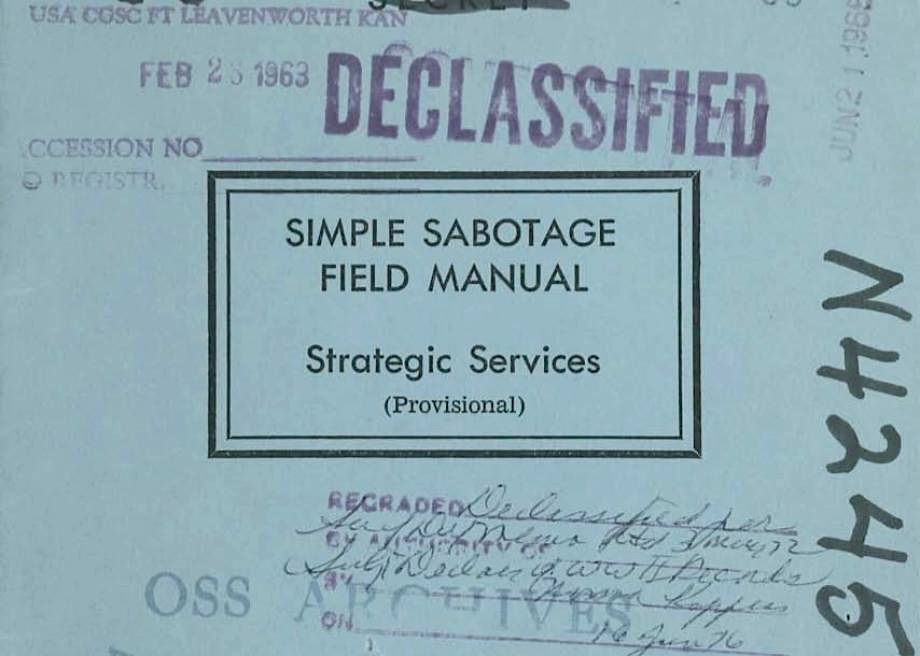
Discover the CIA’s Simple Sabotage Field Manual: A Timeless Guide to Subverting Any Organization with “Purposeful Stupidity” (1944)
I’ve always admired people who can successfully navigate what I refer to as “Kafka’s Castle,” a term of dread for the many government and corporate agencies that have an inordinate amount of power over our permanent records, and that seem as inscrutable and chillingly absurd as the labyrinth the character K navigates in Kafka’s last allegorical novel.
The rise of AI sovereignty: Authoritarian technological imaginaries as a form of reflexive control
Recent literature increasingly examines generative artificial intelligence's (AI's) role in disinformation and propaganda as a key driver of digital authoritarianism. Yet, less attention has been paid to how authoritarian regimes may influence the global governance of AI itself. This essay addresses this gap by analysing the impact of authoritarian technological imaginaries, focusing on the rise of ‘AI sovereignty’ as a central concept shaping global AI governance. It adopts a conceptual framework that combines the notion of imaginaries with the concept of reflexive control, originating in Soviet strategic thought and referring to influencing an adversary's perceptions so they act in ways aligned with the initiator's goals, to study authoritarian diffusion and the global politics of AI. Through an examination of public statements by the Russian president, the study shows how Russia constructs an AI imaginary that extends Cold War logics of nuclear competition into the digital era, framing AI as a matter of security and survival rather than ethics or rights. Drawing on the Russian case, the analysis identifies three frames that underpin the authoritarian AI imaginary: AI as a tool for power and domination; Western AI as a cultural threat; and AI as a guarantor of state efficiency. The article argues that such imaginaries shape the cognitive environment of global policy debates, promoting sovereignty-centred and securitised approaches to AI governance. It suggests that recognising the role of reflexive control in authoritarian diffusion helps distinguish legitimate Global South concerns from authoritarian influence and supports more inclusive and resilient models of AI governance.
Drawing with “obsolete” devices: discovering pen plotters
Join us for a workshop at the Internet Archive Europe where we will explore how pen plotters from the 80s work, together with artists Emanuele Arrigoni and Claudio Castro Chaponan. During the workshop, we will get to know about pen plotters by working with them hands on, reading and writing instructions from an original manual that will translate in drawings and movements of pens on paper. In the past, these devices were used in offices to produce graphs and charts, but what can we use them for today? Emanuele and Claudio are two interdisciplinary artists that share an interest in researching the maintenance and reuse of so called “obsolete” media for artistic purposes. They will share how they search for documentation material of all kinds online to learn about old machinery, how does it work and how to interact with it today beyond its intended use. The purpose of this workshop is explorative, no previous experience is required, just bring your own curiosity!
The FBI Spent a Generation Relearning How to Catch Spies. Then Came Kash Patel.
As China’s spies grow more aggressive, the FBI is distracted and off-balance.
Operation InfeKtion: How Russia Perfected the Art of War | NYT Opinion
One Nation Under Blackmail: The Sordid Union Between Intelligence and Crime that Gave Rise to Jeffrey Epstein$dVol. 1
Cover Page -- Title Page -- Copyright -- Publisher's Foreword -- Contents -- Introduction -- 1) The Underworld -- 2) Booze and Blackmail -- 3) Organized Crime and the State of Israel -- 4) Roy Cohn's "Favor Bank" -- 5) Shades of Gray -- 6) A Private CIA -- 7) A Killer Enterprise -- 8) Clinton Contra -- 9) High Tech Treason -- 10) Government by Blackmail: The Dark Secrets of the Reagan Era -- Documents -- Index -- List of Abbreviations -- Acknowledgments -- Back Cover


AI Art and its Impact on Artists
DOI: https://doi.org/10.1145/3600211.3604681 AIES '23: AAAI/ACM Conference on AI, Ethics, and Society, Montréal, QC, Canada, August 2023
Anthropic claims Claude AI used for missile projects, global espionage
AI was used to develop missile guidance software in Yemen and to power cyber operations, a report alleges.