

Arthur Schopenhauer (1788-1860), was a brilliant German philosopher. These 38 Stratagems are excerpts from "The Art of Controversy", first translated into English and published in 1896.
Counting Arguments and AI
A “counting argument” is a style of argument common among creationists, who argue that the theory of evolution cannot be true and therefore humans (and usually animals too) were made in basically their present form by God.
BICS Essay Contest Winners
The winners were chosen based on the power of the arguments presented and on how persuasively the essays made the case for survival of human consciousness beyond a reasonable doubt as though you were in a courtroom. While the judges were reading and re-reading the 204 submitted essays, they were conscious of the great responsibility of choosing the top three. The judges chose these principal winners with exquisite care.
Competitive Cognitive Artifacts and the Demise of Humanity: A Philosophical Analysis
David Krakauer seems like an interesting guy. He is the president of the Santa Fe institute in New Mexico, a complexity scientist and ...

Five Manifestos for the Beautiful World: The Alchemy Lecture 2023
The Alchemy Lecture 2023
- 1000-Word Philosophy: An Introductory Anthology
Welcome to 1000-Word Philosophy: An Introductory Anthology, an ever-growing set of essays on philosophical questions, theories, figures, and arguments.

Hilbert's problems
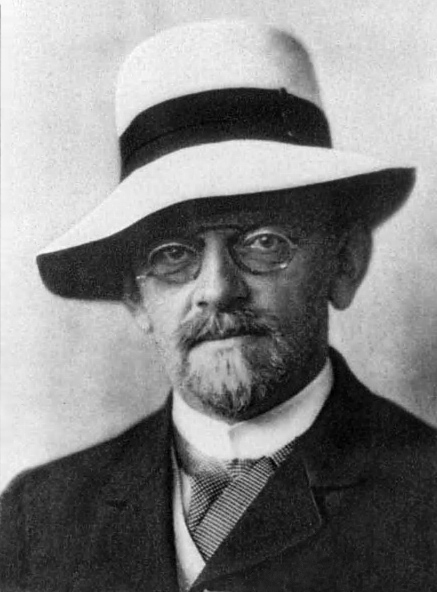
Hilbert's problems are 23 problems in mathematics published by German mathematician David Hilbert in 1900. They were all unsolved at the time, and several proved to be very influential for 20th-century mathematics. Hilbert presented ten of the problems at the Paris conference of the International Congress of Mathematicians, speaking on August 8 at the Sorbonne. The complete list of 23 problems was published later, and translated into English in 1902 by Mary Frances Winston Newson in the Bulletin of the American Mathematical Society. Earlier publications appeared in Archiv der Mathematik und Physik.
Most arguments scatter across papers, posts, and threads — and evaporate. A claim tree gives them a stable structure to gather against, the way a cathedral gathers centuries of work into a single, standing thing.

LLMs and self-referentiality
I woke up yesterday with the following thoughts, which are probably either obvious or dumb. A central thesis that many readers, including me, took from Douglas Hofstadter’s Gödel Escher Bach when y…

The sound of inevitability
Have you ever argued with someone who is seriously good at debating? I have. It sucks. You’re constantly thrown off-balance, responding to a point you didn’t expect to. You find yourself defending the weak edges of your argument, while the main thrust gets left behind in the back-and-forth, and you end up losing momentum, confidence, and ultimately, the argument. One of my close friends won international debate competitions for fun while we were at university (he’s now a successful criminal barrister), and he told me that the only trick in the book, once you boil it all down, is to make sure the conversation is framed in your terms. Once that happens, it’s all over bar the shouting.
Philosophy Experiments — Interactive Thought Experiments
Explore 27 interactive philosophy experiments that challenge your moral intuitions, test your logical reasoning, and probe the boundaries of belief.

Complete Works (1977–2024) — Hirsch Argument Atlas
This atlas maps the complete argument of E.D. Hirsch Jr. across 10 books spanning 1977 to 2024. Every claim is extracted, every piece of evidence tracked, and every counter-argument surfaced. A separate layer of external scholarly research provides independent context.
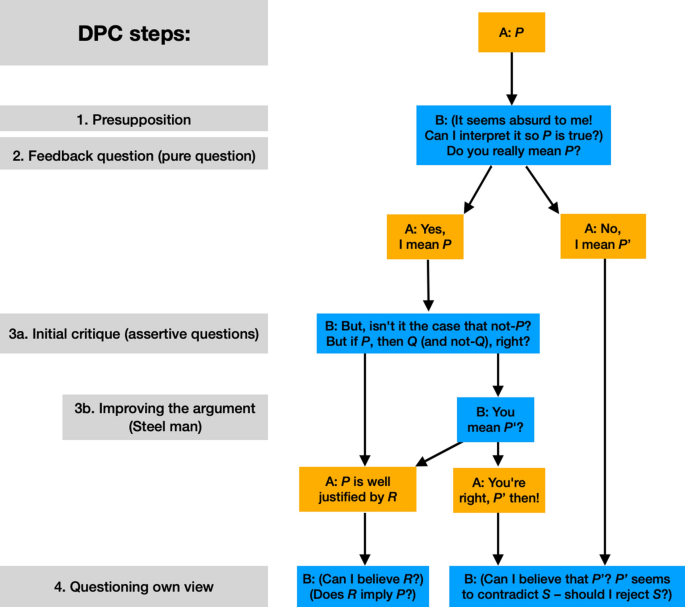
The Dialectical Principle of Charity: A Procedure for a Critical Discussion
This paper aims to discuss a well-known concept from argumentation theory, namely the principle of charity. It will show that this principle, especially in its contemporary version as formulated by Donald Davidson, meets with some serious problems. Since we need the principle of charity in any kind of critical discussion, we propose the way of modifying it according to the presupponendum—the rule written in the sixteenth century by Ignatius Loyola. While also corresponding with pragma-dialectical rules, it also provides additional content. This will be termed the dialectical principle of charity, and it offers a few steps to be performed during an argument in order to make sure that the participants understand each other well and are not deceived by any cognitive bias. The meaning of these results could be of great significance for argumentation theory, pragma-dialectics and the practice of public discourse as it enhances the principle of charity and makes it easier to apply in argumentation.
How Do We Talk about LLMs?
By Jim Clifford It is never fun to watch friends argue. Generative AI has created multiple fractures across our universities and the community of historians. The stakes are high and we are all deal…

Féminisme en ligne : recherche, activisme et néolibéralisme. Entret...
Présentation Christina Scharff est professeure d’études culturelles (Culture and Subjectivity) et vice-doyenne des études doctorales en Arts & Humanités du King’s College London. Soutenue en 2009, ...

Assemblage (philosophy)
Assemblage (from everyday French: agencement, – arrangement, layout, "a collection of things which have been gathered together or assembled") is a philosophical concept developed by Gilles Deleuze and Félix Guattari[1] and subsequently taken up by other theorists, such as Bruno Latour and Michel Callon who developed actor-network theory,[2] Manuel DeLanda in his work on assemblage theory,[3] and Jane Bennett who combines Latour with Deleuze and Guattari forming her own assemblage theory.[4][5][6] Bennett’s assemblage thinking has influenced environmental philosophy (e.g. Timothy Morton’s Hyperobjects), political theory (e.g. William Connolly’s work on complexity and politics), and new materialism (e.g. Rosi Braidotti, Karen Barad).