

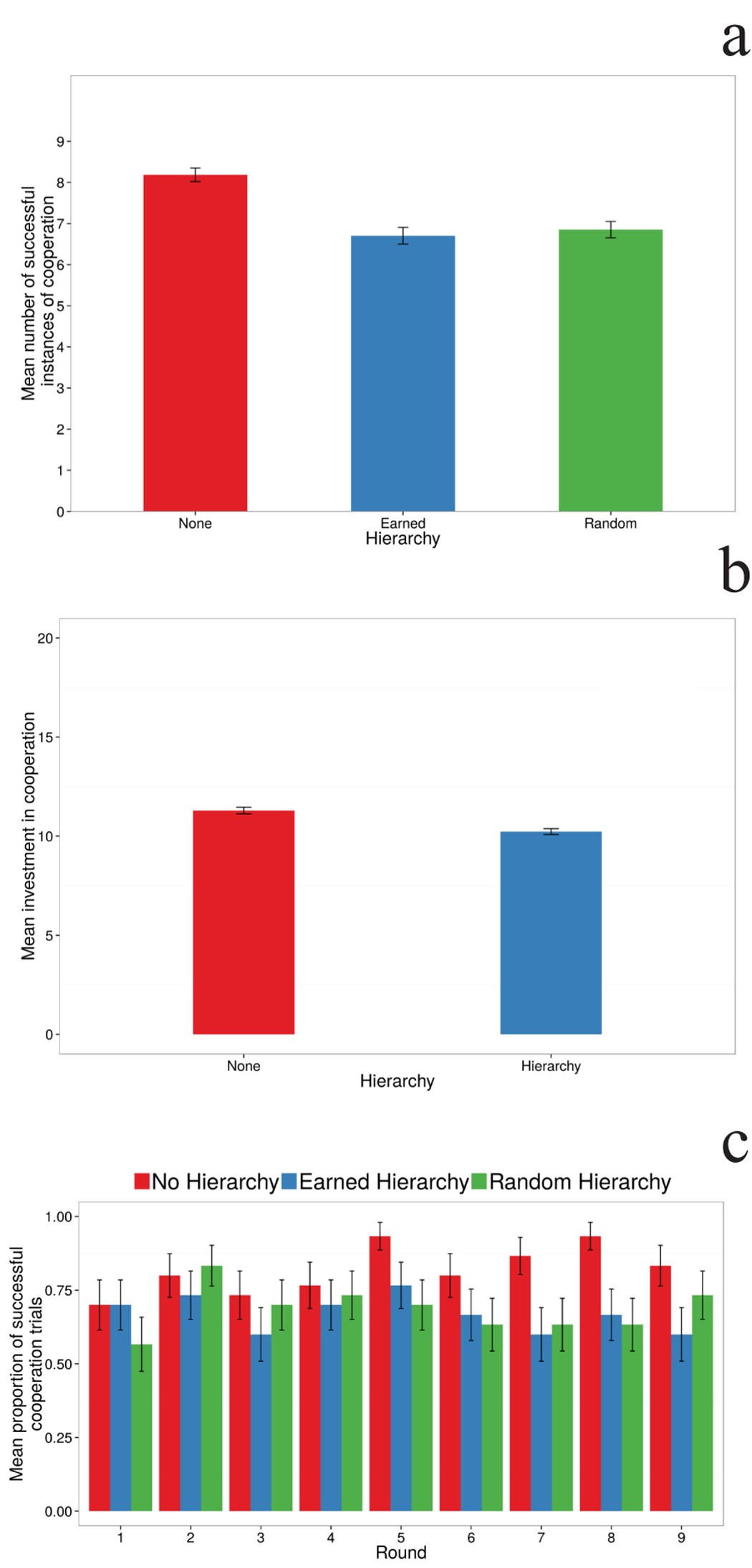
Studies of animal behavior consistently demonstrate that the social environment impacts cooperation, yet the effect of social dynamics has been largely excluded from studies of human cooperation. Here, we introduce a novel approach inspired by nonhuman primate research to address how social hierarchies impact human cooperation. Participants competed to earn hierarchy positions and then could cooperate with another individual in the hierarchy by investing in a common effort. Cooperation was achieved if the combined investments exceeded a threshold and the higher ranked individual distributed the spoils unless control was contested by the partner. Compared to a condition lacking hierarchy, cooperation declined in the presence of a hierarchy due to a decrease in investment by lower ranked individuals. Furthermore, hierarchy was detrimental to cooperation regardless of whether it was earned or arbitrary. These findings mirror results from nonhuman primates and demonstrate that hierarchies are detrimental to cooperation. However, these results deviate from nonhuman primate findings by demonstrating that human behavior is responsive to changing hierarchical structures and suggests partnership dynamics that may improve cooperation. This work introduces a controlled way to investigate the social influences on human behavior and demonstrates the evolutionary continuity of human behavior with other primate species.
Heterospecific social behavior in primates: insights into the evolutionary roots of pet-keeping
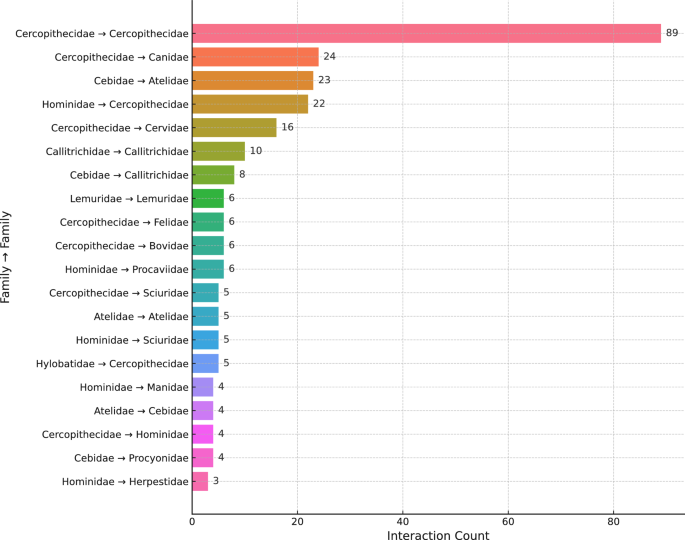
Primate interspecific interactions with both other primates and non-primate species range from predator–prey dynamics to affiliative behaviors such as grooming, play, and carrying. While many primates participate in interspecific associations or commensal relationships, to our knowledge interspecific social interactions have never been systematically synthesized. Here, we present the first comprehensive review of such interactions, compiling 427 cases from the literature, media sources, and a global survey of primatologists. These involved 88 primate species and 127 non-primate species (including mammals, birds, reptiles, amphibians, malacostracans, and insects) across wild (n = 311) and captive (n = 111) contexts. The most frequent interactions occurred within or between primate families (e.g., Cercopithecidae–Cercopithecidae, Cebidae–Atelidae), though affiliative behaviors were also directed toward distantly related taxa such as dogs and birds. Play (n = 139) and grooming (n = 136) were most common. Juveniles and infants predominantly engaged in play, while adult females were more likely to groom. Adult males were less affiliative overall. Contrary to expectations, affiliative behaviors were not more often directed toward immature than adult heterospecifics. Primates were the initiators in most interactions. These findings offer new insights into the diversity and contexts of heterospecific sociality in primates and suggest that some behavioral tendencies relevant to later forms of human–animal companionship – such as caregiving, tolerance, and exploratory play – may be more widespread among primates than previously recognized.
Indirect reciprocity undermines indirect reciprocity destabilizing large-scale cooperation
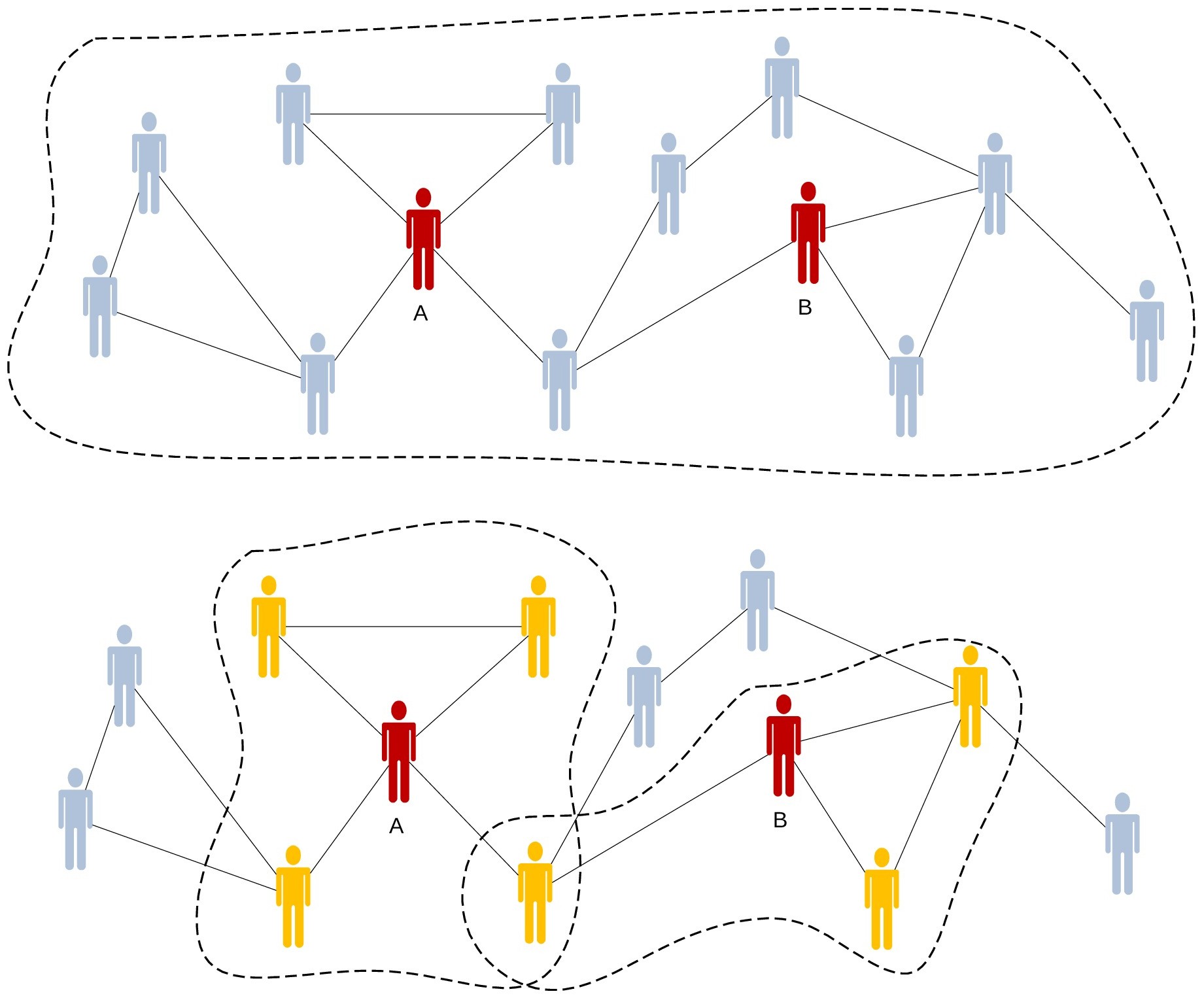
Previous models suggest that indirect reciprocity (reputation) can stabilize large-scale human cooperation [K. Panchanathan, R. Boyd, Nature 432 , 499–502 (2004)]. The logic behind these models and experiments [J. Gross et al. , Sci. Adv. 9 , eadd8289 (2023) and O. P. Hauser, A. Hendriks, D. G. Rand, M. A. Nowak, Sci. Rep. 6 , 36079 (2016)] is that a strategy in which individuals conditionally aid others based on their reputation for engaging in costly cooperative behavior serves as a punishment that incentivizes large-scale cooperation without the second-order free-rider problem. However, these models and experiments fail to account for individuals belonging to multiple groups with reputations that can be in conflict. Here, we extend these models such that individuals belong to a smaller, “local” group embedded within a larger, “global” group. This introduces competing strategies for conditionally aiding others based on their cooperative behavior in the local or global group. Our analyses reveal that the reputation for cooperation in the smaller local group can undermine cooperation in the larger global group, even when the theoretical maximum payoffs are higher in the larger global group. This model reveals that indirect reciprocity alone is insufficient for stabilizing large-scale human cooperation because cooperation at one scale can be considered defection at another. These results deepen the puzzle of large-scale human cooperation.

Inducing Peer Pressure to Promote Cooperation
Cooperation in a large society of self-interested individuals is notoriously difficult to achieve when the externality of one individual's action is spread thin and wide on the whole society. This leads to the ‘tragedy of the commons’ in which rational action will ultimately make everyone worse-off. Traditional policies to promote cooperation involve Pigouvian taxation or subsidies that make individuals internalize the externality they incur. We introduce a new approach to achieving global cooperation by localizing externalities to one's peers in a social network, thus leveraging the power of peer-pressure to regulate behavior. The mechanism relies on a joint model of externalities and peer-pressure. Surprisingly, this mechanism can require a lower budget to operate than the Pigouvian mechanism, even when accounting for the social cost of peer pressure. Even when the available budget is very low, the social mechanisms achieve greater improvement in the outcome.
Mutual Aid: A Factor of Evolution
From Mutual Aid In the animal world we have seen that the vast majority of species live in societies, and that they find in association the best arms for the struggle for life: understood, of course, in its wide Darwinian sense — not as a struggle for the sheer means of existence, but as a … Continued
Mutual Aid: A Factor of Evolution
Mutual Aid: A Factor of Evolution is a 1902 collection of anthropological essays by Russian naturalist and anarchist philosopher Peter Kropotkin. The essays, initially published in the English periodical The Nineteenth Century between 1890 and 1896, explore the role of mutually beneficial cooperation and reciprocity in the animal kingdom and human societies both past and present. It is an argument against theories of social Darwinism that emphasize competition and survival of the fittest, and against the romantic depictions by writers such as Jean-Jacques Rousseau, who thought that cooperation was motivated by universal love. Instead, Kropotkin argues that mutual aid has pragmatic advantages for the survival of human and animal communities and, along with the conscience, has been promoted through natural selection.

Human–Animal Interaction and Human Prosociality: A Meta-Analytic Review of Experimental and Correlational Studies
Pet ownership and interactions with animals confer various physiological and psychological benefits to humans. Although interactions with animals are commonplace, there is no consensus in the liter...
Cooperation emerges when groups are small and memories are long, study finds
The tragedy of the commons, a concept described by ecologist Garrett Hardin, paints a grim view of human nature. The theory goes that, if a resource is shared, individuals will act in their own self-interest, ...

'Networked minds' require fundamentally new kind of economics
In their computer simulations of human evolution, scientists have discovered the emergence of the “homo socialis” with “other-regarding” preferences. The results explain some intriguing findings in experimental economics and call for a new economic theory of “networked minds”. On average, people behave more fairness-oriented and other-regarding than expected. A new theory now explains why.

Richard McElreath Director Department of Human Behavior, Ecology, and Culture [link] Max Planck Institute for Evolutionary Anthropology [link]
Integrative experiments identify how punishment affects welfare in public goods games
Despite decades of research, the conditions under which punishment promotes cooperation remain unclear. Through an integrative experiment varying 14 design parameters of public goods games across 360 experimental conditions (147,618 decisions from 7100 participants), we reveal substantial heterogeneity in punishment effectiveness: Its impact on welfare ranges from 43% improvement to 44% reduction depending on the game parameters. To characterize these patterns, we developed models that outperformed human forecasters in predicting punishment effectiveness in new experiments. Communication emerges as the most important factor, followed by contribution framing (opt out versus opt in), contribution type (variable versus all-or-nothing), game length, and outcome visibility, though these factors often interact. The results reframe the debate from whether punishment works to when it does, demonstrating how integrative experiments enable discovery of generalizable patterns in social phenomena. , Editor’s summary People face conflicts between maximizing personal gain versus supporting collective interests. If we cooperatively recycle or donate to charities, it benefits society, but it also costs us time and resources that could be selfishly preserved for ourselves. We impose penalties to deter those undesirable or selfish behaviors, but under what conditions do punishments or penalties effectively modify behavior to benefit group welfare? Alsobay et al . systematically and simultaneously varied 14 factors together instead of in isolation. Punishment was unequivocally most effective when paired with consistent communication, particularly over time. Another effective factor was “opting out” or withdrawing some, but not all, endowments already in the public fund. These methodological advances revealed when, rather than whether, punishment works. —Ekeoma Uzogara , INTRODUCTION Human societies face many situations where individual and collective interests conflict, often referred to as social dilemmas. Costly peer punishment has been studied for more than 25 years in public goods games (stylized behavioral experiments in which individuals decide how much to contribute to a shared pool that benefits everyone) as a mechanism to promote cooperation. Prior research has identified many contextual factors that moderate punishment’s effectiveness, including game length, communication, group size, punishment cost, and so on. However, the specific conditions under which punishment improves group welfare remain unclear. RATIONALE We argue that this lack of clarity derives from the dominant experimental paradigm, in which any given study manipulates only one or a few theoretically informed factors. Because such studies differ in many ways (different experimental procedures, populations), their results are often difficult to compare or integrate. Consequently, one can list many factors that have some effect, but cannot say how much each matters relative to the others, or how they work together, and as a result, cannot predict when punishment will help or harm welfare in new settings. To address this fundamental knowledge gap, we use an integrative experimental design and systematically vary 14 parameters across 360 conditions (147,618 decisions from 7100 participants) to elucidate when punishment improves versus undermines welfare in public goods games, which factors matter most, and how they interact. RESULTS The effect of punishment on welfare ranged from 43% improvement to 44% reduction depending on the specific combination of game parameters. To characterize this heterogeneity, we trained a model that outperformed all 553 human forecasters (laypeople and experts) in predicting whether punishment would help or harm welfare in new experiments. Communication emerged as roughly three times more important than any other factor, followed by contribution framing (opt in versus opt out), contribution type (variable versus all-or-nothing), game length, and peer outcome visibility (whether participants can see others’ earnings). These factors often interact. For example, longer games enhance punishment’s effectiveness only when communication is available, and contribution framing effects depend on both contribution type and outcome visibility. CONCLUSION Many phenomena in social science are shaped by many factors whose interactions are consequential, yet the dominant experimental paradigm often limits its inquiry to “does a given effect exist?” and examines hypothesized factors in isolation. As a result, research programs can accumulate many partial explanations without a clear picture of how they combine to determine outcomes across settings. Knowing that factors matter individually is fundamentally different from knowing how much each matters and how they interact. The integrative approach implemented here offers one way forward. It varies many factors simultaneously within a shared design space, evaluates models by their predictive accuracy on new experiments, and probes those models to constrain and develop theory. Our hope is that integrative experiment designs, combined with models that integrate prediction and explanation, represent a path toward more cumulative social science. Integrative experiment reveals when punishment helps versus harms. We systematically varied 14 design parameters across 360 experimental conditions. The effect of punishment on cooperation efficiency ranged from −44% to +43% depending on the specific game parameters. Communication emerged as three times more important than any other factor, followed by contribution framing, contribution type, and game length.

Mechanisms of social cognition
Social animals including humans share a range of social mechanisms that are automatic and implicit and enable learning by observation. Learning from others includes imitation of actions and mirroring of emotions. Learning about others, such as their group membership and reputation, is crucial for social interactions that depend on trust. For accurate prediction of others' changeable dispositions, mentalizing is required, i.e., tracking of intentions, desires, and beliefs. Implicit mentalizing is present in infants less than one year old as well as in some nonhuman species. Explicit mentalizing is a meta-cognitive process and enhances the ability to learn about the world through self-monitoring and reflection, and may be uniquely human. Meta-cognitive processes can also exert control over automatic behavior, for instance, when short-term gains oppose long-term aims or when selfish and prosocial interests collide. We suggest that they also underlie the ability to explicitly share experiences with other agents, as in reflective discussion and teaching. These are key in increasing the accuracy of the models of the world that we construct.
Beavers Are Responsible for How We Coexist and Communicate
The buck-toothed rodents have long taken the lead in forging civilization's path forward.

The ultrasocial origin of the Anthropocene
The current geological epoch has been dubbed the Anthropocene—the age of humans. We argue that the roots of the Anthropocene lie in the agricultural revolution that began some 8000years ago. Unique human psychological and cultural characteristics were present in our distant hunter–gatherer past, but in terms of the biophysical impact of our species, agricultural represented an unequivocal and decisive evolutionary break. With the transition to agriculture human society began to function as a superorganism functioning as a single unit designed by social natural selection to produce economic surplus. Where environmental conditions were permitted, early human agricultural societies followed the same pattern as a few social insects and exhibited explosive population growth, complex and detailed division of labor, intensive resource exploitation, territorial expansion, and a social organization favoring the survival and growth of the supergroup over the well-being of individuals within the group. Similar economic forces lie behind ultrasociality in social insects and humans—increased productivity from the division of labor, increasing returns to scale, and the exploitation of stocks of productive resources. Exploring the evolutionary mechanisms behind ultrasociality offers insights into the growth imperative that threatens the stability of the earth's life support systems.
The Cooperative Account of the Rise of Virtues
This chapter presents an account of how virtues evolve. The primary challenge any such account must address is why different societies regard different traits as virtues and why these views change over time. The account developed here builds on the theory of Morality as Cooperation, which identifies seven core types of cooperation that correspond to seven universally valued virtues—filial piety, loyalty, fair-mindedness, courage, deference, justice, and respect for property. The chapter argues that virtues are stable character traits that dispose individuals to perform cooperative actions in response to recurrent social interaction problems. Different societies at different times face different problems of cooperation, which leads to different virtues. The chapter concludes with humility as a test case for this account of the evolution of virtues.

Shifting the Level of Selection in Science
Criteria for recognizing and rewarding scientists primarily focus on individual contributions. This creates a conflict between what is best for scientists’ careers and what is best for science. In this article, we show how the theory of multilevel selection provides conceptual tools for modifying incentives to better align individual and collective interests. A core principle is the need to account for indirect effects by shifting the level at which selection operates from individuals to the groups in which individuals are embedded. This principle is used in several fields to improve collective outcomes, including animal husbandry, team sports, and professional organizations. Shifting the level of selection has the potential to ameliorate several problems in contemporary science, including accounting for scientists’ diverse contributions to knowledge generation, reducing individual-level competition, and promoting specialization and team science. We discuss the difficulties associated with shifting the level of selection and outline directions for future development in this domain.

Evaluating Cooperation in LLM Social Groups through Self Organizing Leadership