

Cooperation in a large society of self-interested individuals is notoriously difficult to achieve when the externality of one individual's action is spread thin and wide on the whole society. This leads to the ‘tragedy of the commons’ in which rational action will ultimately make everyone worse-off. Traditional policies to promote cooperation involve Pigouvian taxation or subsidies that make individuals internalize the externality they incur. We introduce a new approach to achieving global cooperation by localizing externalities to one's peers in a social network, thus leveraging the power of peer-pressure to regulate behavior. The mechanism relies on a joint model of externalities and peer-pressure. Surprisingly, this mechanism can require a lower budget to operate than the Pigouvian mechanism, even when accounting for the social cost of peer pressure. Even when the available budget is very low, the social mechanisms achieve greater improvement in the outcome.
Sustainable Cooperation in Peer-To-Peer Networks
Traditionally, peer-to-peer systems have relied on altruism and reciprocity. Although incentive-based models have gained prominence in new-generation peer-to-peer systems, it is essential to recognize the continued importance of cooperative principles in achieving performance, fairness, and correctness. The lack of this acknowledgment has paved the way for selfish peers to gain unfair advantages in these systems. As such, we address the challenge of selfish peers by devising a mechanism to reward sustained cooperation. Instead of relying on global accountability mechanisms, we propose a protocol that naturally aggregates local evaluations of cooperation. Traditional mechanisms are often vulnerable to Sybil and misreporting attacks. However, our approach overcomes these issues by limiting the benefits selfish peers can gain without incurring any cost. The viability of our algorithm is proven with a deployment to 27,259 Internet users and a realistic simulation of a blockchain gossip protocol. We show that our protocol sustains cooperation even in the presence of a majority of selfish peers while incurring only negligible overhead.

Indirect reciprocity undermines indirect reciprocity destabilizing large-scale cooperation
Previous models suggest that indirect reciprocity (reputation) can stabilize large-scale human cooperation [K. Panchanathan, R. Boyd, Nature 432 , 499–502 (2004)]. The logic behind these models and experiments [J. Gross et al. , Sci. Adv. 9 , eadd8289 (2023) and O. P. Hauser, A. Hendriks, D. G. Rand, M. A. Nowak, Sci. Rep. 6 , 36079 (2016)] is that a strategy in which individuals conditionally aid others based on their reputation for engaging in costly cooperative behavior serves as a punishment that incentivizes large-scale cooperation without the second-order free-rider problem. However, these models and experiments fail to account for individuals belonging to multiple groups with reputations that can be in conflict. Here, we extend these models such that individuals belong to a smaller, “local” group embedded within a larger, “global” group. This introduces competing strategies for conditionally aiding others based on their cooperative behavior in the local or global group. Our analyses reveal that the reputation for cooperation in the smaller local group can undermine cooperation in the larger global group, even when the theoretical maximum payoffs are higher in the larger global group. This model reveals that indirect reciprocity alone is insufficient for stabilizing large-scale human cooperation because cooperation at one scale can be considered defection at another. These results deepen the puzzle of large-scale human cooperation.

Cooperation emerges when groups are small and memories are long, study finds
The tragedy of the commons, a concept described by ecologist Garrett Hardin, paints a grim view of human nature. The theory goes that, if a resource is shared, individuals will act in their own self-interest, ...

Sufficient Decentralization for Social Networks
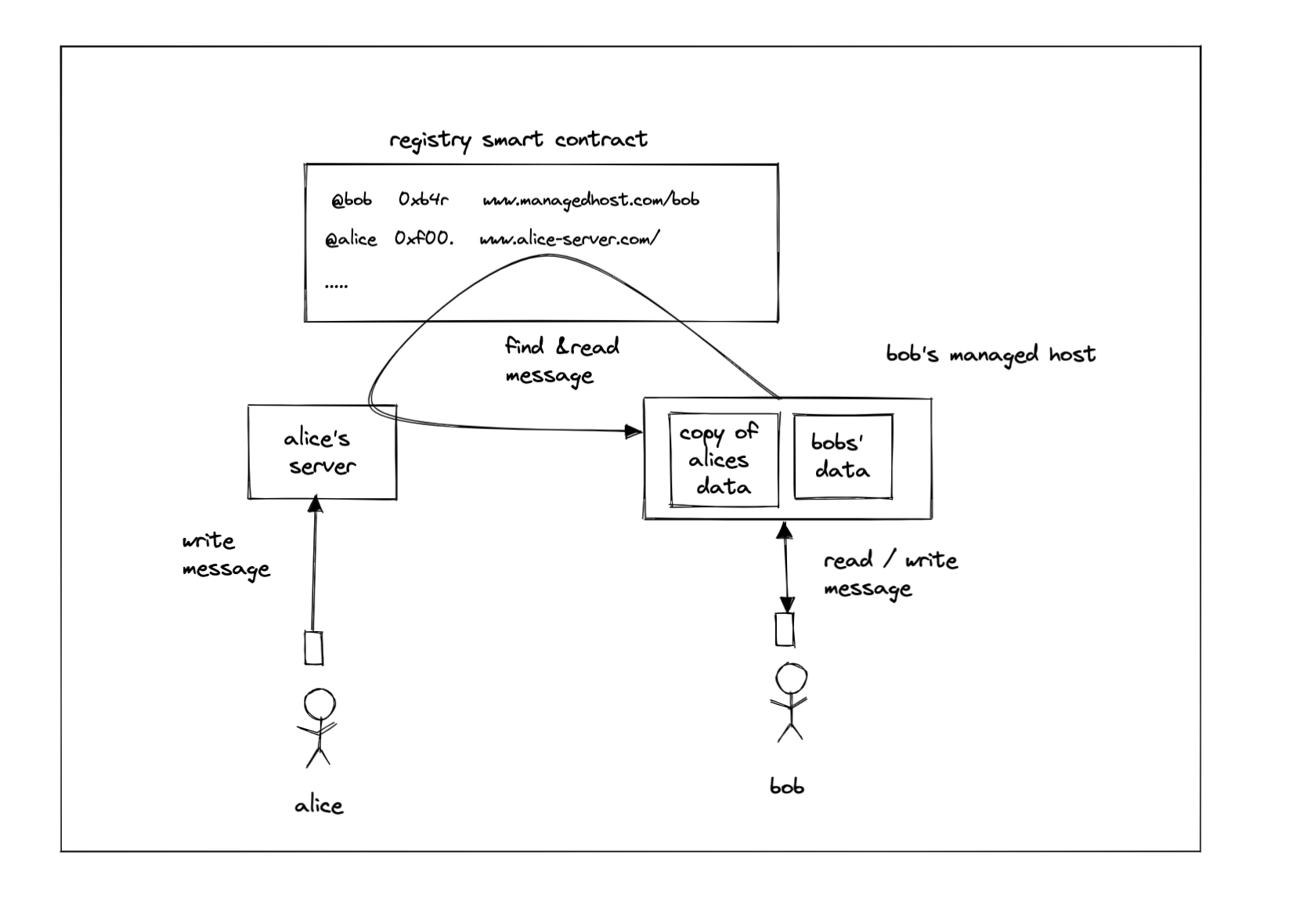
A design pattern to reduce centralized control and change incentives in social networks.
Integrative experiments identify how punishment affects welfare in public goods games
Despite decades of research, the conditions under which punishment promotes cooperation remain unclear. Through an integrative experiment varying 14 design parameters of public goods games across 360 experimental conditions (147,618 decisions from 7100 participants), we reveal substantial heterogeneity in punishment effectiveness: Its impact on welfare ranges from 43% improvement to 44% reduction depending on the game parameters. To characterize these patterns, we developed models that outperformed human forecasters in predicting punishment effectiveness in new experiments. Communication emerges as the most important factor, followed by contribution framing (opt out versus opt in), contribution type (variable versus all-or-nothing), game length, and outcome visibility, though these factors often interact. The results reframe the debate from whether punishment works to when it does, demonstrating how integrative experiments enable discovery of generalizable patterns in social phenomena. , Editor’s summary People face conflicts between maximizing personal gain versus supporting collective interests. If we cooperatively recycle or donate to charities, it benefits society, but it also costs us time and resources that could be selfishly preserved for ourselves. We impose penalties to deter those undesirable or selfish behaviors, but under what conditions do punishments or penalties effectively modify behavior to benefit group welfare? Alsobay et al . systematically and simultaneously varied 14 factors together instead of in isolation. Punishment was unequivocally most effective when paired with consistent communication, particularly over time. Another effective factor was “opting out” or withdrawing some, but not all, endowments already in the public fund. These methodological advances revealed when, rather than whether, punishment works. —Ekeoma Uzogara , INTRODUCTION Human societies face many situations where individual and collective interests conflict, often referred to as social dilemmas. Costly peer punishment has been studied for more than 25 years in public goods games (stylized behavioral experiments in which individuals decide how much to contribute to a shared pool that benefits everyone) as a mechanism to promote cooperation. Prior research has identified many contextual factors that moderate punishment’s effectiveness, including game length, communication, group size, punishment cost, and so on. However, the specific conditions under which punishment improves group welfare remain unclear. RATIONALE We argue that this lack of clarity derives from the dominant experimental paradigm, in which any given study manipulates only one or a few theoretically informed factors. Because such studies differ in many ways (different experimental procedures, populations), their results are often difficult to compare or integrate. Consequently, one can list many factors that have some effect, but cannot say how much each matters relative to the others, or how they work together, and as a result, cannot predict when punishment will help or harm welfare in new settings. To address this fundamental knowledge gap, we use an integrative experimental design and systematically vary 14 parameters across 360 conditions (147,618 decisions from 7100 participants) to elucidate when punishment improves versus undermines welfare in public goods games, which factors matter most, and how they interact. RESULTS The effect of punishment on welfare ranged from 43% improvement to 44% reduction depending on the specific combination of game parameters. To characterize this heterogeneity, we trained a model that outperformed all 553 human forecasters (laypeople and experts) in predicting whether punishment would help or harm welfare in new experiments. Communication emerged as roughly three times more important than any other factor, followed by contribution framing (opt in versus opt out), contribution type (variable versus all-or-nothing), game length, and peer outcome visibility (whether participants can see others’ earnings). These factors often interact. For example, longer games enhance punishment’s effectiveness only when communication is available, and contribution framing effects depend on both contribution type and outcome visibility. CONCLUSION Many phenomena in social science are shaped by many factors whose interactions are consequential, yet the dominant experimental paradigm often limits its inquiry to “does a given effect exist?” and examines hypothesized factors in isolation. As a result, research programs can accumulate many partial explanations without a clear picture of how they combine to determine outcomes across settings. Knowing that factors matter individually is fundamentally different from knowing how much each matters and how they interact. The integrative approach implemented here offers one way forward. It varies many factors simultaneously within a shared design space, evaluates models by their predictive accuracy on new experiments, and probes those models to constrain and develop theory. Our hope is that integrative experiment designs, combined with models that integrate prediction and explanation, represent a path toward more cumulative social science. Integrative experiment reveals when punishment helps versus harms. We systematically varied 14 design parameters across 360 experimental conditions. The effect of punishment on cooperation efficiency ranged from −44% to +43% depending on the specific game parameters. Communication emerged as three times more important than any other factor, followed by contribution framing, contribution type, and game length.

Crowdmatching for Public Goods — Snowdrift.coop
We support works that everyone can use, adapt, and share freely. But as public goods, anyone can freeride. And that presents a dilemma in getting funded. Our innovative platform brings people together to address this problem.
The Social Cost of Cheap Pseudonyms
We consider the problems of societal norms for cooperation and reputation when it is possible to obtain cheap pseudonyms, something that is becoming quite common in a wide variety of interactions on the Internet. This introduces opportunities to misbehave without paying reputational consequences. A large degree of cooperation can still emerge, through a convention in which newcomers “pay their dues” by accepting poor treatment from players who have established positive reputations. One might hope for an open society where newcomers are treated well, but there is an inherent social cost in making the spread of reputations optional. We prove that no equilibrium can sustain significantly more cooperation than the dues‐paying equilibrium in a repeated random matching game with a large number of players in which players have finite lives and the ability to change their identities, and there is a small but nonvanishing probability of mistakes. Although one could remove the inefficiency of mistreating newcomers by disallowing anonymity, this is not practical or desirable in a wide variety of transactions. We discuss the use of entry fees, which permits newcomers to be trusted but excludes some players with low payoffs, thus introducing a different inefficiency. We also discuss the use of free but unreplaceable pseudonyms, and describe a mechanism that implements them using standard encryption techniques, which could be practically implemented in electronic transactions.

Hierarchy is Detrimental for Human Cooperation
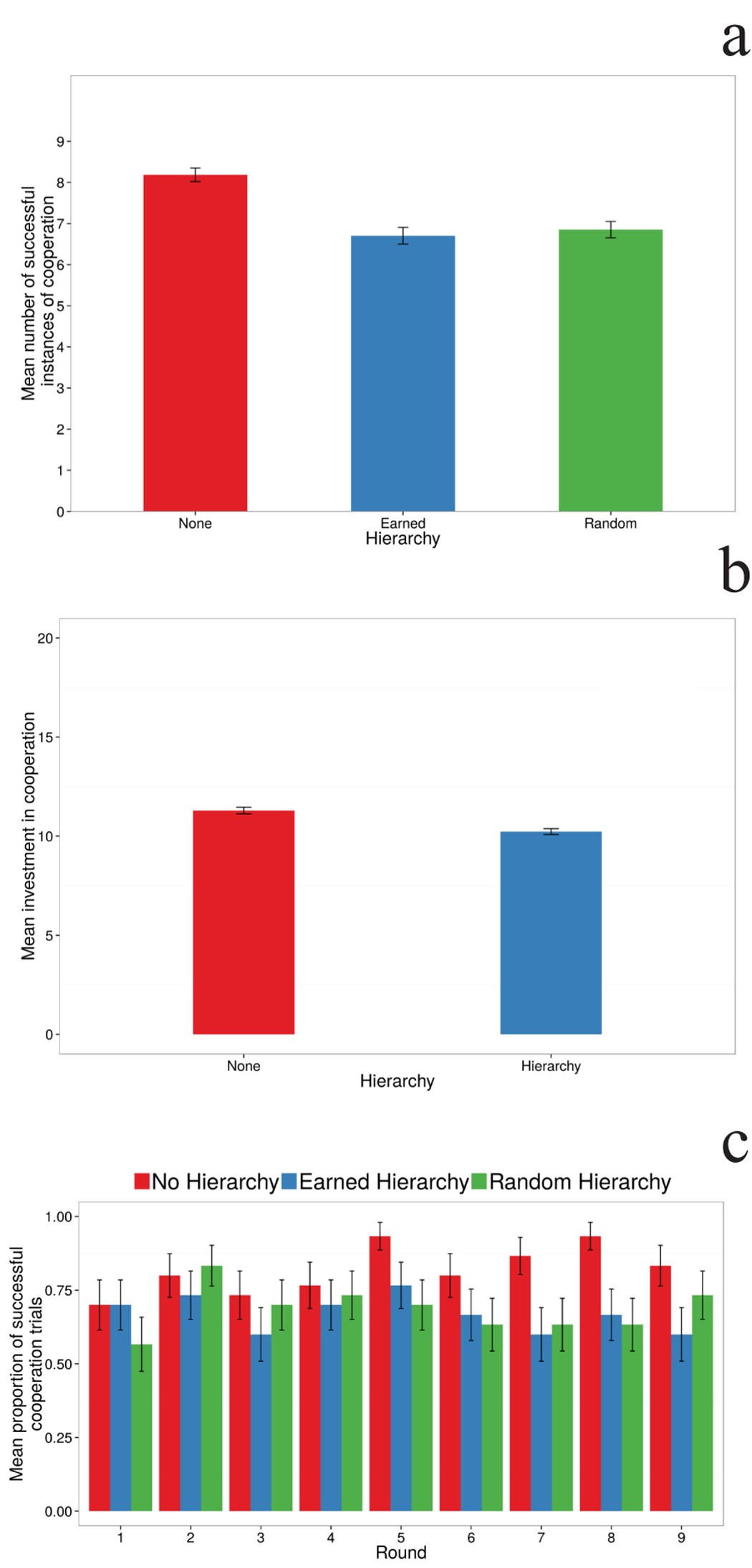
Studies of animal behavior consistently demonstrate that the social environment impacts cooperation, yet the effect of social dynamics has been largely excluded from studies of human cooperation. Here, we introduce a novel approach inspired by nonhuman primate research to address how social hierarchies impact human cooperation. Participants competed to earn hierarchy positions and then could cooperate with another individual in the hierarchy by investing in a common effort. Cooperation was achieved if the combined investments exceeded a threshold and the higher ranked individual distributed the spoils unless control was contested by the partner. Compared to a condition lacking hierarchy, cooperation declined in the presence of a hierarchy due to a decrease in investment by lower ranked individuals. Furthermore, hierarchy was detrimental to cooperation regardless of whether it was earned or arbitrary. These findings mirror results from nonhuman primates and demonstrate that hierarchies are detrimental to cooperation. However, these results deviate from nonhuman primate findings by demonstrating that human behavior is responsive to changing hierarchical structures and suggests partnership dynamics that may improve cooperation. This work introduces a controlled way to investigate the social influences on human behavior and demonstrates the evolutionary continuity of human behavior with other primate species.
From Competition to Cooperation | Primavera De Filippi | TEDxCambridge
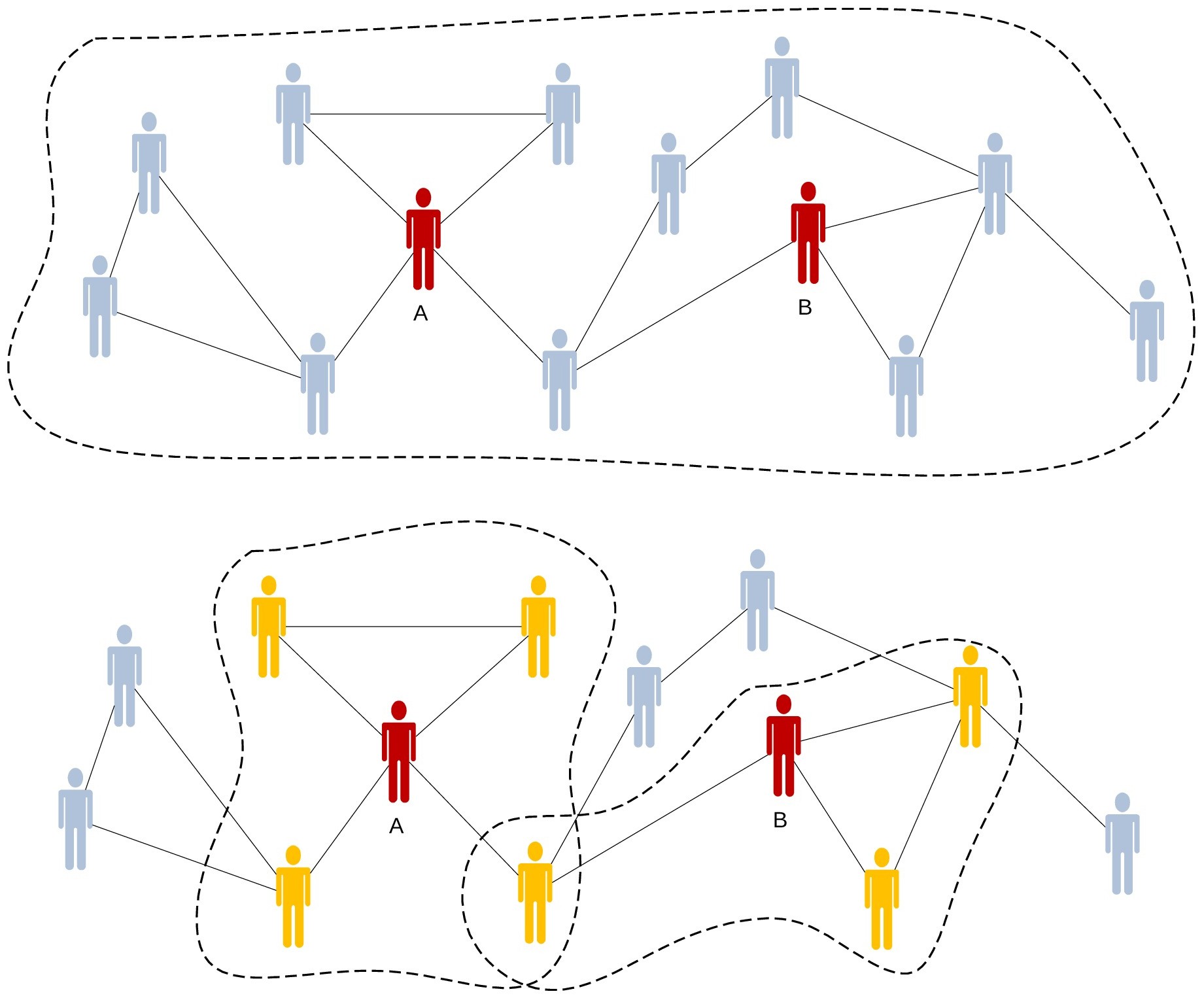
The Majority Illusion in Social Networks
Social behaviors are often contagious, spreading through a population as individuals imitate the decisions and choices of others. A variety of global phenomena, from innovation adoption to the emergence of social norms and political movements, arise as a result of people following a simple local rule, such as copy what others are doing. However, individuals often lack global knowledge of the behaviors of others and must estimate them from the observations of their friends' behaviors. In some cases, the structure of the underlying social network can dramatically skew an individual's local observations, making a behavior appear far more common locally than it is globally. We trace the origins of this phenomenon, which we call "the majority illusion," to the friendship paradox in social networks. As a result of this paradox, a behavior that is globally rare may be systematically overrepresented in the local neighborhoods of many people, i.e., among their friends. Thus, the "majority illusion" may facilitate the spread of social contagions in networks and also explain why systematic biases in social perceptions, for example, of risky behavior, arise. Using synthetic and real-world networks, we explore how the "majority illusion" depends on network structure and develop a statistical model to calculate its magnitude in a network.
'Networked minds' require fundamentally new kind of economics
In their computer simulations of human evolution, scientists have discovered the emergence of the “homo socialis” with “other-regarding” preferences. The results explain some intriguing findings in experimental economics and call for a new economic theory of “networked minds”. On average, people behave more fairness-oriented and other-regarding than expected. A new theory now explains why.

Shaping Preferences with Pigouvian Taxes
A Pigouvian tax is a tax that is imposed to correct an externality, which arises when a person engages in behavior that harms others without their consent. Pigouvian taxes are popular among academics—with prominent economists and legal scholars arguing for their imposition on myriad goods and activities that harm third parties, like carbon emissions and alcohol. Policymakers have recently been receptive to at least some of these arguments as evidenced by taxes imposed on or proposed for a variety of externality-generating goods, including guns, plastic bags, and sugary drinks.The conventional economic rationale for Pigouvian taxes assumes that they affect behavior by increasing the prices of taxed goods and not by altering people’s underlying preferences for them. For example, a carbon tax reduces driving by making gasoline more expensive, but it otherwise leaves people’s desire to drive unchanged. This conclusion follows from the standard assumption in economics that people’s tastes and preferences are fixed and determined exogenously to public policy.Contrary to standard analysis, I argue that Pigouvian taxes can in fact shape preferences and that policymakers should consider using them for that purpose. A carbon tax, for instance, would not only make driving more expensive, it might also modify preferences such that people develop a taste for alternative modes of transportation—making driving less desirable, even if we ignore the increase in gas prices.I make an original contribution to the literature on Pigouvian taxes by explaining in detail the psychological mechanisms through which these taxes can alter preferences. I also argue that once we relax the assumption of fixed preferences, the already strong case for Pigouvian taxes often becomes even more compelling. Specifically, preference endogeneity means that the loss in consumer utility resulting from Pigouvian taxes will often be smaller than standard analysis suggests. Moreover, malleable preferences dramatically expand the potential scope for Pigouvian taxes and enhance their impact on behavior through a social multiplier effect that can make taxes more effective in achieving public policy goals than scholars have traditionally assumed. I illustrate these points in a variety of policy-relevant contexts, including environmental law, gun control, and public health policy.
Designing decentralized moderation
In decentralized social networks, moderation decisions are made locally by users, servers, or other network entities. This basic…

Proto-Social Infrastructure and Stewardship of Commitment Pooling
This paper examines Commitment Pooling as a commons-based resource coordination framework. The Commitment Pooling protocol establishes rules for the exchange of resources, emphasizing reciprocity and mutual support. The infrastructure, blending proto-social systems like rotational labor with modern technologies such as blockchain, enables a transition from extractive to cooperative models. Central to this framework is stewardship, ensuring responsible governance and long-term sustainability of the commons. By integrating protocol, infrastructure, and stewardship, Commitment Pooling provides a flexible, scalable model for fostering cooperative, resilient economies and addressing contemporary challenges in resource management.
