

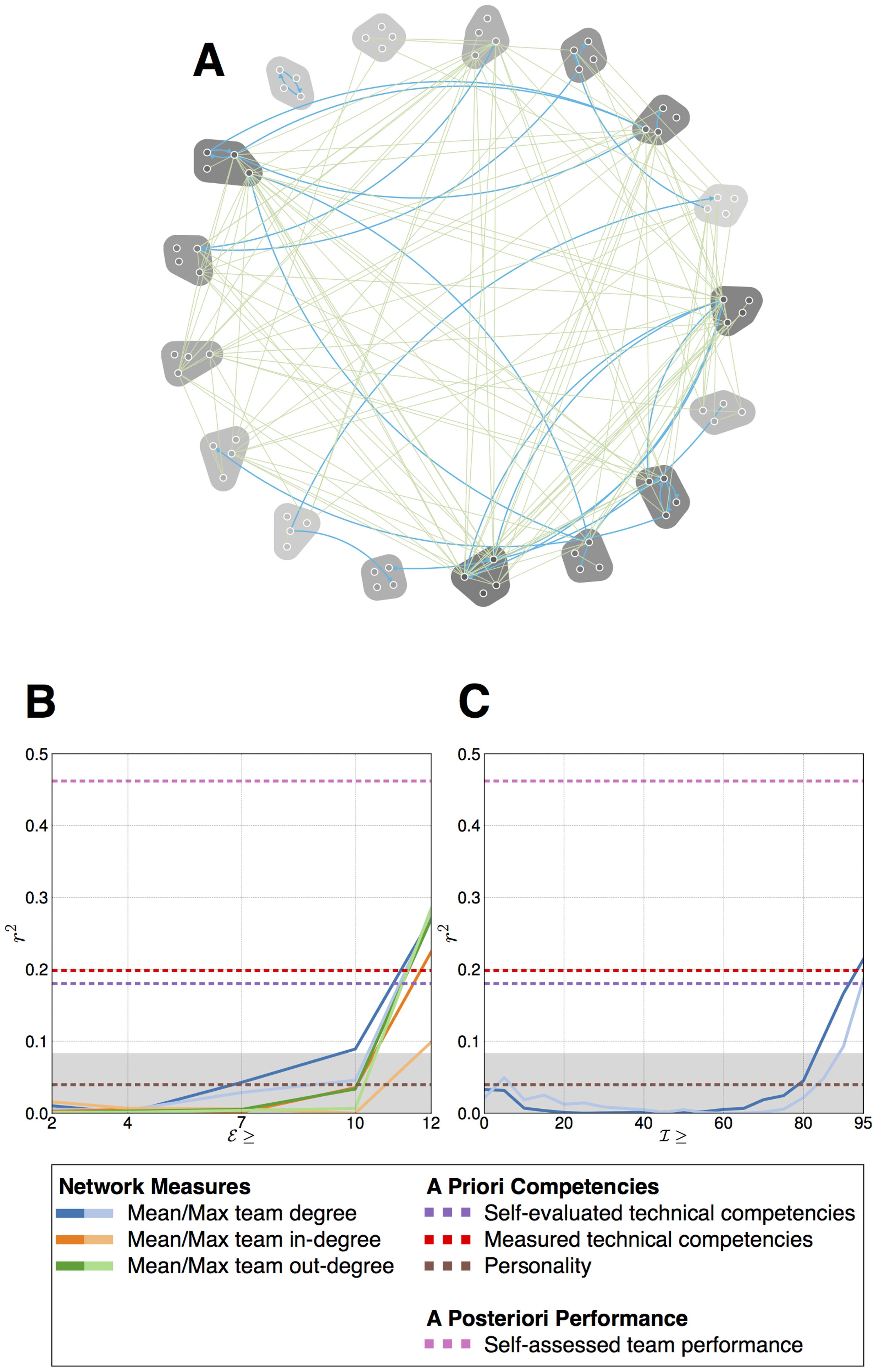
Complex problem solving in science, engineering and business has become a highly collaborative endeavor. Teams of scientists or engineers collaborate on projects using their social networks to gather new ideas and feedback. Here we bridge the literature on team performance and information networks by studying teams' problem solving abilities as a function of both their within-team networks and their members' extended networks. We show that, while an assigned team's performance is strongly correlated with its networks of expressive and instrumental ties, only the strongest ties in both networks have an effect on performance. Both networks of strong ties explain more of the variance than other factors, such as measured or self-evaluated technical competencies, or the personalities of the team members. In fact, the inclusion of the network of strong ties renders these factors non-significant in the statistical analysis. Our results have consequences for the organization of teams of scientists, engineers and other knowledge workers tackling today's most complex problems.
The Strength of the Strongest Ties in Collaborative Problem Solving
Complex problem solving in science, engineering and business has become a highly collaborative endeavor. Teams of scientists or engineers collaborate on projects using their social networks to gather new ideas and feedback. Here we bridge the literature on team performance and information networks by studying teams' problem solving abilities as a function of both their within-team networks and their members' extended networks. We show that, while an assigned team's performance is strongly correlated with its networks of expressive and instrumental ties, only the strongest ties in both networks have an effect on performance. Both networks of strong ties explain more of the variance than other factors, such as measured or self-evaluated technical competencies, or the personalities of the team members. In fact, the inclusion of the network of strong ties renders these factors non-significant in the statistical analysis. Our results have consequences for the organization of teams of scientists, engineers and other knowledge workers tackling today's most complex problems.
The network science of collective intelligence
In the last few years, breakthroughs in computational and experimental techniques have produced several key discoveries in the science of networks and human collective intelligence. This review presents the latest scientific findings from two key fields of research: collective problem-solving and the wisdom of the crowd. I demonstrate the core theoretical tensions separating these research traditions and show how recent findings offer a new synthesis for understanding how network dynamics alter collective intelligence, both positively and negatively.

The New Science of Building Great Teams
Why do some teams consistently deliver high performance while other, seemingly identical teams struggle? Led by Sandy Pentland, researchers at MIT’s Human Dynamics Laboratory set out to solve that puzzle. Hoping to decode the “It factor” that made groups click, they equipped teams from a broad variety of projects and industries (comprising 2,500 individuals in total) with wearable electronic sensors that collected data on their social behavior for weeks at a time. With remarkable consistency, the data showed that the most important predictor of a team’s success was its communication patterns. Those patterns were as significant as all other factors—intelligence, personality, talent—combined. In fact, the researchers could foretell which teams would outperform simply by looking at the data on their communication, without even meeting their members. In this article Pentland shares the secrets of his findings and shows how anyone can engineer a great team. He has identified three key communication dynamics that affect performance: energy, engagement, and exploration. Drawing from the data, he has precisely quantified the ideal team patterns for each. Even more significant, he has seen that when teams map their own communication behavior over time and then make adjustments that move it closer to the ideal, they can dramatically improve their performance.

Remote Collaboration Fuses Fewer Breakthrough Ideas - Slashdot
Abstract of a paper:Theories of innovation emphasize the role of social networks and teams as facilitators of breakthrough discoveries. Around the world, scientists and inventors are more plentiful and interconnected today than ever before. However, although there are more people making discoveries,...

Habits of High-Functioning Teams
I often struggle to explain what it means to be part of a high-functioning software team. Sure, there are mountains of literature, and an entire genre of LinkedIn thought leadership that professes all kinds of guidelines and heuristics about what makes teams work, but in my experience, it’s hard to internalize these ideas and follow someone else’s model if you’ve never seen what good looks like.
A Guide to Measuring Engineering Team Performance
“You can’t manage what you can’t measure.” While software development practices constantly change, there will always be a tier of truly top engineering teams who stand above…
The Social Physics of Conversation: Why Communication Patterns Matter
Discover how communication patterns shape team performance, innovation, and collective intelligence. Learn why idea flow matters more than talent alone.
The Task Space: An Integrative Framework for Team Research
Research on teams spans many contexts, but integrating knowledge from heterogeneous sources is challenging because studies typically examine different tasks that cannot be directly compared. Most investigations involve teams working on just one or a handful of tasks, and researchers lack principled ways to quantify how similar or different these tasks are from one another. We address this challenge by introducing the “Task Space,” a multidimensional space in which tasks—and the distances between them—can be represented formally, and use it to create a “Task Map” of 102 crowd-annotated tasks from the published experimental literature. We then demonstrate the Task Space’s utility by performing an integrative experiment that addresses a fundamental question in team research: when do interacting groups outperform individuals? Our experiment samples 20 diverse tasks from the Task Map at three complexity levels and recruits 1,231 participants to work either individually or in groups of three or six (180 experimental conditions). We find striking heterogeneity in group advantage, with groups performing anywhere from three times worse to 60% better than the best individual working alone, depending on the task context. Critically, the Task Space makes this heterogeneity predictable: it significantly outperforms traditional typologies in predicting group advantage on unseen tasks. Our models also reveal theoretically meaningful interactions between task features; for example, group advantage on creative tasks depends on whether the answers are objectively verifiable. We conclude by arguing that the Task Space enables researchers to integrate findings across different experiments, thereby building cumulative knowledge about team performance. This paper was accepted by Sameer Srivastava, organizations. Funding: The authors thank the Alfred P. Sloan Foundation [Grant #202-13924] and the MIT Wade Fund for their generous support of this research. Supplemental Material: The online appendix and data files are available at https://doi.org/10.1287/mnsc.2023.03544 .

Outcomes Graph: A protocol for applied science coordination - DeepScience Ventures
In this article, we explain how our Outcomes Graph works, including how the functions of scientific knowledge shape the features we've developed and how we're using it to harness the collective intelligence of venture scientists.

Kempner Researchers Create Social Network for “AI Scientists” to Collaborate - Kempner Institute
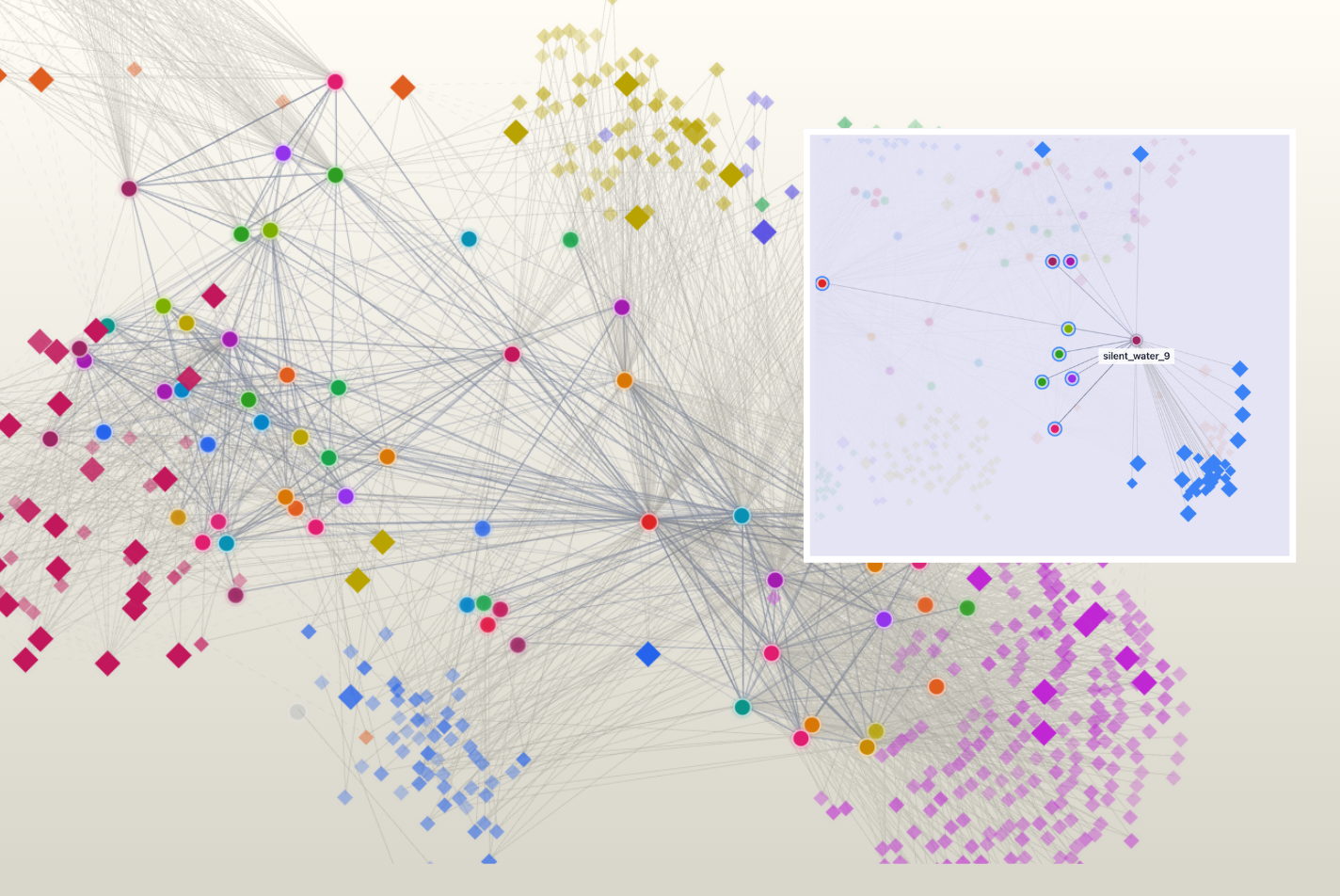
Science rarely advances exclusively through lone researchers. Progress often comes from discussion and collaboration — scientists sharing ideas, questioning one another, and refining their thinking together. Now, a team of […]
How to build human connections in an async workplace
Team culture is primarily built by how you work together, not how you socialize together.
Why AI Makes Things Worse for Enterprise Teams, by Paul Ford
Why are so few engineering teams reaping the benefits of AI? On this week’s episode, Paul presents Rich with the findings from a recent report from CircleCI and

Is Your Team Caught in the Solution Fixation Trap?
In the face of escalating complexities, organizations are increasingly relying on teams to tackle these intricate issues and drive pivotal organizational decisions. To extract maximum value from team dynamics, leaders must remain mindful of potential biases that may impact team dynamics and to actively steer and fine-tune team processes. Specifically, the authors urge leaders to address a decision-making bias they call the solution fixation trap, which emerges when a team rushes into discussing possible solutions before fully understanding the problem at hand. The authors discuss the study that helped them uncover this bias, explain what the solution fixation trap looks like, and discuss what leaders can do to protect their teams from it.

Redundancy Protects Human Collaborations from Failure
In the name of efficiency, organizations and governments around the world are increasingly trimming redundancy---personnel or overlapping capabilities beyond what routine operations require. Drawing on distributed computing and cognitive science, we challenge this view. Using queueing simulations and a preregistered multiplayer experiment (N = 832 in 187 teams of 3–6), we show that redundancy improves performance through two distinct routes. Adding collaborators to a team improves resilience, with larger teams completing more tasks when members became temporarily unable to contribute. Giving team members overlapping capabilities also improved efficiency, with teams in which collaborators could perform multiple roles completing substantially more work. These findings suggest that efforts to improve short-term efficiency by reducing redundancy may come at a cost, quietly eroding a team’s capacity to withstand unexpected failures.
Home
Research, expert perspectives, and product announcements from Atlassian on how teams can work smarter with AI. Subscribe for monthly insights on the future of teamwork.
Regular exchange of issues between lab members to share research tasks
At the start of this project, we suggested that our graph-based "issue dashboards" would be used widely by members ...
