


Today I learned of the passing of a great physicist, friend and colleague, Michel Baranger. Professor in the MIT physics department, Michel was a student of the great physicists Hans Bethe and Richard Feynman and an important contributor to theoretical nuclear physics and quantum chaos. Michel was also a modest person and a pleasure to interact with. Our association began when he attended as a student my first course on complex systems at Boston University in the early 1990s. He honored me by calling me his teacher. He was a founding member of the NECSI board of directors serving long after he moved in retirement to Arizona. With his postdoc, long since a professor, Marcus d’Aguiar, we worked together on fundamental ideas about complex systems as well as applications to evolutionary biology. Michel's engagement with research was ever a process of building a deep understanding, focusing on key ideas, and the way we can frame them mathematically. I would pick out two papers of his to mention. The first provides a mind broadening perspective on how chaos revolutionizes traditional physics thinking, the second shows how we can use chaos to understand a key paradox of traditional physics, the way systems go toward equilibrium. Despite ill health in recent years he continued to visit us in Boston and engage in research, some of which will never be completed. We will miss him.
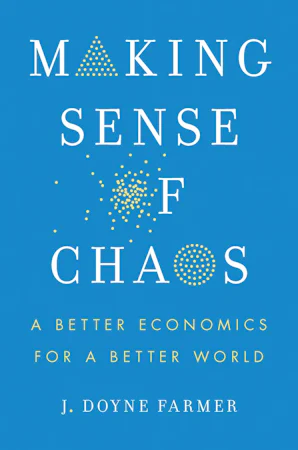
Making Sense of Chaos
From a pioneer in the field of complexity science and chaos theory, a plan for solving the world’s most pressing problems “Farmer convincingly argues t...
Weirding Diary: 9
I'm noticing a resurgence of interest in classical systems theory that mildly worries me. I suspect it is being driven by an infectious desire to theorize the…

These scientists created jewelry out of the striking shapes of chaos theory
Not just inspired by chaos theory, but directly created from its mathematical principles.

Complexity Explorables
A collection of interactive explorable explanations of complex systems in biology, physics, mathematics, social sciences, epidemiology, ecology and other fields....
Review: ‘Chaos Monkeys’ Is a Guide to the Spirit of Silicon Valley (Published 2016)
Underneath the braggadocio and evisceration of professional nemeses in Antonio García Martinez’s book lies the beating heart of a formidable teacher.

Stephen J. Dubner
Stephen Joseph Dubner is an American author, journalist, and podcast and radio host. He is co-author of the popular Freakonomics book series: Freakonomics, SuperFreakonomics, Think Like a Freak and When to Rob a Bank. He is the host of Freakonomics Radio.

Jacob Barandes | Quantum Theory as a New Kind of Stochastic Process
Jacob Barandes | Quantum Theory as a New Kind of Stochastic Process

Social Physics: How Good Ideas Spread | Sandy Pentland | Talks at Google
AI Data Centers Will Be Obsolete (Geometric Reasoning Explained)
Will we have a theory for in-the-wild AI agents? - undisciplinary
Thoughts after writing a sociology-meets-physics-meets-agents paper I just put out a preprint out on a theory of role emergence in multi-agent systems (soci…
Theorizing the Human Sciences in the Age of Absolute Disruption: Historical Criticism and Its Remainders | The Journal for Cultural and Religious Theory | JCRT
Adam DJ Brett reads Jason Ānanda Josephson-Storm’s trilogy — The Myth of Disenchantment, Metamodernism, and The Genealogy of Genealogy — as one project asking whether a thing exists, how it arose, what grounds our claims

Social Physics in the Age of Generative AI: How, Exactly, Is Society Complex?
The aspiration for a social physics — a science that would reveal universal laws of social life analogous to those governing the natural world—has haunted the social sciences since Comte. Each new wave of quantitative and computational methods breathes fresh life into this vision. The current moment is no exception: advances in artificial intelligence and large language models have reinvigorated attempts to model society through the methods of social physics. This essay argues that these ambitions rest on a confusion about the nature of social complexity. Drawing a distinction between systems complexity and anthropological complexity, we identify the limitations of analyzing society as a complex system akin to natural systems. One crucial obstacle for social physics is the analysis of meaning and interpretation. Generative artificial intelligence (GenAI) offers important opportunities to model language and reflexivity, inviting and perhaps compelling social physics to confront meaning and interpretation as constitutive features of the social world. At the same time, GenAI leaves untouched and may even aggravate social physics’ failure to grasp power, institutions, and inequality.
math complex systems

papers added probably have a bio connection or implication i made

Quantifying causal emergence shows that macro can beat micro | PNAS