

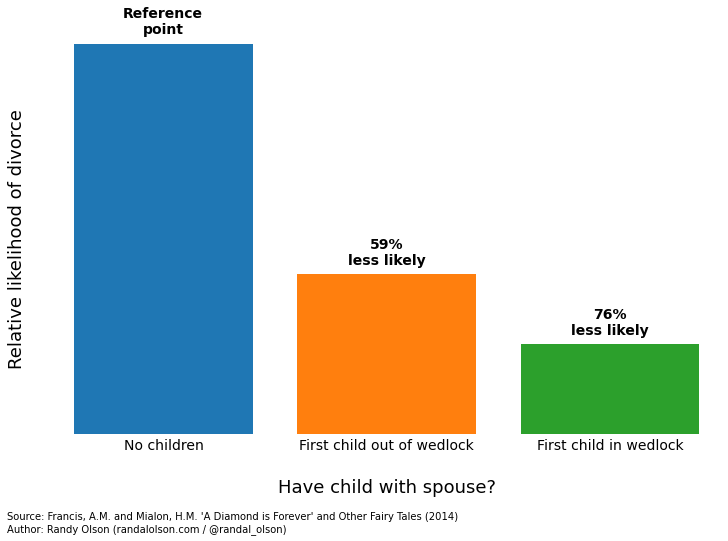
Randy Olson reviews more of a research paper that outlines what makes for a stable marriage in the U.S.
When Sturdy Love Is What You Need (Published 2018)
There is the often facile social media narrative of overcoming adversity in marriage. And then there is the reality.

What You Lose When You Gain a Spouse
What if marriage is not the social good that so many believe and want it to be?

Political divides cut through marriages and families in the run-up to the 2024 election
For many Americans, politics has become far more personal, and divisive, than it once was. Now, in the run-up to the November election, that’s creating some friction within families. Tonight, Judy Woodruff looks at the impact of politics on marriages, dating and families as part of her ongoing series, America at a Crossroads.

The inconvenient truth about love — and divorce
American society has branded marriage as an institution of love, and yet we cling to old-fashioned narratives about divorce. Astro Teller and Danielle Teller argue that this is harmful to individua…

Unhappy Coincidences
marriages of licensing convenience, and changed circumstances

A bad marriage can seriously damage your health, say scientists
Psychologists monitored 373 couples over 16 years and found that couples who continuously disagree have poorer health

If you're in a bad marriage, don't try to mend it – end it | Nichi Hodgson
Research shows the impact of unhappy marriages on health. Sometimes it’s better to walk away than to stay, says relationships writer and broadcaster Nichi Hodgson

I'm a psychologist who studies couples: People in the happiest relationships have 5 things in common with their partner
Opposites may attract, but similarities are usually what determine if a relationship can stand the test of time, says Mark Travers, a psychologist who studies couples. Here's what the happiest couples share in common with their partner.

Beyond Equality—Non-Monogamy and the Necropolitics of Marriage
‘Marriage equality’ has been a widely used slogan and mobilizing concept for LGBTQ+ rights’ movements across the globe striving for formal recognition for ‘same-sex’ or ‘same-gender’ marriages. In this article, we critically interrogate the terminology and political rationality that have given shape to ‘marriage equality’ campaigns. We demonstrate the structural erasure of non-monogamous relations and populations from the changes hoped for and envisioned in these mobilizations. The lack of any genuine and substantial concern with consensual non-monogamies (CNMs) from most of the literature in the field highlights the close entanglement of marriage with monogamy. As a result, ideas are scarce about how meaningful and adequate legal recognition and social policy provisions for a wide range of intimate, sexual, familial, and/or caring bonds or constellations on the CNM continuum could look like. We argue that the critique of the mononormativity inherent to marriage is fundamental to understanding the role of this in the 21st century. We identify the roots of the mononormativity of marriage in its governmental role as a necropolitical and biopolitical technology, evidenced by its ‘civilizing’ function in white settler colonial projects. Because of this, an expansion of the call for equality to include non-monogamous populations does not resolve but rather aggravates the problem. We conclude that any truly queer politics of CNM consequently needs to be anti-marriage.
The World Files for Economic Divorce from America
What you do when your (trading) partner is abusive

Relationship Design
Peter McGraw sits with Jessalyn Dean to discuss relationship design. Tune in as they challenge societal norms and craft connections beyond convention.
Intra-Household Frictions, Anchoring, and the Credit Card Debt Puzzle
Abstract I study how intra-household frictions and anchoring contribute to the credit card debt puzzle, the co-holding of high-cost debt, and low-yield liquid assets. First, I find couples co-hold 42% more as units than as individuals relative to income. Moreover, in a natural experiment, couples do not cooperate to reduce high-cost debt, suggesting that intra-household frictions contribute to co-holding. Second, I find individuals who regularly make credit card debt payments equal to or near the minimum account for 59% of individual co-holding. The evidence suggests anchoring to the minimum payment contributes to co-holding via these low payments.
Locating Family Values: A Field Trial of the Whereabouts Clock: (Nominated for the Best Paper Award)
The short instructional manifesto for relationship anarchy
Andie Nordgren The short instructional manifesto for relationship anarchy 2006


Relationship Anarchy - LGBTQIA+ Wiki
Relationship Anarchy (abbreviated RA) is the belief that relationships should not be bound by set rules, aside from the rules the individuals involved mutually agree...
