


The high distrust in political institutions and a growing sense of powerlessness among many citizens suggest that prevailing democratic governance systems lack a capability for collective dialogue ...
Binding Chaos: Mass Collaboration on a Global Scale
The world is long overdue for a completely new system of governance. If there was ever a need for political representation or a paternalistic and opaque authority, it has been removed by technology. Every political system we have tried has proven incapable of protecting human rights and dignity. Every political system we have tried has devolved into oligarchy. To effect the change we require immediately, to give individuals control and responsibility, to bring regional systems under regional governance, allow global collaboration and protect the heritage of future generations, we need a new political model.
Laboratories against Democracy
As national political fights are waged at the state level, democracy itself pays the price

Consensus Democracy | The Paper Pilot
The Paper Pilot's digital garden of thoughts on philosophy, politics, and sociology
Digital Democracy in Decentralised Autonomous Organisations
Decentralised autonomous organisations (DAOs) are institutional technologies that enable democratic governance innovation. They inherit key democratic principles such as procedural transparency and immutable records from being based on blockchain technology. This paper conducts a systematic literature review to examine governance mechanisms and challenges of digital democracy in DAOs. While issues like power concentration and coordination failures exist in current implementations, we argue that the concept of DAOs offers new opportunities for transparent governance and participatory decision-making. As testbeds for governance experiments, we find that DAOs have the potential to reshape democratic processes and foster innovative governance models in the digital era. Calling for interdisciplinary collaboration, further research is needed around Sybil-resistant voting mechanisms, ideological path dependencies and deliberation mechanisms.

Liquid Democracy: True Democracy for the 21st Century
Liquid Democracy, a subset of Delegative Democracy, is a powerful voting model for collective decision making in large communities. Liquid…
New Project to Tackle the Challenge of Scaling Democratic Innovations | CoP CC on Participatory and Deliberative Democracy
The “Missing Link” between Research and Society
Think Like a Commoner | A Short Introduction to the Life of the Commons
In our age of predatory markets and make-believe democracy, our troubled political institutions have lost sight of real people and practical realities. But if you look to the edges, ordinary people are reinventing governance and provisioning on their own terms. The commons is arising as a serious, practical alternative to the corrupt Market/State.
Democracy and the Epistemic Commons
The Consilience Project is a publication of the Civilization Research Institute (CRI)

Paper | SDC
Strengthening American democracy through collaboration, cooperation, and crowdsourcing.
Scoping report: Future challenges to democracy | CoP CC on Participatory and Deliberative Democracy
The report from the European Commission identifies 10 key challenges and emerging trends impacting European democratic systems and suggests future policy options. These challenges are structured across three interconnected levels: citizens and societal dynamics, the information and knowledge environment, and institutions and the democratic system. This framework aims to provide a comprehensive and integrated view of democracy as a connected ecosystem, emphasising how challenges in one area can affect the entire system.
Democracy as a Scaled Collective Intelligence Process: Points of Vulnerability and Augmentation
As part of the Digital Library's transition to Open Access, new features for researchers are available in the Premium Edition. Click here to learn more.

First steps | Decidim
Decidim is a digital platform fordemocratic participation andcommunity governance
Can Politicians Bargain with Business?: A Theoretical and Comparative Perspective on Urban Development
These authors examine the capability of local government to influence economic development by formulating a framework that treats state-business relations as a bargaining process. This framework suggests that governmental influence is tied to the distribution of bargaining advantages along three dimensions of a liberal-democratic political economy: market conditions, popular-control systems, and public-intervention mechanisms. The authors offer an explanation of how characteristics of these dimensions strengthen or weaken city governments in dealing with private enterprise; experiences of U.S. and Western European cities are drawn upon to illustrate this. They conclude that differences in bargaining resources accounts for wide variation in local political control of business development.

Why Online Democracies Fail - Eclectic Corvine Muses
A compendium to my upcoming proposal for community infrastructure within the AT Protocol
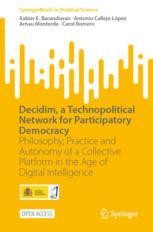
Decidim, a Technopolitical Network for Participatory Democracy
This Open Access book explains the philosophy, design principles, and community organization of Decidim and provides essential insights into the platform.
Democracy is an epistemic discipline, it only works if truth can constrain power. Without a faster, more transparent architecture for shared reality, the arc of democracy bends away from substance, through simulation, and toward authoritarianism. Without major action, it's the inevitable end state.
