How to make friends and influence people on the other side of the aisle.
7 Habits That Make People Seem Less Intelligent
It's surprisingly easy to do things that make you look unintelligent in public. Here's a list of the most common mistakes...and how to avoid them.
How social norms emerge: The interindividual actor–critic.
Op-Ed: If you want to influence people don't try to persuade them. Use ‘pre-suasion’ instead.
Today and every day we are the targets of salespeople, marketers, advertisers, fundraisers and (heaven knows) politicians trying to persuade us to buy something, do something or think a certain way.

The Emergence of Social Norms and Conventions
The utility of our actions frequently depends upon the beliefs and behavior of other agents. Thankfully, through experience, we learn norms and conventions that provide stable expectations for navigating our social world. Here, we review several distinct influences on their content and distribution. At the level of individuals locally interacting in dyads, success depends on rapidly adapting pre-existing norms to the local context. Hence, norms are shaped by complex cognitive processes involved in learning and social reasoning.

Solitude and Leadership - The American Scholar
If you want others to follow, learn to be alone with your thoughts

Undersociality: miscalibrated social cognition can inhibit social connection
A person’s well-being depends heavily on forming and maintaining positive relationships, but people can be reluctant to connect in ways that would create or strengthen relationships. Emerging research suggests that miscalibrated social cognition may create psychological barriers to connecting with others more often. Specifically, people may underestimate how positively others will respond to their own sociality across a variety of social actions, including engaging in conversation, expressing appreciation, and performing acts of kindness.



Concentric Groups, Knowledge Bridges and Epistemic Communities
vs Elitism, Celebrity and Oligarchy This article is part of a series: ‘Stigmergy: Systems of Mass Collaboration’. Note: Concentric circles relate to sound amplification – the voic…

The Science of Making Friends
Starting in early adulthood, our number of friends starts to decrease steadily; there are ways to reverse the tide, writes Elizabeth Bernstein.

Want to Instantly Become a Better Leader? Science Says 3 Simple Habits Will Make You More Influential and Charismatic
Simple things you can immediately start doing, without changing your leadership style. (Or yourself.)

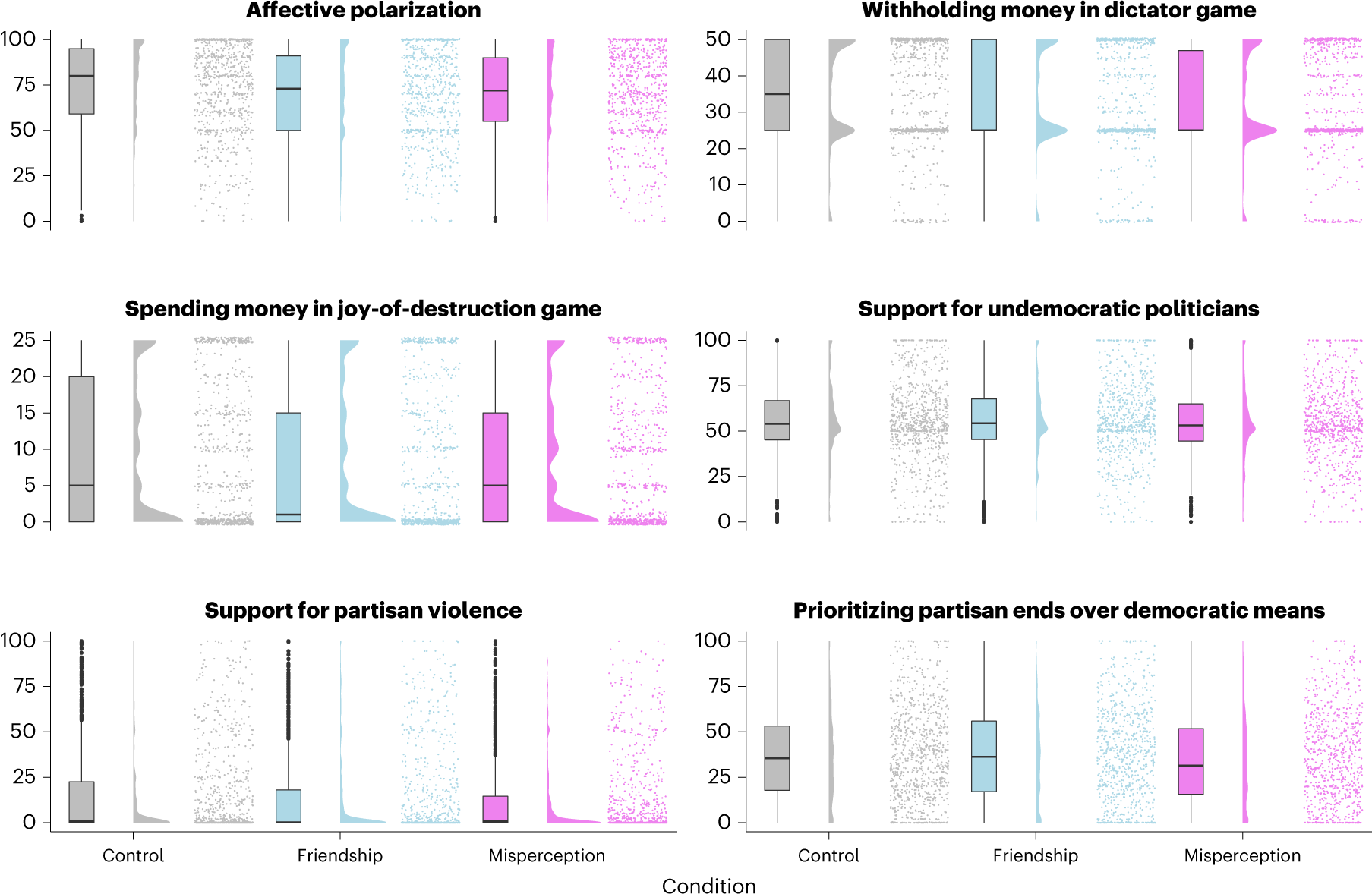
Interventions reducing affective polarization do not necessarily improve anti-democratic attitudes
There is widespread concern that rising affective polarization—particularly dislike for outpartisans—exacerbates Americans’ anti-democratic attitudes. Accordingly, scholars and practitioners alike have invested great effort in developing depolarization interventions that reduce affective polarization. Critically, however, it remains unclear whether these interventions reduce anti-democratic attitudes, or only change sentiments towards outpartisans. Here we address this question with experimental tests (total n = 8,385) of three previously established depolarization interventions: correcting misperceptions of outpartisans, priming inter-partisan friendships and observing warm cross-partisan interactions between political leaders. While these depolarization interventions reliably reduced affective polarization, we do not find compelling evidence that these interventions reduced support for undemocratic candidates, support for partisan violence or prioritizing partisan ends over democratic means. Thus, future efforts to strengthen pro-democratic attitudes may do better if they target these outcomes directly. More broadly, these findings call into question the previously assumed causal effect of affective polarization on anti-democratic attitudes.
Misperceptions About Others
Perceptions about others play an important role in shaping people's attitudes and behaviors, as well as social norms more broadly. This review presents a meta-analysis of the recent empirical literature that examines perceptions about others in the field, covering over a million observations for a total of 434 elicited perceptions. We document a number of stylized facts. Misperceptions about others are widespread, asymmetric, much larger when about out-group members, and positively associated with one's own attitudes. Experimental treatments to recalibrate misperceptions generally work as intended; they sometimes lead to meaningful changes in behaviors, though this often occurs only immediately after the treatments. We discuss different conceptual frameworks that could explain the origin, persistence, and rigidity of misperceptions about others. We point to several directions for future research.

Misplaced Divides? Discussing Political Disagreement With Strangers Can Be Unexpectedly Positive
Differences of opinion between people are common in everyday life, but discussing those differences openly in conversation may be unnecessarily rare. We report three experiments ( N = 1,264 U.S.-based adults) demonstrating that people’s interest in discussing important but potentially divisive topics is guided by their expectations about how positively the conversation will unfold, leaving them more interested in having a conversation with someone who agrees versus disagrees with them. People’s expectations about their conversations, however, were systematically miscalibrated such that people underestimated how positive these conversations would be—especially in cases of disagreement. Miscalibrated expectations stemmed from underestimating the degree of common ground that would emerge in conversation and from failing to appreciate the power of social forces in conversation that create social connection. Misunderstanding the outcomes of conversation could lead people to avoid discussing disagreements more often, creating a misplaced barrier to learning, social connection, free inquiry, and free expression.

Impact, agency, and taste
understand + work backwards from the root goal • don’t rely too much on permission or encouragement • make success inevitable • find your angle • think real hard • reflect on your thinking
Stop Passive-Aggressive Behavior and Strengthen Relationships With This 6-Word Phrase
To stop passive aggression—in yourself or others—remember these words.