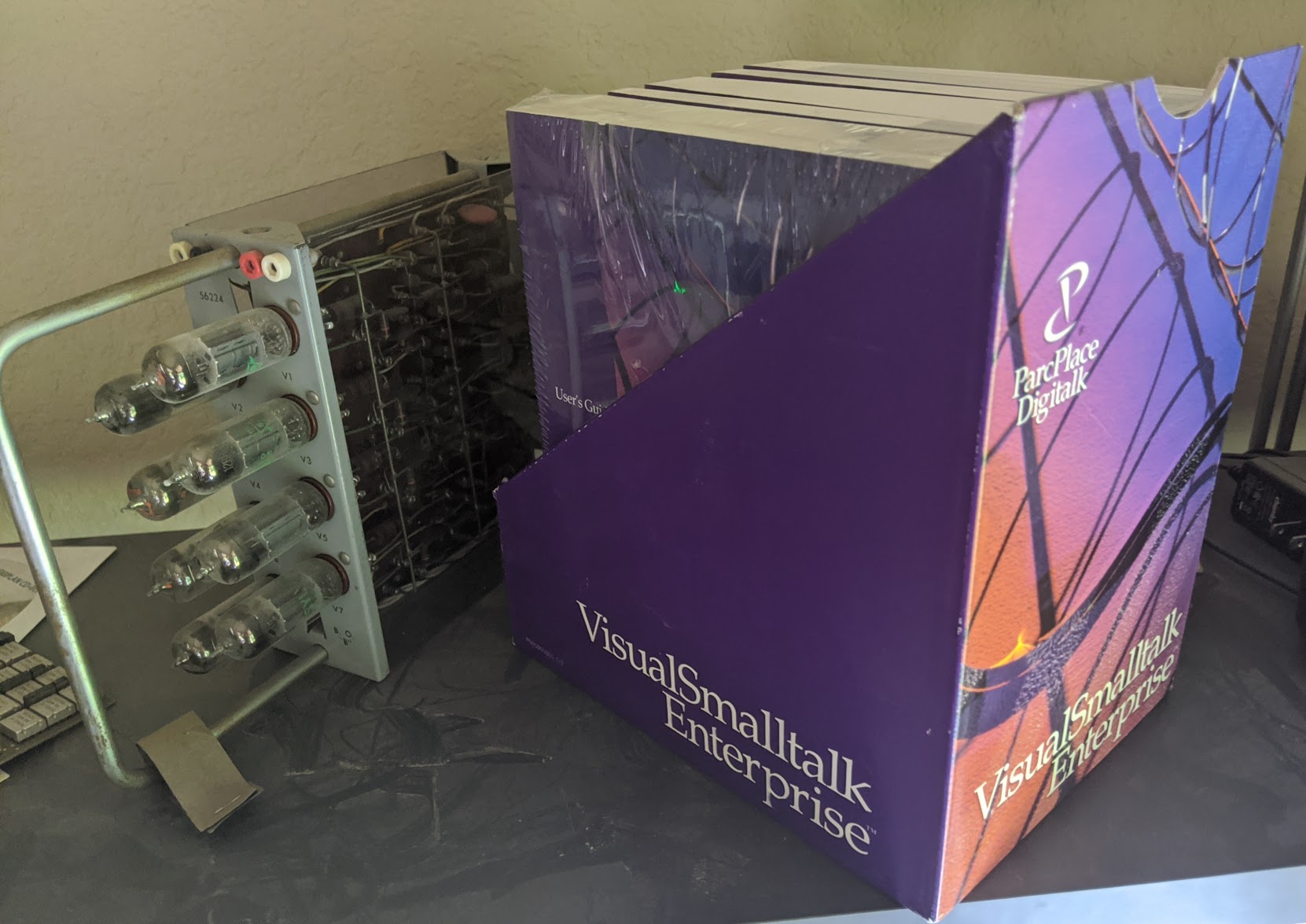
Relics Gilad Bracha recently posted an article "Bits of History, Words of Advice" that talks about the incredible influence of Smalltalk but bemoans the fact that: ...today Smalltalk is relegated to a small niche of true believers. Whenever two or more Smalltalkers gather over d
Travels With Smalltalk
Reprinted from Celebrating 25 Years of Smalltalk, SIGS Publications.
26 - Gilad Bracha - Utopia And Dystopia: Smalltalk And The Wider World
Smalltalk
Smalltalk is a purely object-oriented programming language that was originally created in the 1970s for educational use, specifically for constructionist learning, but later found use in business. It was created at Xerox PARC by Learning Research Group (LRG) scientists, including Alan Kay, Dan Ingalls, Adele Goldberg, Ted Kaehler, Diana Merry, and Scott Wallace.

Small talk acts like social glue – here’s how to get better at it
Maybe think of small talk as a technology: a human invention for accomplishing social goals.

Unorthodocs: Abandon your DVCS and Return to Sanity - bitquabit
I’ve pretty much always been a DVCS apologist. I know quite a few people who’ve been using DVCSes since Mercurial and Git, and a few who go back to BitKeeper, but I can totally out-hipster you. I was there for Monotone. I actually remember struggling to grok tla, and being happy that someone took the time to write baz. I remember the promise and the failure that was Darcs. I remember thinking that even Darcs was comically primitive, because it was nothing but a poor imitation of Smalltalk DVCSes like Monticello, themselves mere iterative improvements on classic Smalltalk changesets.[1]
The Early History Of Smalltalk
Permission to copy without fee all or part of this material is granted provided that the copies are not made or distributed for direct commercial advantage, the ACM copyright notice and the title of the publication and its date appear, and notice is given that copying is by permission of the Association for Computing Machinery. To copy otherwise, or to republish, requires a fee and/or specific permission. HOPL-II/4/93/MA, USA © 1993 ACM 0-89791-571-2/93/0004/0069...$1.50
Researchers say we’re talking less than ever
It’s not just small talk, it’s all talk that’s dying.

The AT Protocol's interesting design - LittleBit
Bluesky's backend was made to be more than a social network
The year we wanted the internet to be smaller
Why tiny, weird online communities made a comeback in 2017

The Rise of the Silicon Valley Small Business
What you need to know about the next big startup archetype
The Shrinking RSS Pie
This piece was initially published on Medium. I’m resharing here, for when Medium will go away… We all know that RSS and openness are key to the web’s resilience and independence, yet the RSS ecosystem is still shrinking. It’s because of us…
The rise (and future fall) of Discord
I want to talk about Discord. Not about all the issues like privacy, accessibility, performance. No, the good things. The part where it completely revolutionized the internet. And how it will destroy it all.
Building Communities That Think
Social media and instant messaging fundamentally changed how we talk to each other. The paragraph has ceded power to fast moving and ephemeral chat that inevitably leans toward the shallow and reactive.
ChatBots Explained: Not Conscious, No Revolution — Just Searching's Next Step
The Melancholy of Subculture Society
Internet links small groups, helping dissolve big groups; good, bad? But a bit sad.