


Freewheeling economist Glen Weyl is on a warpath to reform liberal democratic institutions in order to save them.
Technically Radical
They're so thoroughly hypnotized by the short-term victory of global capitalism that they can't surf the new paradigm, look to the longer term. – Charles Stross, Accelerando One obvious role for a radical intellectual is to do precisely that: look at those who are creating viable alternatives, try to figure out what might be the larger implications of what they are (already) doing, and then offer those ideas back [to the world], not as prescriptions, but as contributions, possibilities—as gifts. – David Graeber, Fragments of an Anarchist Anthropology Over 2024, we saw major tech investors and company owners overtly turn toward the right, overtly backing Donald Trump in his electoral campaign....
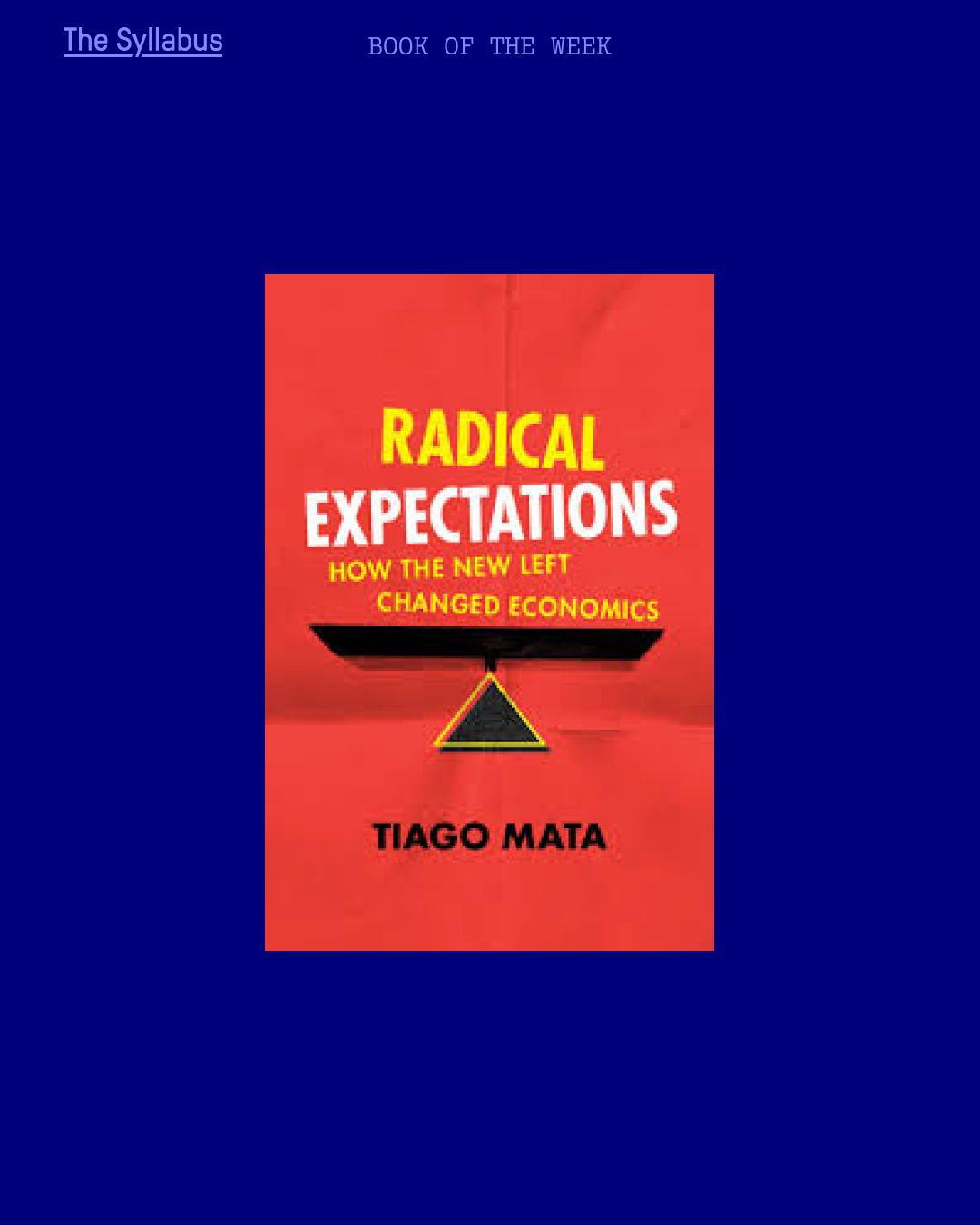
Radical expectations: how the New Left changed economics
In the 1970s radical economists campaigned to reform their discipline and their universities. They became journalists and activists, moving beyond academia, to forge new models of public engagement and collaborative knowledge in economic life. Radical Expectations tells the story of how these economists set out to make economics more democratic. It traces their campaign to bring protest movements to the campuses, triggering the emergence of an alternative understanding of expertise directed at validating and empowering the perspectives and voices of women, Black Americans, labor activists, and the urban poor. It shows how a radical identity formed and how radicals helped reform disciplinary institutions. Furthermore, it argues that the radical economics' legacy was the development of a language and models of expert-lay collaboration that empowers direct action in economic affairs. The book is about the community of radical economists who championed the promise of change and what came of it

Capitalism, Democracy, and Du Bois’s <em>Two</em> Proletariats
[epq-quote align="align-right"]"What can be more radical or liberating than freedom and justice for all?"[/epq-quote] As an ideal, liberal democracy has great appeal. What can be more radical or liberating than...

Work, Justice, and Collective Capital Institutions: Revisiting Rudolf Meidner and the Case for <span style="font-variant:small-caps;">Wage‐Earner</span> Funds
ABSTRACT This article makes the case for a specific variety of what we call Collective Capital Institutions (CCIs), by returning to the idea of Wage‐Earner Funds (WEFs) – a 1970s Swedish policy proposal designed gradually to shift ownership and control over parts of the economy to democratically controlled institutions. We identify two attractive rationales in favour of such a scheme and argue that both can fruitfully be transposed to the current worldwide economic situation. The egalitarian rationale is that WEFs could help in the pursuit of equality by giving a wider set of people a stake in collectively owned companies and a right to their profits. The democratic rationale is that WEFs redistribute not only these profits, but also the power over economic decisions made within companies. We then contrast such schemes for collective capital ownership with the similar but much more privatised proposals set out in, for instance, John Rawls's idea of a ‘property‐owning democracy’. We argue that CCIs ultimately are more likely to contribute to the development of the ‘sense of justice’ within society that is needed for a stable just society. We conclude that CCIs deserve a great deal more exploration in academic and political discussions of egalitarian economic systems.

Hope in Common
We seem to have reached an impasse. Capitalism as we know it appears to be coming apart. But as financial institutions stagger and crumble, there is no obvious alternative. Organized resistance appears scattered and incoherent; the global justice movement a shadow of its former self. There is good reason to believe that, in a generation […]

The Syllabus on Twitter / X
In the 1970s, radical economists left the university to work as activists. From the Union for Radical Political Economics to economic affairs bulletins, our book of the week investigates how the New Left changed economics.By Tiago Mata on @CambridgeUPhttps://t.co/aQQi9nqd0C pic.twitter.com/FM1A9nK5vN— The Syllabus (@syllabus_tweets) September 1, 2026
Radical markets: uprooting capitalism and democracy for a just society
Many blame today's economic inequality, stagnation, and political instability on the free market. The solution is to rein in the market, right? Radical Markets turns this thinking on its head. With a new foreword by Ethereum creator Vitalik Buterin and virtual reality pioneer Jaron Lanier as well as a new afterword by Eric Posner and Glen Weyl, this provocative book reveals bold new ways to organize markets for the good of everyone. It shows how the emancipatory force of genuinely open, free, and competitive markets can reawaken the dormant nineteenth-century spirit of liberal reform and lead to greater equality, prosperity, and cooperation. Only by radically expanding the scope of markets can we reduce inequality, restore robust economic growth, and resolve political conflicts. But to do that, we must replace our most sacred institutions with truly free and open competition Radical Markets shows how

Radical Interoperability is a Political Agenda
Model the world you want to live in.
The Authoritarian Stack
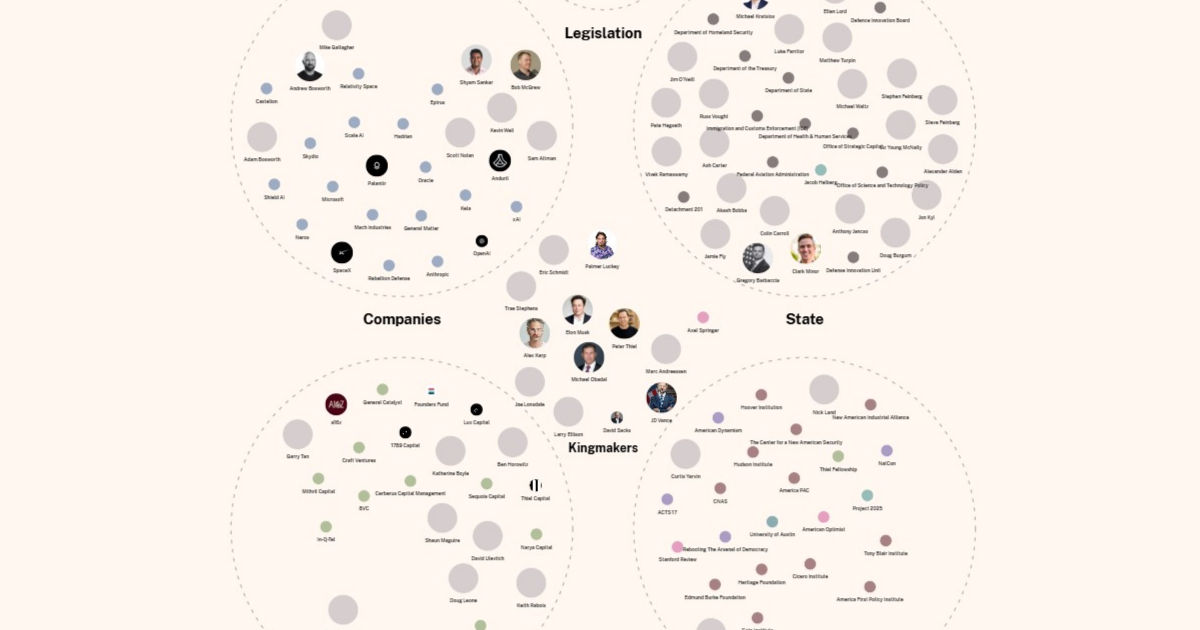
How Tech Billionaires Are Building a Post-Democratic America — And Why Europe Is Next
The Authoritarian Stack
How Tech Billionaires Are Building a Post-Democratic America — And Why Europe Is Next
AnarchyValues Results
Ideological matching is a work in progress, and is much less accurate than the values and axes.
How AI Destroys Institutions
Civic institutions—the rule of law, universities, and a free press—are the backbone of democratic life. They are the mechanisms through which complex societies encourage cooperation and stability, while also adapting to changing circumstances. The real superpower of institutions is their ability to evolve and adapt within a hierarchy
Power: A Primer for Perplexed Economists
Let's Assume an Unfettered Marketplace of Ideas! Or Actually, Let's Not.

Decentralisation as a shifting mental framework
Programming note: every week I send out an email newsletter. It contains all the articles I published that week, as well as an additional essay that has been not been published elsewhere yet. This is a republication of last week’s essay I send out. If you’re interested, subscribe below to get all the updates directly […]

It can also be argued that authoritarianism is just politically superior at administering a political economy of broken promises and stagnating or falling standards of living. hup.harvard.edu/books/9780674976788

The Triumph of Broken Promises — Harvard University Press
www.hup.harvard.edu