

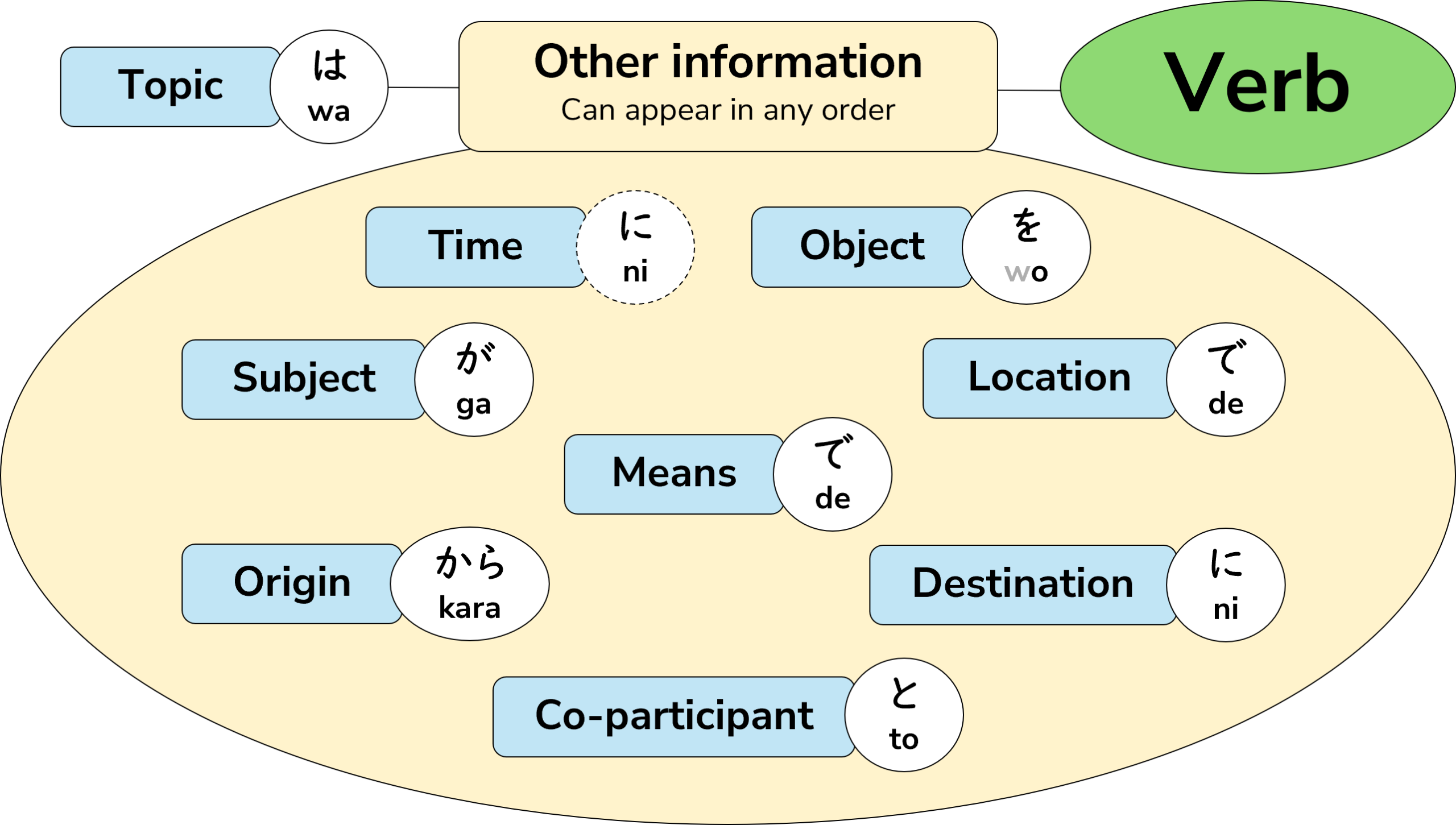
Finally make sense of Japanese grammar Master Japanese grammar through visual explanations that show you why the language works the way it does, so you can build your own sentences with confidence, not just memorize phrases. “ Your course is AMAZING! It’s a lifesaver to having me communicate properly with my coworkers and getting around […]
Introduction – Learn Japanese
This guide was created as a resource for those who want to learn Japanese grammar in a rational, intuitive way that makes sense in Japanese. The explanations are focused on how to make sense of the grammar not from English but from a Japanese point of view.
Why You Should Keep Listening Even If You Don’t Understand | AJATT | All Japanese All The Time
Like I’ve said before…the set of tools/methods described on this site…I don’t know why it all works; looking at and thinking about how people learn their native language, it just all seemed obvious to me. In other words, I knew what I needed to do to achieve fluency…but not much more.
How linguistics learned to stop worrying and love the language models
Language models (LMs) can produce fluent, grammatical text. Nonetheless, some maintain that language models don’t really learn language and also, even if they did, that would not be informative for the study of human learning and processing. On the other side, there have been claims that the success of LMs obviates the need for studying linguistic theory and structure. We argue that both extremes are wrong. LMs can contribute to fundamental questions about linguistic structure, language processing, and learning. They force us to rethink arguments and ways of thinking that have been foundational in linguistics. While they do not replace linguistic structure and theory, they serve as model systems and working proofs of concept for gradient, usage-based approaches to language. We offer an optimistic take on the relationship between language models and linguistics.

Japanese writing system basics
Explains how the Japanese writing system works by comparing it to expanding the English alphabet.

machines will never understand language
I thought language was too complicated for machines to understand, until I got sick. a lifelong, meandering journey of parsing, learning, and fixing my broken body.
Stephen Krashen: Language Acquisition and Comprehensible Input
Designing a Language by Asking the Language Models — using an LLM panel as a syntax usability lab (from the kaish project)
Designing a Language by Asking the Language Models — using an LLM panel as a syntax usability lab (from the kaish project) · GitHub
AI for Me, Not (Yet) for Thee? Desirable Difficulties and Deliberate Friction with LLMs
In December 2025, I was grading final projects for my course on data visualization with R. On one of my screens, I had a browser open to my university’s learning management system and came across a now-familiar phenomenon: a student had used verbatim ChatGPT output for their assignment. The code they included was flawless, but used function arguments and code syntax that we never covered in class and that weren’t actually necessary. More concerning, the original chat prompt was inadvertently still included, along with fill-in-the-blank sections that the large language model (LLM) had included to help tailor the response to the course (e.g. “[insert an example from your professor’s class here]”). Following my course’s AI policy, I gave a sizable point reduction, sighed heavily, and moved on to the next assignment.
How I use LLMs to learn complex topics · Laurentiu Raducu
LLMs are used for any things. Learning new things is one of the top use cases.
Automated Sentence Generation for a Spaced Repetition Software
This paper presents and tests AllAI, an app that utilizes state-of-the-art NLP technology to assist second language acquisition through a novel method of sentence-based spaced repetition. Diverging from current single word or fixed sentence repetition, AllAI dynamically combines words due for repetition into sentences, enabling learning words in context while scheduling them independently. This research explores various suitable NLP paradigms and finds a few-shot prompting approach and retrieval of existing sentences from a corpus to yield the best correctness and scheduling accuracy. Subsequently, it evaluates these methods on 26 learners of Danish, finding a four-fold increase in the speed at which new words are learned, compared to conventional spaced repetition. Users of the retrieval method also reported significantly higher enjoyment, hinting at a higher user engagement.
Methodologies for Improving the Quality of AI Tutoring in K-12 Education
Many AI tutors leverage large language models (LLMs) today. Given that LLMs are opaque black boxes, robust evaluation and live experimentation to measure the impact of every change are essential. We pioneered AI-powered tutoring for K-12 with the launch of Khanmigo (Khan Academy 2023). We describe the metrics we use to measure AI tutoring quality and student engagement as well as various experiments we have run. We highlight the changes that have moved our metrics, including models, prompting, personalization and agents.

How to keep learning in the age of LLMs | Oğuzhan Olguncu
Notes on how I keep learning as a programmer in the age of LLMs
Learning to Learn: You, Too, Can Rewire Your Brain (Published 2017)
How an engineering professor who “flunked my way” through high school math and science went on to create the world’s most popular online course.

Do LLMs write like humans? Variation in grammatical and rhetorical styles
As large language models (LLMs) have grown in power and become more widely available, research has focused on their ability to complete various tasks and the biases they exhibit when doing so. In this study, we instead examine their writing style in detail. We show that instruction-tuned models, which are trained to answer questions and solve problems, have a distinct noun-heavy, informationally dense writing style, even when prompted to match the style of informal speech and writing. These findings suggest that instruction-tuned models generate text that does not align with genre conventions familiar to human audiences, and demonstrate the value of linguistic variables in evaluating the output of LLMs., Large language models (LLMs) are capable of writing grammatical text that follows instructions, answers questions, and solves problems. As they have advanced, it has become difficult to distinguish their output from human-written text. While past research has found some differences in features such as word choice and punctuation and developed classifiers to detect LLM output, none has studied the rhetorical styles of LLMs. Using several variants of Llama 3 and GPT-4o, we construct two parallel corpora of human- and LLM-written texts from common prompts. Using Douglas Biber’s set of lexical, grammatical, and rhetorical features, we identify systematic differences between LLMs and humans and between different LLMs. These differences persist when moving from smaller models to larger ones and are larger for instruction-tuned models than base models. This observation of differences demonstrates that despite their advanced abilities, LLMs struggle to match human stylistic variation. Attention to more advanced linguistic features can hence detect patterns in their behavior not previously recognized.

AI’s Memorization Crisis
Large language models don’t “learn”—they copy. And that could change everything for the tech industry.

I'm creating a series of short form videos about how language models work technically. The goal is to be something in between "you know it's next token prediction" and "now you've taken a machine learning class." I'd love your thoughts so here are the first few! 🧵 youtube.com/shorts/VZB8XCcyllE

How does ChatGPT work? Or rather, language models in general- Part 1 attempting a lay explanation.
www.youtube.com