What happens when the personal knowledge graph ends up in the wrong hands. A breach hands you records; this store hands you conclusions (who your family are, who you are closest to, with a confidence beside each). How can it be weaponized, and what's the blast radius? Here is a worst-case thought experiment.
Anatomy of Apple's Personal Knowledge Graph — Eighth Rank
Every Mac since macOS 13 (2022) ships a pair of daemons whose only purpose in life is to build a graph about who you are, who you know, how those people are related to you and to each other, how you communicate with them, where you go, what you do and when. In this post, we look into how this system works and give you a tool to peek into your own graph.
How to Hide One’s Relationships from Link Prediction Algorithms
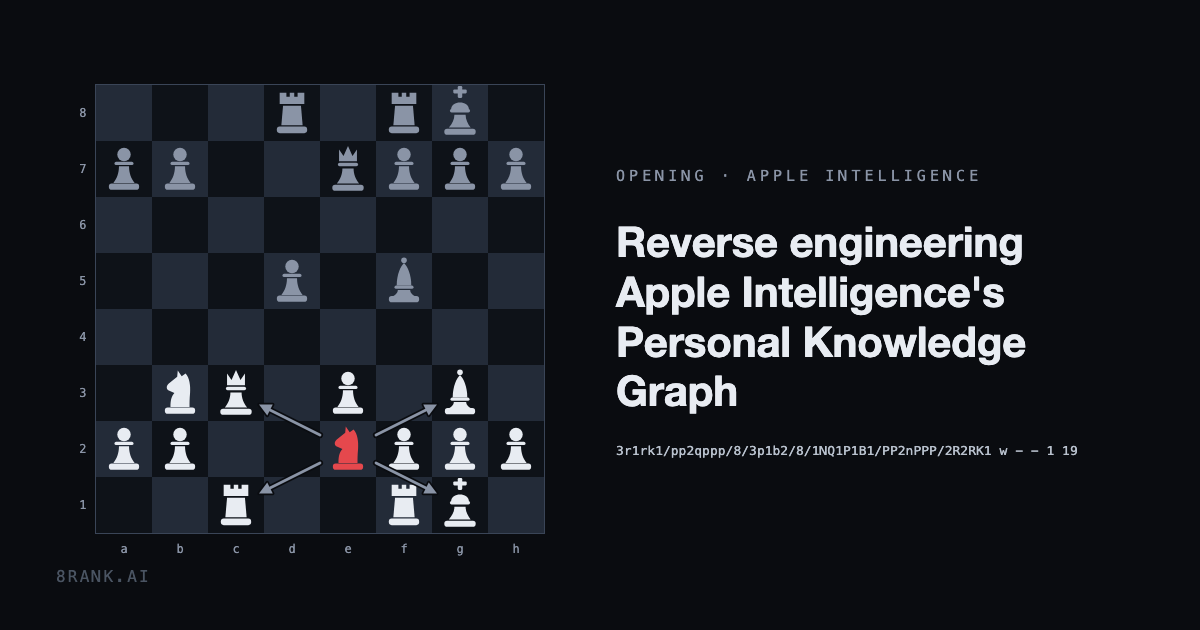
Our private connections can be exposed by link prediction algorithms. To date, this threat has only been addressed from the perspective of a central authority, completely neglecting the possibility that members of the social network can themselves mitigate such threats. We fill this gap by studying how an individual can rewire her own network neighborhood to hide her sensitive relationships. We prove that the optimization problem faced by such an individual is NP-complete, meaning that any attempt to identify an optimal way to hide one’s relationships is futile. Based on this, we shift our attention towards developing effective, albeit not optimal, heuristics that are readily-applicable by users of existing social media platforms to conceal any connections they deem sensitive. Our empirical evaluation reveals that it is more beneficial to focus on “unfriending” carefully-chosen individuals rather than befriending new ones. In fact, by avoiding communication with just 5 individuals, it is possible for one to hide some of her relationships in a massive, real-life telecommunication network, consisting of 829,725 phone calls between 248,763 individuals. Our analysis also shows that link prediction algorithms are more susceptible to manipulation in smaller and denser networks. Evaluating the error vs. attack tolerance of link prediction algorithms reveals that rewiring connections randomly may end up exposing one’s sensitive relationships, highlighting the importance of the strategic aspect. In an age where personal relationships continue to leave digital traces, our results empower the general public to proactively protect their private relationships.
Algorithmic personalization of information can cause inaccurate generalization and overconfidence.
The "Majority Illusion" in Social Networks
Individual’s decisions, from what product to buy to whether to engage in risky behavior, often depend on the choices, behaviors, or states of other people. People, however, rarely have global knowledge of the states of others, but must estimate them from the local observations of their social contacts. Network structure can significantly distort individual’s local observations. Under some conditions, a state that is globally rare in a network may be dramatically over-represented in the local neighborhoods of many individuals. This effect, which we call the “majority illusion,” leads individuals to systematically overestimate the prevalence of that state, which may accelerate the spread of social contagions. We develop a statistical model that quantifies this effect and validate it with measurements in synthetic and real-world networks. We show that the illusion is exacerbated in networks with a heterogeneous degree distribution and disassortative structure.
Legally Cognizable Manipulation
Swaths of personal and nonpersonal information collected online about Internet users are increasingly being used in sophisticated ways for online political mani

How Data Can Be Used Against People: A Classification of Personal Data Misuses
Even after decades of intensive research and public debates, the topic of data privacy remains surrounded by confusion and misinformation. Many people still str
From Principle to Practice: Vertical Data Minimization for Machine Learning
Aiming to train and deploy predictive models, organizations collect large amounts of detailed client data, risking the exposure of private information in the event of a breach. To mitigate this,...

Joining the Dots—Knowledge Graphs for Investigators and Analysts
Anyone who has watched a detective drama knows the scene. A wall covered in photographs, newspaper cuttings and index cards, with red string running from pin to pin.

Social Media Algorithms Warp How People Learn From Each Other, Research Shows - Slashdot
William Brady writes via The Conversation: People are increasingly interacting with others in social media environments where algorithms control the flow of social information they see. Algorithms determine in part which messages, which people and which ideas social media users see. On social media...

When I asked Tinder for my data, it sent me 800 pages of my deepest secrets | Hacker News
It's going to be interesting to see how Tinder tackles the 2018 EU General Data Protection Regulation in 2018 and how things will play out in courts and practice.
Stanford quantifies the privacy-stripping power of metadata | TechCrunch
More proof, if proof were needed, of the privacy-stripping power of metadata. A multi-year crowdsourced study, conducted by Stanford scientists and published this week, underlines how much information can be inferred from basic phone logs cross-referenced with other public datasets.

Using Metadata to find Paul Revere
London, 1772. I have been asked by my superiors to give a brief demonstration of the surprising effectiveness of even the simplest techniques of the new-fangled Social Networke Analysis in the pursuit of those who would seek to undermine the liberty enjoyed by His Majesty’s subjects. This is in connection with the discussion of the role of “metadata” in certain recent events and the assurances of various respectable parties that the government was merely “sifting through this so-called metadata” and that the “information acquired does not include the content of any communications”. I will show how we can use this “metadata” to find key persons involved in terrorist groups operating within the Colonies at the present time. I shall also endeavour to show how these methods work in what might be called a relational manner.

Opinion | The Dark Market for Personal Data (Published 2014)
Companies should disclose the information they sell about us.

Data Is a Toxic Asset - Schneier on Security
Thefts of personal information aren’t unusual. Every week, thieves break into networks and steal data about people, often tens of millions at a time. Most of the time it’s information that’s needed to commit fraud, as happened in 2015 to Experian and the IRS. Sometimes it’s stolen for purposes of embarrassment or coercion, as in the 2015 cases of Ashley Madison and the US Office of Personnel Management. The latter exposed highly sensitive personal data that affects security of millions of government employees, probably to the Chinese. Always it’s personal information about us, information that we shared with the expectation that the recipients would keep it secret. And in every case, they did not...
Defense Against Dishonest Charts
This is a guide to protect ourselves and to preserve what is good about turning data into visual things.