

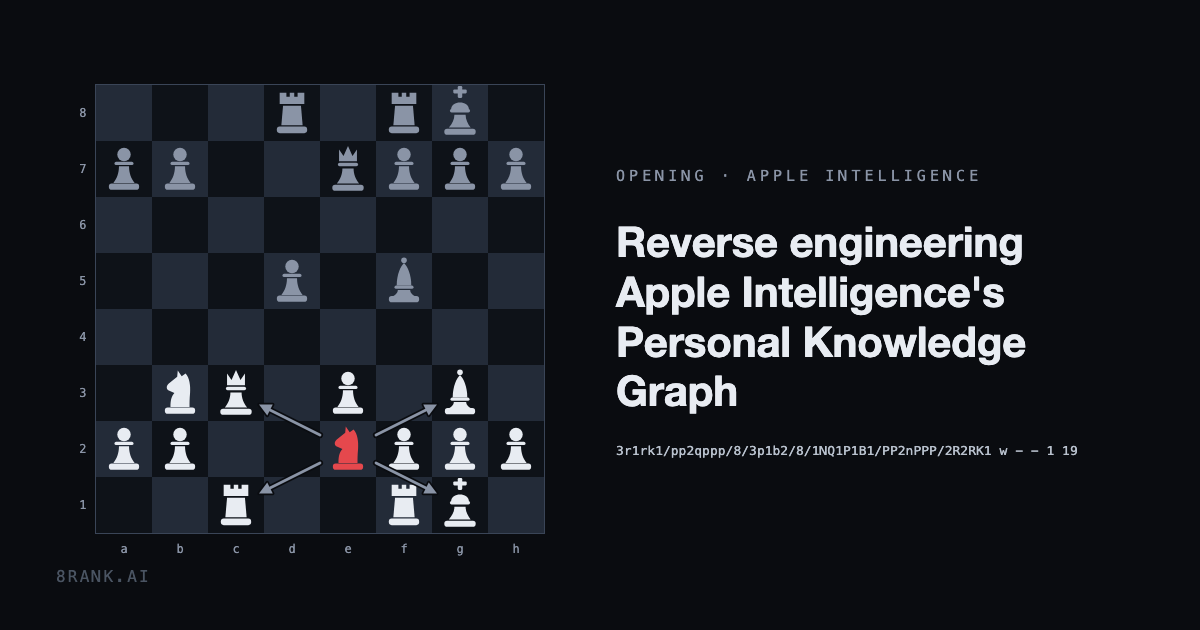
Every Mac since macOS 13 (2022) ships a pair of daemons whose only purpose in life is to build a graph about who you are, who you know, how those people are related to you and to each other, how you communicate with them, where you go, what you do and when. In this post, we look into how this system works and give you a tool to peek into your own graph.
Introducing the Knowledge Graph: things, not strings
We hope this will give you a more complete picture of your interest, provide smarter search results, and pique your curiosity.

Santiago on Twitter / X
Knowledge graphs for representing information are unbeatable.After this, you will never build a RAG system without knowledge graphs.It will take you five lines of code to build a knowledge graph with your data.I recorded a video to show you how you can do this.I used… pic.twitter.com/1jQ6Gejczq— Santiago (@svpino) September 26, 2025

How NASA is Using Graph Technology and LLMs to Build a People Knowledge Graph
Missed NASA’s People Graph webinar? Catch the recap and see how graph technology and AI are shaping the future of workforce intelligence.
SciOS Graph — live graph
Your name rides along on whatever you add — questions, thoughts, connections, reactions. Just here to look? Close this and explore the graph; you can add your name any time.
Home - GRAPHIA
Through the creation of the first comprehensive SSH Knowledge Graph enriched with AI and LLM applications, GRAPHIA will transform SSH data.

Weaponizing Personalization: From Knowledge Graph to Extortion — Eighth Rank
What happens when the personal knowledge graph ends up in the wrong hands. A breach hands you records; this store hands you conclusions (who your family are, who you are closest to, with a confidence beside each). How can it be weaponized, and what's the blast radius? Here is a worst-case thought experiment.
ProbablyFrens, Contextual Feeds and Intent-Based Discovery
It’s that time of the year—ETHDenver is just around the corner! Index will be there, and if you’re attending, we’d love to connect! But that’s not all—Index has been evolving, bringing new experiences to make discovery more intuitive and personalized.Meet ProbablyFrens: The Matchmaker AgentWe’re introducing Index’s Matchmaker Agent, an autonomous connector that helps you find the friendships, collaborations, and conversations that should already exist. Whether you’re looking for thought partn...

Email Is The Last, And Ultimate, Social Graph | TechCrunch
One of the magical innovations of the Web 2.0 era was when the bigger social platforms opened their doors to third-party app developers. LinkedIn, Facebook and Twitter widely touted ,and profited from, the concept of allowing consumers to plug their social graph into other applications. We saw the meteoric rise of games, apps and business tools that leverage the ability to quickly insert value into the relationship. RIP, Good Times.

Roster — Your relationships are yours
Roster is a contact-graph-first social platform where your contacts are encrypted, your communities are portable, and nobody mines your relationships for profit.

Cornell Tech STech Lab Bluesky Account Activity Labeler
We are part of Jacobs Institute’s Connective Media hub at Cornell Tech. We utilize a variety of methods from mining data on social media to conducting controlled experiments to interviewing users. Our work aims to understand the significance of people’s digital traces and to leverage this information for positive social good.
Social Media Algorithms Warp How People Learn From Each Other, Research Shows - Slashdot
William Brady writes via The Conversation: People are increasingly interacting with others in social media environments where algorithms control the flow of social information they see. Algorithms determine in part which messages, which people and which ideas social media users see. On social media...

#atdev friends, if you had an analytics database of all atproto records, what are some interesting things you'd like to know? - how many total posts? - how many chars have been typed across all posts? - how many live/dead PDSes out there? - how many "Jerry, no!"s? - something with the social graph?
@semble.so is really cool. It's basically if someone implemented the original comind knowledge graph stuff I wrote up here: cameron.stream/blog/comind-network
The cognitive layer for the open web
cameron.streamYou have to mainline info all the time because our information tools make you do so. Infinite scroll timelines, group chats with no beginning or end, recommender algorithms with no sense of place — all of them require constant vigilance to make sense of. We can do better.

Charlie Warzel
had a death in the family and was almost completely off the internet for a few days & my observation is that there is too much happening too fast such that basic facts abt the world are difficult to ascertain unless you are mainlining info all the time & doing that seems to drive people insane


