

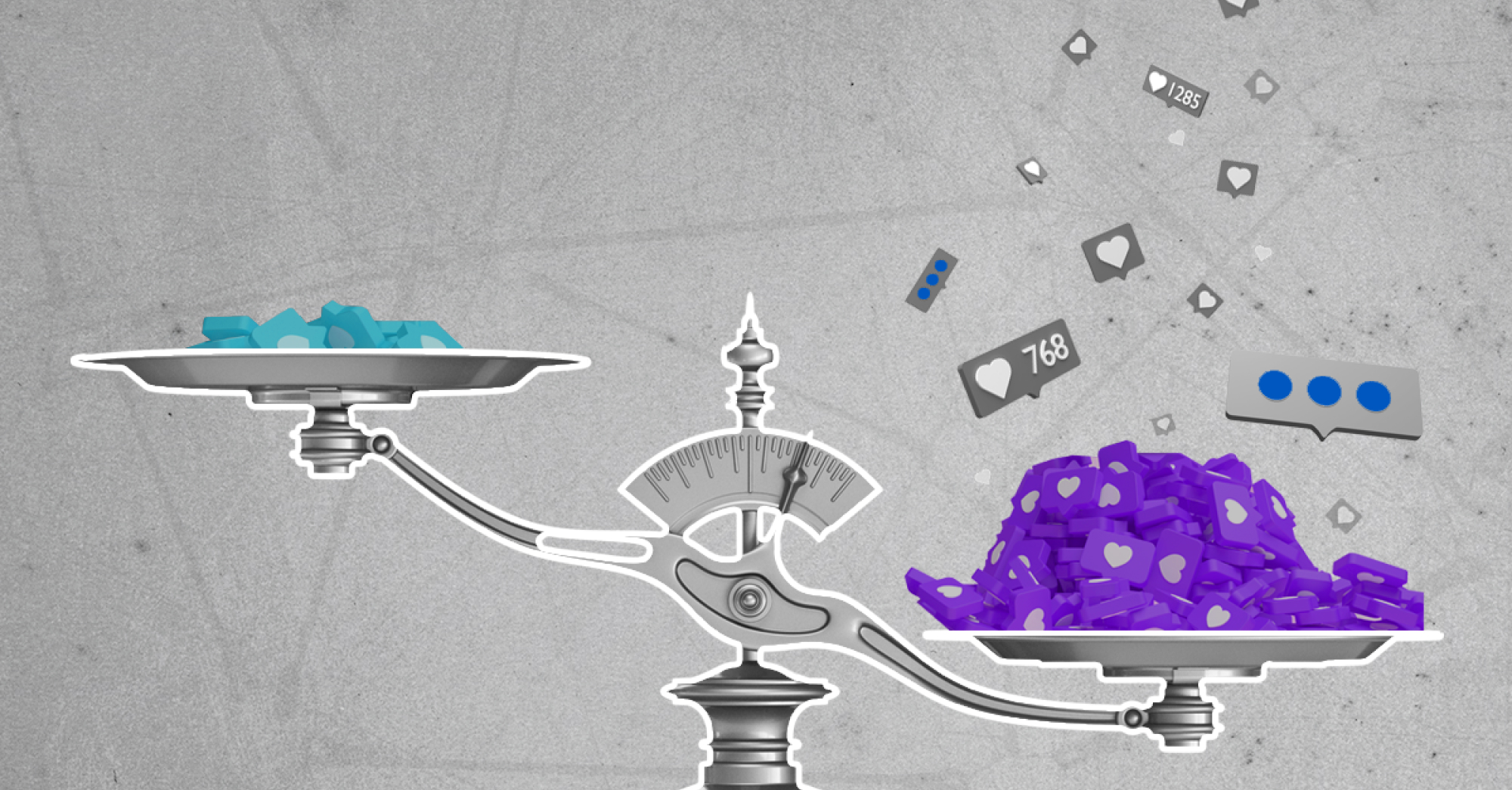
Countering social networks’ tendency toward “social capital” inequality requires thinking like an economist and learning from the web2 days.
W Don't Have Time | Offprint
"Trust community, not wealth" Holding power accountable on the open social web.

🔭🖤🚀 Social media’s next evolution: decentralized, open-source, and scalable
How Blacksky grew to millions of users without spending a dollar

Who Makes Money From Social Media?
Investigate platforms' revenue redistribution schemes.
Media and Social Capital
We survey the empirical literature in economics on the impact of media technologies on social capital. Guided by a simple model of information and collective action, we cover a range of different outcomes related to social capital—from social and political participation to interpersonal trust—in its benign and destructive manifestations. The impact of media technologies hinges on their content (information versus entertainment), their effectiveness in fostering coordination, and the networks they create as well as on individual characteristics and media consumption choices.

The Wealth of Networks
The Wealth of Networks: How Social Production Transforms Markets and Freedom is a book by Harvard Law School professor Yochai Benkler published by Yale University Press on April 3, 2006. The book has been recognized as one of the most influential works of its time concerning the rise and impact of the Internet on the society, particularly in the sphere of economics. It also helped popularize the term Benkler coined few years earlier, the commons-based peer production (CBPP).
Introducing a network for thoughtful conversations
The quality of conversations on the Internet is terrible. Most platforms like Twitter, Facebook, Instagram, Reddit, etc. optimize for engagement as their key metric. This spawns and rewards behavior that leads to bragging of gameable metrics such as likes and followers, self-feeding thought bubbles, knee-jerk reactions, “if you’re not on our side, you’re on their side” mentality, and thought policing even by people who think they’re fighting for a good cause. Today’s Internet doesn’t incentiviz
Bluesky & Open Social Media Tech
The 3 Levels of Wealth
Slack is a lot like Twitter from my vantage point. It’s a service I use all the time. It’s become an integral part of my life from both a work and social perspective. Every time I talk to someone else who uses the service they share my love for the platform. And it’s almost impossible to explain its usefulness...
Publishers fearing Facebook dependency: fight for your future, reinvent RSS.
Right now Facebook accounts for over 40% of all traffic for U.S. news organizations, making many dependent on the social network for…

Free Our Feeds
Social media is broken: controlled by a handful of billionaires who shape what people see, say, and believe. These platforms profit from division, exploit user data, and lock people into closed systems.

An analysis of social network-based Sybil defenses | Request PDF
Request PDF | An analysis of social network-based Sybil defenses | Recently, there has been much excitement in the research community over using social networks to mitigate multiple identity, or Sybil, attacks. A... | Find, read and cite all the research you need on ResearchGate

🗣️🗣️🗣️ THE OPEN SOCIAL WEB IS THE LONG GAME If we win, it'll be for the next generations. Sit with that thought, move accordingly.

Rudy Fraser
Many builders in the Open Social Web are discouraged by the lack of funding in the ecosystem, slow pace of feature development (e.g. private accounts), and “low” adoption relative to incumbents like Meta. In my keynote I emphasized multi-generational struggle & movement building. People who faced…
Social media algorithms don't allow us to understand or control what we see online and why... until now! Top scholars @jonathanstray.com and @noupside.bsky.social are sharing @mysky.social, a tool that allows users to adjust their feed’s priorities and explains why certain posts appear over others.

🎛️📲 Meet the algorithm you can actually control and understand
newpublic.substack.com
