We're introducing SAM Audio, a state-of-the-art AI model that enables you to segment sound.
HAIM: Human-AI Music Datasets for AI Music Production Tracking Benchmark
As generative platforms such as Suno and Udio reach human-grade audio quality, the scope of AI's utility has expanded across the entire music production workflow. Beyond simple track generation, these advancements have catalyzed the adoption of AI-driven methodologies in diverse forms. These include vocal synthesis, arrangement, and professional mastering. However, current detection research remains largely confined to a binary `AI-or-human' paradigm. It fails to reflect the realities of contemporary music production workflows. In real-world production, AI tools are increasingly used to refine or master human-produced tracks, and human engineers likewise post-process AI-generated material to ensure professional quality. Moreover, users often employ adversarial tactics to bypass AI detectors, such as applying human mastering to AI-generated tracks. This creates a grey area that a simple binary classification fails to capture. In this paper, we define and investigate ``AI Music Tracking'': the challenge of identifying specific AI integration across the multifaceted spectrum of music production. To this end, we introduce HAIM, a dataset with diverse labels for stages of music production. It is designed to isolate stages of AI intervention, including hybrid production and agent-level tracking. Our evaluation of state-of-the-art detectors reveals systemic flaws. By releasing HAIM, we propose a new benchmark that shifts the field beyond binary classification toward a granular, structured evaluation of AI music.

Realtime and audio | OpenAI API
Learn which realtime and audio guide to use for each speech application.

Stability AI optimized its audio generation model to run on Arm chips | TechCrunch
AI startup Stability AI has teamed up with chipmaker Arm to bring Stability's Stable Audio Open, an AI model that can generate audio including sound

Introducing AI Extensions Beta
The Millions of Songs Mashed Into AI-Generated Music
Explore the astonishing amount of music available to AI developers.

Voice AI & Voice Agents | An Illustrated Primer
A comprehensive guide to voice AI in 2026


DeepL AI Platform: Translation, Voice & API
Explore our AI suite and get more done: Translate speech, text, and media, or integrate the DeepL API.

Interaction Models: A Scalable Approach to Human-AI Collaboration
Interaction models move beyond turn-based AI interfaces by handling multimodal, real-time collaboration natively across audio, video, and text.
How Much AI Is in This Track? Quantifying the Proportion of AI-Generated Stems in Hybrid Music Mixtures
AI-generated music is increasingly used at the stem level, with producers integrating synthetic drums, basslines, or vocals alongside human-performed instruments. However, current AI music detection systems are binary, treating tracks as either fully AI or fully human. In this paper, we reformulate AI music detection as a regression problem on a continuous AI energy ratio, alpha in [0, 1]. We propose a methodology that leverages a multi-track music dataset to assemble mixtures of human-performed and AI-reconstructed stems (obtained using a neural audio codec) with known proportions of each content type. Using this approach, we first show that a CNN-based model trained on fully AI-generated or human-performed tracks, which achieves >99% accuracy as a binary detector, when faced with mixed content, yields an output that rises with the AI stems' energy contribution, acting as a noisy and miscalibrated estimator. Our analysis of the influence of different stems shows that detection sensitivity depends on the instrument and reflects its frequency content: drums and guitar carry strong codec-artifact signatures, while vocals and bass are less detectable. Based on these insights, we train a similar CNN-based model for regression of alpha, achieving MAE = 0.076 and R^2 = 0.85 on held-out mixtures from the same pipeline. These results suggest that the regression formulation is an initial promising step towards AI-music detection in realistic music production workflows.
On-device intelligence for every product
We're building a frontier lab for on-device AI. Small, specialized models for audio, vision, and text, faster than the cloud and free.

Introducing GPT-Live
A new generation of voice models for natural human-AI interaction, now powering ChatGPT Voice.

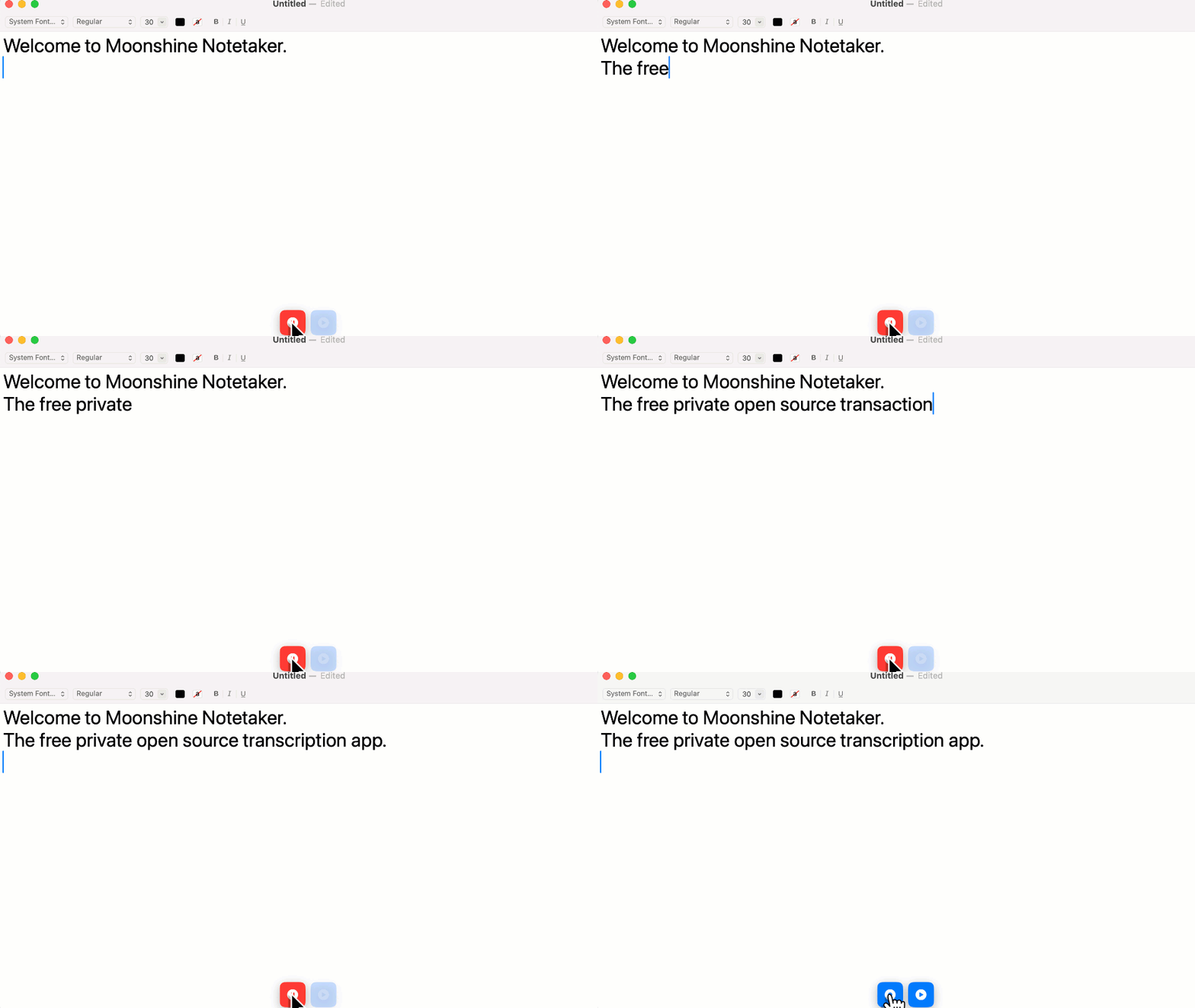
Launching a free, open-source, on-device transcription app
TL;DR – Please try Moonshine Note Taker on your Mac! For years I’ve been telling people that AI wants to be local, that on-device models aren’t just a poor man’s alternative…
This AI guitar pedal let me roll my own effects
That new sound you’ve been looking for?

VoiceInk - Advanced AI Voice Recognition for Mac
Transform Your Voice Into Text Instantly with Offline AI. Built for Mac, Optimized for Privacy. One-Time Purchase, No Subscriptions.