


How Government Agencies Can Embrace the Social Web for Public Communications In recent years, there has been a significant shift in how government agencies communicate with the public. Social media…
FediForum | Growing the Open Social Web:<br>An Online Un-Workshop
Since the Twitter takeover by Elon Musk over three years ago, the Open Social Web has been adopted by an enthusiastic community. People world-wide are building and using open social platforms and open social protocols to better interact with others online.

Social media algorithms can be redesigned to bridge divides — here’s how
"It falls to both the tech companies that built these systems and an engaged public to create technologies designed for social cohesion."

Hello, Social Web 👋🏼
Our mission is to liberate people's networks from their platforms, enabling The Last Network Effect and leveling the playing field across the open social web.

We’re in the middle of a perfect storm for rollback of the “open web” and burgeoning online surveillance
Looking at fallout of the KOSA hearings today — and subsequent commentary — I remain optimistic for the development of social technology & communication but I’m beginning to think the ope…

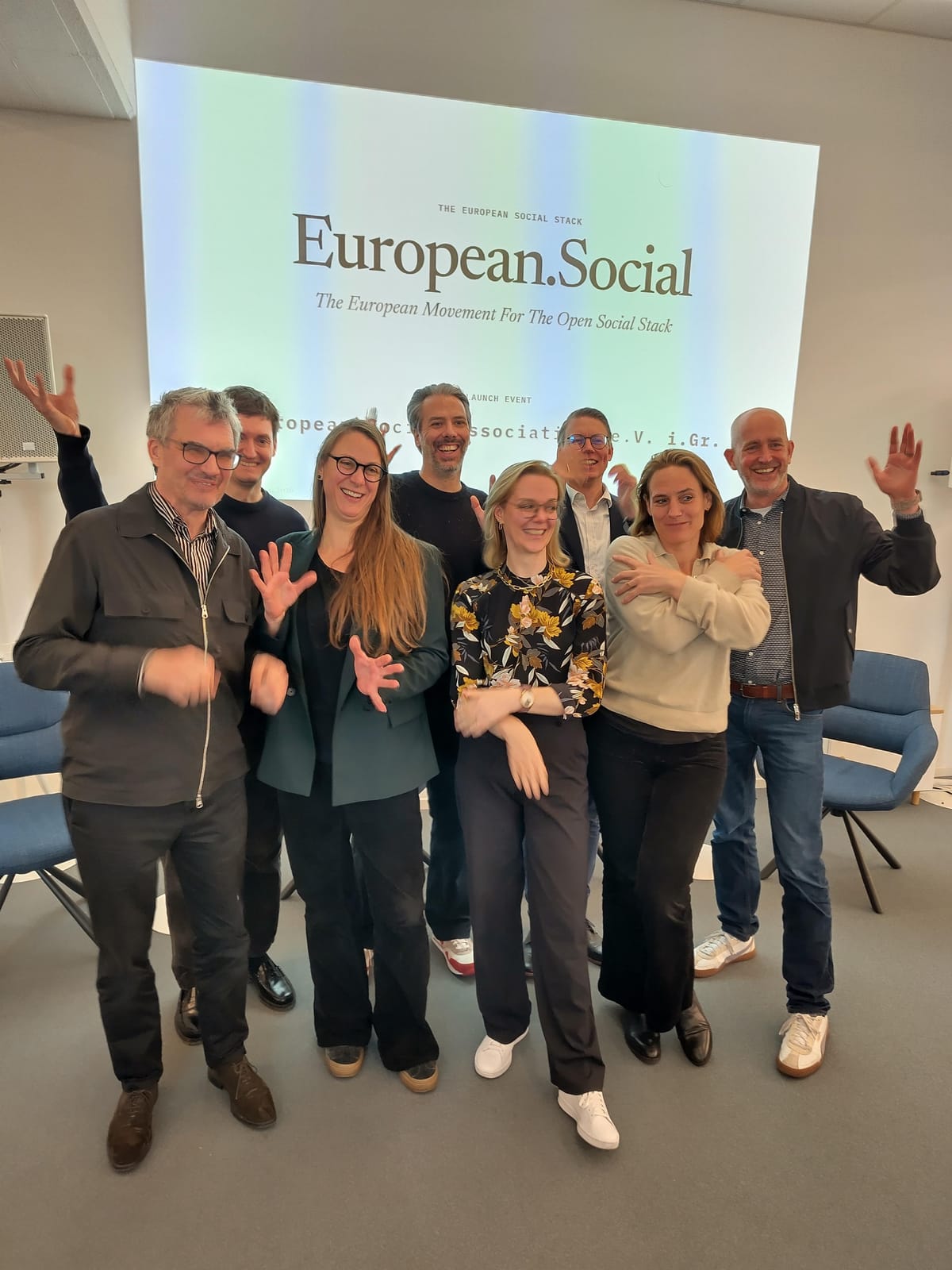
Political communication as public infrastructure: notes from the European.Social launch
Today, at the European.Social launch in Berlin, people working on different parts of the Open Social Web came together around a common purpose. I left hopeful. I also left wanting to put one idea at the centre of the conversation: Political communication is part of our public infrastructure. We
Shifts in U.S. Social Media Use, 2020–2024: Decline, Fragmentation, and Enduring Polarization
The social media ecosystem appears to be in flux. Twitter’s rebranding to X has come to symbolize a broader reorganization of online publics – political reshuffling, user attrition, and uncertainty over the role of legacy platforms. Simultaneously, the shift from text-based, networked feeds toward algorithmically curated, short-form video has accelerated, with TikTok setting the pace for the wider ecosystem [18, 14, 16]. At the same time, everyday communication increasingly migrates from large, open networks to semi-private spaces such as group chats and messaging apps. Commentators describe a digital public sphere in transition: smaller, more fragmented, less dominated by traditional social networking sites, and rise of more broadcast-oriented forms of media – with some even suggesting that we are seeing the beginning of the end of the social media era.
Recently I’ve been thinking about a couple of... - Adam Wood
Recently I’ve been thinking about a couple of different tech-related things that sort of overlap. One is the (emerging) shape of the new social web; the other is a pull I’m feeling to try and lessen reliance on American companies. I’ve been interested in / concerned by what became of social media for some time.1 Since the sundering of Twitter in 2022, I’ve kept an eye on the various alternatives, with particular interest in Mastodon and Bluesky. Actually, to be more accurate, my interest has been in the protocols behind those platforms: ActivityPub and AT Protocol respectively. Both have their...

Bluesky & Open Social Media Tech
Traditional Social Media as a Prison · What’s Happening on My Feed?
Social media apps have become a vehicle for community building, world news, and political campaigns. As app owners have enmeshed themselves more with the state, the carceral logics that haunt marginalized communities offline, became a part of their digital realities online.
The Atmosphere . Building the open social web
What would social media look like if it served the public interest?
What would social media look like if it served the public interest?

I now fully believe that the open social web will be more key to the agentic web than folks think. #AgenticWeb
Check more about the concept on Open Social Media (and back to Open Web), and how it might be the future (hopefully) of the web.

Open Social Media (and back to Open Web)
www.ssp.shAnother reason why it’s so important that we have open protocols for social media.

Kai Kupferschmidt
One of the issues that has come up again and again in my reporting on misinformation and social media is the massive influence social media companies have on research in the field. Last night a preprint dropped that tries to get at this with some numbers. My piece in @science.org (and 🧪🧵 coming):
The open social web is vibrant, dynamic, and full of amazing apps and websites! At the PublicSpaces Conference in Amsterdam, we just gave out the #OpenSocialAwards. We’re excited to introduce you to these impressive, inventive winners. 🧵

Open Social Awards | New_ Public
newpublic.org


