

AbstractAbstract: This chapter examines the social patterns of elder caregiving among women ages 50 and older in the United States. We find that women who
How Caregiving for Parents Reduces Women’s Employment: Patterns across Sociodemographic Groups
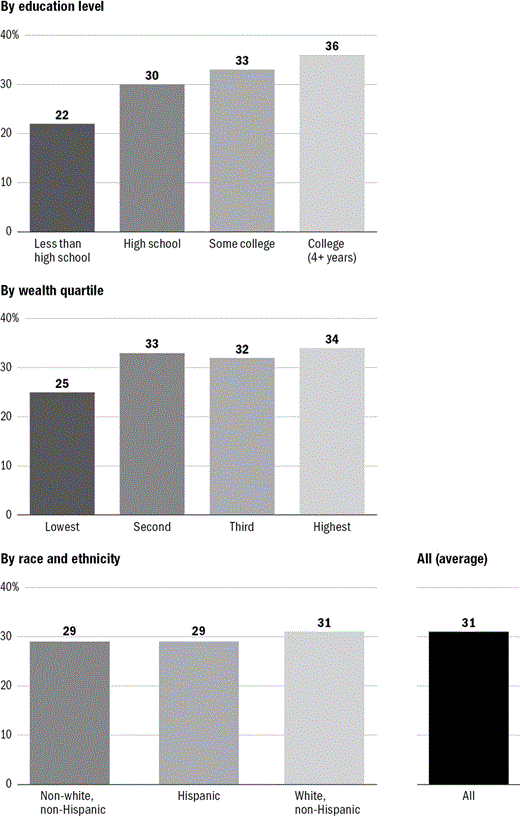
Abstract Abstract: This chapter examines the social patterns of elder caregiving among women ages 50 and older in the United States. We find that women who provide personal care for parents or parents-in-law, tend to be from more advantaged sociodemographic groups, with larger differences by socio-economic status than by race and ethnicity. Prior to initiating care, caregivers also have greater labor market attachment than non-caregivers. In contrast, although less likely to provide care, women from less advantaged groups tend to provide more time-intensive care when they do provide care, particularly in the extreme upper-end of the distribution of care hours. We find strong negative associations between caregiving and employment, hours, and earnings, both immediately and over a longer 10-year period. The relationship between care and work is similar across the sociodemographic groups that we examine.
Own Gender, Sibling’s Gender, Parent’s Gender: The Division of Elderly Parent Care among Adult Children
Research on the gender division of family labor largely focuses on housework and childcare in spousal couples. This article advances scholarship by examining the gender division of elderly parent care in sibling groups. Using the Health and Retirement Study, a nationally representative survey of elderly Americans, I find that caregiving to elderly parents varies not only by an adult child’s own gender, but also by the gender of the siblings with whom caregiving is shared and by the gender of the parent to whom care is provided. The salience of an adult child’s gender manifests in two primary ways: not only do daughters provide more care than do sons to their elderly parents, but daughters’ caregiving is also more elastic with respect to their own and their parents’ attributes than is sons’ caregiving. With respect to the gender of the siblings, sons provide relatively less care if they have sisters, whereas daughters provide relatively more care if they have brothers. With respect to the gender of the parent, sons provide relatively more care to fathers, and daughters provide relatively more care to mothers. Finally, analyses did not reveal changes over time.

Dementia Care, Women’s Health, and Gender Equity
This Viewpoint discusses gender inequity among caregiving for individuals with dementia and its effects on women’s health.

Dementia Care, Women's Health, and Gender Equity: The Value of Well-Timed Caregiver Support
This Viewpoint discusses gender inequity among caregiving for individuals with dementia and its effects on women’s health.
A Comprehensive Measure of the Costs of Caring For a Parent
Providing unpaid care for an older parent has costs that go well beyond a caregiver’s lost wages. A new estimate suggests that the median direct and indirect costs of caregiving are $180,000…

Own Gender, Sibling’s Gender, Parent’s Gender: The Division of Elderly Parent Care among Adult Children | Request PDF
Request PDF | Own Gender, Sibling’s Gender, Parent’s Gender: The Division of Elderly Parent Care among Adult Children | Research on the gender division of family labor largely focuses on housework and childcare in spousal couples. This article advances scholarship... | Find, read and cite all the research you need on ResearchGate

Experiences of Direct Care Workers and Family Caregivers of Home- and Community-Based Services (HCBS) | KFF
This issue brief presents findings from the focus groups including caregiver characteristics; physical, emotional, and mental caregiving demands of caregiving; their wages, finances, and opportunities for advancement; and what caregivers would like policymakers to know about their work.
Paternity leave isn’t closing the gender pay gap
Wider initiatives are needed to change social norms regarding caregiving responsibilities

Long-term Care in the United States
The population of the United States, as with the rest of the world, is aging rapidly, with the most rapid growth occurring among the age 85 and older population, those who rely most on long-term care. In this chapter, we review the delivery and financing of long-term care in the U.S. We show that the resources of most elderly in the U.S. are insufficient to finance these ongoing long-term care needs and the public sector finances the majority of long-term care spending. At the same time, informal care plays a critical role, with the elderly at every age and every disability level receiving informal care more frequently than formal care. Indeed, when properly valued, informal care accounts for more than one-third of the nearly 2 percent of U.S. GDP devoted to long-term care.

Black Women and the Care Agenda | National Partnership for Women & Families
Black women are family caregivers – and they need flexibility and economic supports to make the best decisions for themselves and their families

Facing Financial Ruin as Costs Soar for Elder Care (Published 2023)
The United States has no coherent system for providing long-term care, leading many who are aging to struggle to stay independent or to rely on a patchwork of solutions.

Caregiving in the US 2025
The 2025 edition of Caregiving in the US, released by AARP and the National Alliance for Caregiving, reveals a rapidly evolving caregiving landscape.

Caregiving in the US 2025
The 2025 edition of Caregiving in the US, released by AARP and the National Alliance for Caregiving, reveals a rapidly evolving caregiving landscape.
Long‐Term Care Across Europe and the United States: The Role of Informal and Formal Care
Abstract Large cross‐country variation in long‐term‐care (LTC) policy in conjunction with household‐level data on caregiving provides a valuable laboratory for policy analysis. However, there is a lack of comprehensive cross‐country data on how care is provided. In order to close this gap, we draw on data from the Survey of Health, Ageing, and Retirement in Europe (SHARE) and the Health and Retirement Study (HRS) in the United States. Because care hours are missing for some care forms (especially for nursing‐home residents), we propose a selection model to impute these. The model allows selection into care forms to differ by country. Our estimates imply that nursing‐home residents have higher care needs, even when conditioning on observed characteristics. In contrast to the bulk of the literature, we also take into account care provision from persons in the same household, and we find that this contributes one‐third of all care hours. Informal‐care provision in Europe follows a steep North–South gradient, with the United States falling in between Central European and Southern European countries. The results are robust to alternative imputation schemes.

Men not at work: Why so many men aged 25 to 54 are not working | Brookings
The job market is a whole lot better than it was during the worst of the Great Recession, but around 7 million American men between the ages of 25 and 54 – mostly too old to be in school and too young to retire – are neither working nor looking for work. That amounts to […]

A growing number of Black boys and young men have stepped into the role of caregiver. Most don’t know or consider themselves “youth caregivers.” They’re just “good” sons and grandchildren. bit.ly/4xCDiAF

Young Black Men and Boys Are Quietly Taking On a Caregiving Crisis Few People See
capitalbnews.org