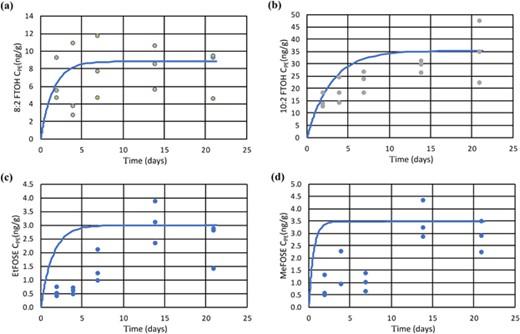
Abstract . Fluorotelomer alcohols (FTOHs), perfluorooctane‐sulfonamidoethanols (FOSEs), perfluorooctane‐sulfonamides (FOSAs), and other poly‐ and perfluori
Furthering the Capabilities of Diffusive-Gradient Passive Samplers for Per- and Polyfluoroalkyl Substances
Abstract. Per- and polyfluoroalkyl substances (PFAS) are chemical pollutants of growing concern for many stakeholders. Due to their ubiquity, persistence i

Diffusive-Gradient Passive Samplers for Per- and Polyfluoroalkyl Substances.
Per- and polyfluoroalkyl substances (PFAS) are chemical pollutants of growing concern. Due to their ubiquity, persistence in the environment, and potential for toxicity at low environmental concentrations, it is necessary to have convenient and reliable methods to measure PFAS in natural waters. Passive sampling methods (in situ pre-concentration of PFAS) are investigated for monitoring purposes. The following dataset specifically deals with the calibration and application of a diffusive gradient in thin film (DGT) passive sampler, as well as comparisons to previously designed microporous polyethylene tube (MPT) passive samplers and water grab samples. Concentrations are measured with tandem liquid-chromatography mass spectrometry (LC-MS/MS) for all sampling methods. The dataset comprises: (i) a list of 25 PFAS compounds considered for the study at hand, (ii) method detection limits of considered PFAS compounds, (iii) calibration experiments of the DGT passive sampler, as well as results from modelling approaches to determine sampling rates, (iv) lab deployment of the developed DGT to challenge determined sampling rates, (v) field deployments of the developed DGT in an assortment of streams, ponds, and lakes in Minnesota and Maine, where concentrations of PFAS compounds are compared to concentrations measured by MPT, and water grab samples.
Calibration of Perfluorinated Alkyl Acid Uptake Rates by a Tube Passive Sampler in Water
Abstract. Per- and polyfluoroalkyl substances (PFAS) are a group of 4000+ man-made compounds of great concern due to their environmental ubiquity and adver

Passive Sampler Derived Profiles and Mass Flows of Perfluorinated Alkyl Substances (PFASs) across the Fram Strait in the North Atlantic
Abstract. Per- and polyfluorinated alkyl substances (PFAS) are a family of pollutants of high concern due to their ubiquity and negative human health impac

Perfluorinated Carbon Chain Length Drives Uptake of Diverse Per- and Polyfluoroalkyl Substances in Field-Deployed Passive Samplers
Abstract. Per- and polyfluoroalkyl substances (PFAS) are a group of compounds of high concern due to their ubiquity, persistence, and adverse health impact

Addressing Urgent Questions for PFAS in the 21st Century
Abstract. Despite decades of research on per- and polyfluoroalkyl substances (PFAS), fundamental obstacles remain to addressing worldwide contamination by

Stability of Per- and Polyfluoroalkyl Substances in Solvents Relevant to Environmental and Toxicological Analysis
Abstract. Per- and polyfluoroalkyl substances (PFASs) are widely used anthropogenic chemicals. For environmental and toxicological analysis, it is importan
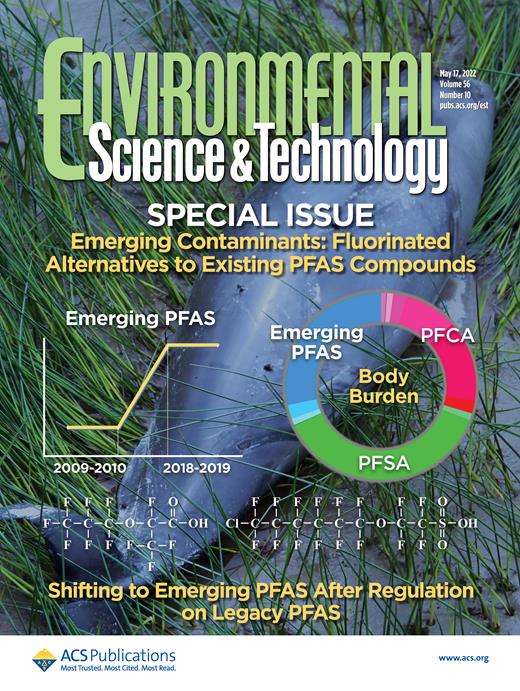
Atmospheric concentrations of per- and polyfluoroalkyl substances in Michigan's ambient air using passive sampling
Supplemental data for "Atmospheric concentrations of per- and polyfluoroalkyl substances in Michigan's ambient air using passive sampling". Atmospheric passive samplers were deployed at 27 sites around Michigan, USA to measure atmospheric PFAS concentrations. Data includes information for sites, analytical information, and concentrations measured.
How Do We Measure Poly- and Perfluoroalkyl Substances (PFASs) at the Surface of Consumer Products?
Abstract. Exposures to poly- and perfluoroalkyl substances (PFASs) have been linked to metabolic disruption, immunotoxicity, and cancer in humans. PFASs ar

Field Validation of a Novel Passive Sampler for Dissolved PFAS in Surface Waters
Abstract Numerous per- and polyfluoroalkyl substances (PFAS) are of growing concern worldwide due to their ubiquitous presence, bioaccumulation and adverse effects. Surface waters in the United States have displayed elevated concentrations of PFAS, but so far discrete water sampling has been the commonly applied sampling approach. In the present study we field-tested a novel integrative passive sampler, a microporous polyethylene tube, and derived sampling rates (Rs) for nine PFAS in surface waters. Three sampling campaigns were conducted, deploying polyethylene tube passive samplers in the effluent of two wastewater treatment plant (WWTP) effluents and across Narragansett Bay (Rhode Island, USA) for 1 month each in 2017 and 2018. Passive samplers exhibited linear uptake of PFAS in the WWTP effluents over 16–29 days, with in situ Rs for nine PFAS ranging from 10 ml day−1 (perfluoropentanoic acid) to 29 ml day−1 (perfluorooctanesulfonic acid). Similar sampling rates of 19 ± 4.8 ml day−1 were observed in estuarine field deployments. Applying these Rs values in a different WWTP effluent predicted dissolved PFAS concentrations mostly within 50% of their observations in daily composite water samples, except for perfluorobutanoic acid (where predictions from passive samplers were 3 times greater than measured values), perfluorononanoic acid (1.9 times), perfluorodecanoic acid (1.7 times), and perfluoropentanesulfonic acid (0.1 times). These results highlight the potential use of passive samplers as measurement and assessment tools of PFAS in dynamic aquatic environments. Environ Toxicol Chem 2022;41:2375–2385. © 2022 SETAC Abstract A novel integrative passive sampler was field-tested and sampling rates derived for nine per- and polyfluoroalkyl substances in two wastewater treatment plant effluents and in Narragansett Bay surface waters.

A Liquid–Liquid Extraction Method for Measuring Ultrashort PFCAs and Longer-Chain PFAS in Water
Abstract. Natural waters can contain diverse per- and polyfluoroalkyl substances (PFAS) with contrasting chemistries, presenting challenges for using a sin

Are Fluoropolymers Really of Low Concern for Human and Environmental Health and Separate from Other PFAS?
Abstract. Fluoropolymers are a group of polymers within the class of per- and polyfluoroalkyl substances (PFAS). The objective of this analysis is to evalu
A Statistical Approach for Identifying Private Wells Susceptible to Perfluoroalkyl Substances (PFAS) Contamination
Abstract. Drinking water concentrations of per- and polyfluoroalkyl substances (PFAS) exceed provisional guidelines for millions of Americans. Data on priv

Uptake of Per- and Polyfluoroalkyl Substances by Fish, Mussel, and Passive Samplers in Mobile Laboratory Exposures using Groundwater from a Contamination Plume at a Historical Fire Training Area, Cape Cod, Massachusetts - Chemical and Biological Data from August to September 2018
This data release presents chemical and biological results from an investigation of the uptake of per- and polyfluoroalkyl substances (PFAS) from groundwater contaminated by fire training activities on Cape Cod, Massachusetts. Exposure experiments were conducted from August 29 to September 21, 2018 using groundwater from a relatively uncontaminated reference site and a fire training area contaminated site. To assess the uptake characteristics of the PFAS mixtures present in the 2 groundwater sources, 21-day mobile laboratory exposure experiments were conducted using fathead minnows (Pimephales promelas), polar organic chemical integrative samplers, and polyethylene tube samplers. Freshwater mussel (Ligumia subrostrata) exposure experiments were conducted for 14 days, beginning on day 7 of the fish and passive sampler exposures. Groundwater samples were collected daily (with a few exceptions). Samples for male fish and passive samplers were collected on days 0, 4, 7, 14, and 21. Samples for female fish were collected on days 0, 7, 14, and 21. The 14 day mussel exposures began on day 7 of the fish and passive sampler exposures, and mussel samples were collected on days 7, 11, 14, and 21. Groundwater site locations and well characteristics are presented in Table 1. Information on the various PFAS and co-occurring contaminants measured in the different media are presented in Table 2. Quality assurance results for PFAS analysis of the different media are presented in Table 3. Results for PFAS in groundwater are presented in Table 4. Results for co-occurring contaminants in groundwater are presented in Table 5. Results for fish biomarkers are presented in Table 6. Results for PFAS in male and female fish tissue are presented in Table 7. Results for PFAS in mussel tissue are presented in Table 8. Results for PFAS in polar organic chemical integrative samplers are presented in Table 9. Results for PFAS in polyethylene tube samplers are presented in Table 10.
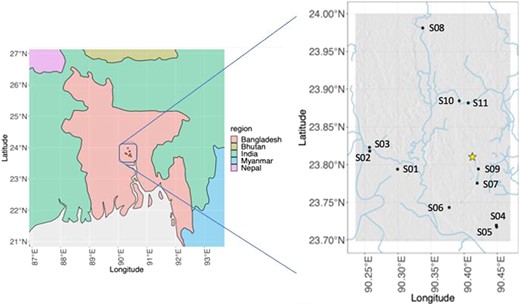
Poly‐ and Perfluorinated Alkyl Substances in Air and Water from Dhaka, Bangladesh
Abstract. Bangladesh hosts extensive textile manufacturing, for some of which per‐ and polyfluorinated alkyl substances (PFAS) have been used to impart wat
Whale Baleen To Monitor Per- and Polyfluoroalkyl Substances (PFAS) in Marine Environments
Abstract. Per- and polyfluoroalkyl substances (PFAS) comprise >10 000 synthetic compounds that are globally distributed and highly persistent but remain