

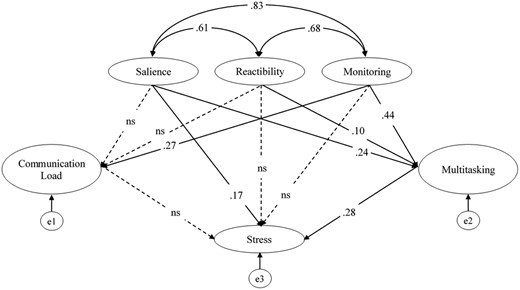
Abstract. Concerns have been expressed that permanent online connectedness might negatively affect media user’s stress levels. Most research has focused on
Social Media and Change in Psychological Distress Over Time: The Role of Social Causation
Abstract This article tests the relationship between information and communication technologies (ICT), such as the Internet, cell phones, and social media, and change over time in psychological distress (PD) and risk of serious psychological distress (SPD) associated with depression and anxiety disorders. Using a longitudinal panel design, survey data from a representative sample of American adults, findings revealed that home Internet and social network site (SNS) use are associated with decreased PD over time. Having extended family who are also Internet users further decreases PD. PD increased or decreased in relation to change in the PD of extended family who also use SNSs. For most people, ICT substantively reduce PD; in rare cases, an extreme spike in PD of extended family also on SNSs, there was a trivial increase to the risk of SPD. PD did not change when extended family not on social media experienced a change in their PD.
Social Media and Depression Symptoms: a Meta-Analysis
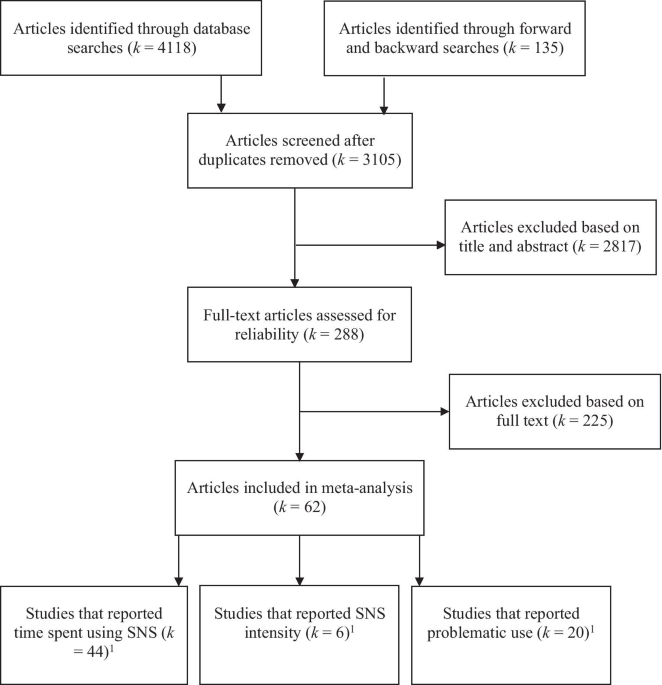
Social Networking Sites (SNS) have close to 3 billion users worldwide. Recently, however, SNS have come under media scrutiny for their potential association with depression. Two previous meta-analyses failed to find evidence for a robust concurrent association between SNS use and depression symptoms. However, these analyses focused primarily on the time spent using SNS. The current meta-analysis is the first to consider the multi-dimensional nature of SNS use, and examines separately the quantitative associations of depression symptoms to SNS use in three types of SNS studies examining three distinct constructs of SNS use: time spent using SNS, intensity of SNS use, and problematic SNS use. Sixty-two studies (N = 451, 229) met inclusion criteria. Depression symptoms were significantly, but weakly, associated with time spent using SNS (r = 0.11) and intensity of SNS use (r = 0.09). However, the association of depression symptoms to problematic SNS use was moderate (r = 0.29), was significantly higher than for time spent using SNS (Qbetween = 35.85, p < 0.001) or intensity of SNS use (Qbetween = 13.95, p < 0.001), and was not significantly moderated by age, gender, year of study publication, or mode of recruitment. These results suggest that future research examining causal models of the relation of SNS use and depression, as well as research on intervention and prevention, should focus in more detail on individuals who are engaging in a pattern of problematic SNS use.
The Impact of Internet and Social Media Use on Well-Being: A Longitudinal Analysis of Adolescents Across Nine Years
Abstract The present research examines the longitudinal average impact of frequency of use of Internet and social networking sites (SNS) on subjective well-being of adolescents in Germany. Based on five-wave panel data that cover a period of nine years, we disentangle between-person and within-person effects of media use on depressive symptomatology and life satisfaction as indicators of subjective well-being. Additionally, we control for confounders such as TV use, self-esteem, and satisfaction with friends. We found that frequency of Internet use in general and use of SNS in particular is not substantially related subjective well-being. The explanatory power of general Internet use or SNS use to predict between-person differences or within-person change in subjective well-being is close to zero. TV use, a potentially confounding variable, is negatively related to satisfaction with life, but it does not affect depressive symptomatology. However, this effect is too small to be of practical relevance.
Hard Questions: Is Spending Time on Social Media Bad for Us?
With people spending more time on social media, many rightly wonder whether that time is good for us. Do people connect in meaningful ways online? Or are they simply consuming trivial updates and polarizing memes at the expense of time with loved ones?

Media Use Habits: What, Why, When, and How People Read Online :: UXmatters
Web magazine about user experience matters, providing insights and inspiration for the user experience community
No effect of different types of media on well-being
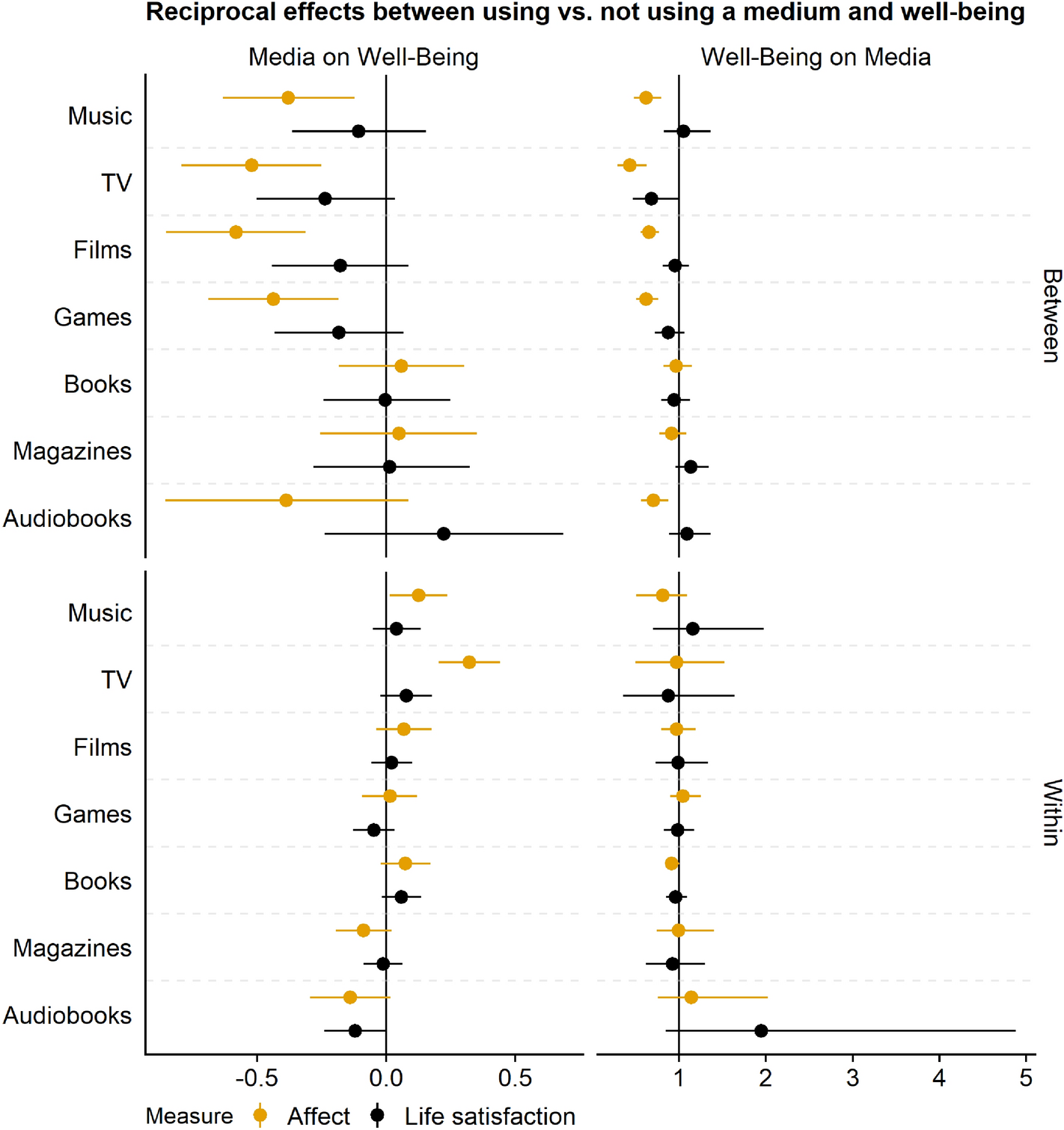
It is often assumed that traditional forms of media such as books enhance well-being, whereas new media do not. However, we lack evidence for such claims and media research is mainly focused on how much time people spend with a medium, but not whether someone used a medium or not. We explored the effect of media use during one week on well-being at the end of the week, differentiating time spent with a medium and use versus nonuse, over a wide range of different media types: music, TV, films, video games, (e-)books, (digital) magazines, and audiobooks. Results from a six-week longitudinal study representative of the UK population 16 years and older (N = 2159) showed that effects were generally small; between-person relations but rarely within-person effects; mostly for use versus nonuse and not time spent with a medium; and on affective well-being, not life satisfaction.
Why Linking Matters: Network Effects and Other Benefits - Interaction Institute for Social Change
“We cannot live for ourselves alone. Our lives are connected by a thousand invisible threads, and along those sympathetic fibers, our actions run as causes and return to us as results.” – Herman Melville In an earlier post in this series on networks and education, we explored the underlying vitality of connection and flow in... Read More
Two tests of social displacement through social media use
The present manuscript presents two tests of the hypothesis that social media use decreases social interaction, leading to decreased well-being. Study 1 used the Longitudinal Study of American Yout...

Associations between social media use and loneliness in a cross-national population: do motives for social media use matter?
Background: We aimed to examine the association between social media use and loneliness two years after the COVID-19 pandemic outbreak. Methods: Participants were 1649 adults who completed a cross-sectional online survey disseminated openly in Norway, United Kingdom, USA, and Australia between November 2021 and January 2022. Linear regressions examined time spent on social media and participants’ characteristics on loneliness, and interactions by motives for social media use. Results: Participants who worried more about their health and were younger, not employed, and without a spouse or partner reported higher levels of loneliness compared to their counterparts. More time spent on social media was associated with more loneliness (β = 0.12, p < 0.001). Three profile groups emerged for social media use motives: 1) social media use motive ratings on avoiding difficult feelings higher or the same as for maintaining contact; 2) slightly higher ratings for maintaining contact; and 3) substantially higher ratings for maintaining contact. Time spent on social media was significant only in motive profile groups 2 and 3 (β = 0.12 and β = 0.14, both p < 0.01). Conclusions: Our findings suggest that people who use social media for the motive of maintaining their relationships feel lonelier than those who spend the same amount of time on social media for other reasons. While social media may facilitate social contact to a degree, they may not facilitate the type of contact sought by those who use social media primarily for this reason.

Rewire: Digital Cosmopolitans in the Age of Connection
A rousing call to action for those who would be citizens of the world―online and off. We live in an age of connection, one that is accelerated by the Internet. This increasingly ubiquitous, immensely powerful technology often leads us to assume that as the number of people online grows, it inevitably leads to a smaller, more cosmopolitan world. We’ll understand more, we think. We’ll know more. We’ll engage more and share more with people from other cultures. In reality, it is easier to ship bottles of water from Fiji to Atlanta than it is to get news from Tokyo to New York. In Rewire, media scholar and activist Ethan Zuckerman explains why the technological ability to communicate with someone does not inevitably lead to increased human connection. At the most basic level, our human tendency to “flock together” means that most of our interactions, online or off, are with a small set of people with whom we have much in common. In examining this fundamental tendency, Zuckerman draws on his own work as well as the latest research in psychology and sociology to consider technology’s role in disconnecting ourselves from the rest of the world.For those who seek a wider picture―a picture now critical for survival in an age of global economic crises and pandemics―Zuckerman highlights the challenges, and the headway already made, in truly connecting people across cultures. From voracious xenophiles eager to explore other countries to bridge figures who are able to connect one culture to another, people are at the center of his vision for a true kind of cosmopolitanism. And it is people who will shape a new approach to existing technologies, and perhaps invent some new ones, that embrace translation, cross-cultural inspiration, and the search for new, serendipitous experiences.Rich with Zuckerman’s personal experience and wisdom, Rewire offers a map of the social, technical, and policy innovations needed to more tightly connect the world.

Ten Myths About the Effect of Social Media Use on Well-Being
This viewpoint reviews the empirical evidence regarding the association between social media use and well-being, including life satisfaction and affective well-being, and the association between social media use and ill-being, including loneliness, anxiety, and depressive symptomology. To frame this discussion, this viewpoint will present 10 widely believed myths about social media, each drawn from popular discourse on the topic. In rebuttal, this viewpoint will offer a warranted claim supported by the research. The goal is to bring popular beliefs into dialogue with state-of-the-art quantitative social scientific evidence. It is the intention of this viewpoint to provide a more accurate and nuanced claim to challenge each myth. This viewpoint will bring attention to the importance of using rigorous scientific evidence to inform public debates about social media use and well-being, especially among adolescents and young adults.

The Internet's Meaning Crisis
Parasocial media is a response to excessive irrelevance

No Sense of Place: The Impact of Electronic Media on Social Behavior
Electronic media present us with a collage of experiences from everyplace. We eat dinner at home while watching starving children thousands of miles away reach out to us for food. From our easy chairs, we stare at blindfolded hostages, and coolly

20 shared papers
Hall JA Ten myths about the effect of social media use on well-being J. Med. Internet Res. • Dissing AS et al. Smartphone interactions and mental well-being in young adults: A longitudinal study based on objective high-resolution smartphone data Scand. J. Public Health • Beyens I et al. The effect of social media on well-being differs from adolescent to adolescent Sci. Rep. • Valkenburg PM Social media use and well-being: What we know and what we need to know Curr. Opin. Psychol. • Panova T et al. Is smartphone addiction really an addiction? J. Behav. Addict. • Heffer T et al. The longitudinal association between social-media use and depressive symptoms among adolescents and young adults: An empirical reply to Twenge et al. (2018) Clin. Psychol. Sci. • Stavrova O et al. Does using social media jeopardize well-being? The importance of separating within- from between-person effects Soc. Psychol. Personal. Sci. • Lawrence D et al. Reciprocal relationships between trajectories of loneliness and screen media use during adolescence J. Child Fam. Stud. • Cunningham S et al. Social media and depression symptoms: A meta-analysis Res. Child Adolesc. Psychopathol. • Hall JA et al. Experimentally manipulating social media abstinence: results of a four-week diary study Media Psychol. • Panayiotou M et al. Time spent on social media among the least influential factors in adolescent mental health: preliminary results from a panel network analysis Nat. Ment. Health • Johannes N et al. Objective, subjective, and accurate reporting of social media use: No evidence that daily social media use correlates with personality traits, motivational states, or well-being Technol. Mind Behav. • Johannes N et al. No effect of different types of media on well-being Sci. Rep. • Meier A et al. Computer-mediated communication, social media, and mental health: A conceptual and empirical meta-review Communic. Res. • Bruce LD et al. Loneliness in the United States: A 2018 national panel survey of demographic, structural, cognitive, and behavioral characteristics Am. J. Health Promot. • Schemer C et al. The impact of Internet and social media use on well-being: A longitudinal analysis of adolescents across nine years J. Comput. Mediat. Commun. • Hall JA et al. Two tests of social displacement through social media use Inf. Commun. Soc. • Hampton KN Social media and change in psychological distress over time: The role of social causation J. Comput. Mediat. Commun. • Steinsbekk S et al. The new social landscape: Relationships among social media use, social skills, and offline friendships from age 10-18 years Comput. Human Behav. • Odgers CL The great rewiring: is social media really behind an epidemic of teenage mental illness? Nature

Reciprocal Relationships between Trajectories of Depressive Symptoms and Screen Media Use during Adolescence
Adolescents are constantly connected with each other and the digital landscape through a myriad of screen media devices. Unprecedented access to the wider world and hence a variety of activities, particularly since the introduction of mobile technology, has given rise to questions regarding the impact of this changing media environment on the mental health of young people. Depressive symptoms are one of the most common disabling health issues in adolescence and although research has examined associations between screen use and symptoms of depression, longitudinal investigations are rare and fewer still consider trajectories of change in symptoms. Given the plethora of devices and normalisation of their use, understanding potential longitudinal associations with mental health is crucial. A sample of 1,749 (47% female) adolescents (10–17 years) participated in six waves of data collection over two years. Symptoms of depression, time spent on screens, and on separate screen activities (social networking, gaming, web browsing, TV/passive) were self-reported. Latent growth curve modelling revealed three trajectories of depressive symptoms (low-stable, high-decreasing, and low-increasing) and there were important differences across these groups on screen use. Some small, positive associations were evident between depressive symptoms and later screen use, and between screen use and later depressive symptoms. However, a Random Intercept Cross Lagged Panel Model revealed no consistent support for a longitudinal association. The study highlights the importance of considering differential trajectories of depressive symptoms and specific forms of screen activity to understand these relationships.

Computer-Mediated Communication, Social Media, and Mental Health: A Conceptual and Empirical Meta-Review
Computer-mediated communication (CMC), and specifically social media, may affect the mental health (MH) and well-being of its users, for better or worse. Research on this topic has accumulated rapidly, accompanied by controversial public debate and numerous systematic reviews and meta-analyses. Yet, a higher-level integration of the multiple disparate conceptual and operational approaches to CMC and MH and individual review findings is desperately needed. To this end, we first develop two organizing frameworks that systematize conceptual and operational approaches to CMC and MH. Based on these frameworks, we integrate the literature through a meta-review of 34 reviews and a content analysis of 594 publications. Meta-analytic evidence, overall, suggests a small negative association between social media use and MH. However, effects are complex and depend on the CMC and MH indicators investigated. Based on our conceptual review and the evidence synthesis, we devise an agenda for future research in this interdisciplinary field.
