

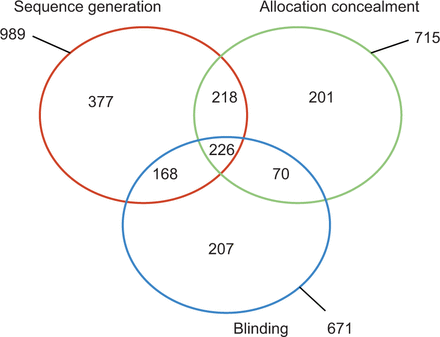
Abstract. Background: Risk-of-bias assessments are now a standard component of systematic reviews. At present, reviewers need to manually identify relevant
Automating risk of bias assessment in systematic reviews: a real-time mixed methods comparison of human researchers to a machine learning system
Machine learning and automation are increasingly used to make the evidence synthesis process faster and more responsive to policymakers’ needs. In systematic reviews of randomized controlled trials (RCTs), risk of bias assessment is a resource-intensive task that typically requires two trained reviewers. One function of RobotReviewer, an off-the-shelf machine learning system, is an automated risk of bias assessment.
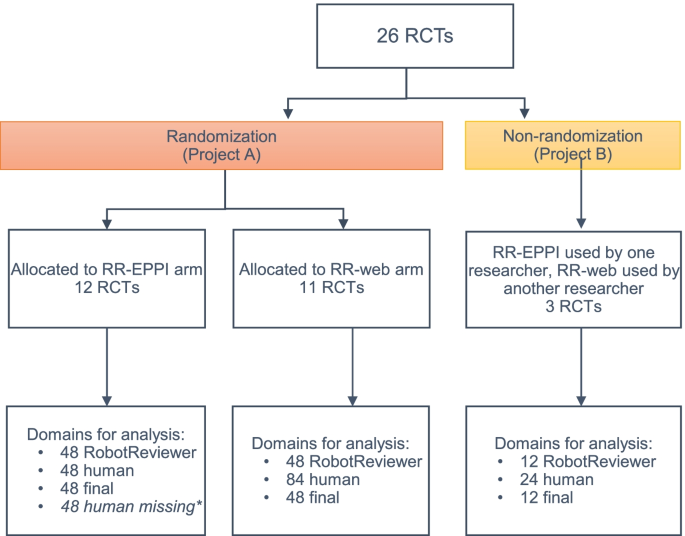
Machine learning to help researchers evaluate biases in clinical trials: a prospective, randomized user study
Assessing risks of bias in randomized controlled trials (RCTs) is an important but laborious task when conducting systematic reviews. RobotReviewer (RR), an open-source machine learning (ML) system, semi-automates bias assessments. We conducted a user study of RobotReviewer, evaluating time saved and usability of the tool.

Agreement in Risk of Bias Assessment Between RobotReviewer and Human Reviewers: An Evaluation Study on Randomised Controlled Trials in Nursing‐Related Cochrane Reviews
Abstract Purpose RobotReviewer is a machine learning system for semi‐automated assistance in risk of bias assessment. The tools’s performance in randomized controlled trials (RCTs) in the field of nursing remains unknown. We aimed therefore to evaluate the agreement in risk of bias assessment between RobotReviewer and human reviewers. Design Evaluation study using a retrospective diagnostic design. Methods We used RobotReviewer as the index test and human reviewers’ risk of bias assessment reported in Cochrane reviews as the reference test. A convenience sample of electronically available English‐language full texts of RCTs included in Cochrane reviews with nurs* in the title were eligible for inclusion. In this context, we assessed random sequence generation, allocation concealment, and blinding (personnel or participants and assessors) corresponding to Cochrane risk of bias version 2011. Two independent research teams performed and double‐checked data extraction and analysis. We calculated sensitivity, specificity, receiver operating characteristic (ROC) curve, the area under the ROC curve, predictive values, observed percentage of agreement, and Cohen’s kappa (including confidence intervals, if applicable). Findings The selection process yielded 190 RCTs published between 1958 and 2016 in 23 Cochrane reviews published between 2000 and 2018. Missing assessments of risk of bias domains in Cochrane reviews or RobotReviewer yielded varying sample sizes per risk of bias domain. Sensitivity ranged from 0.44 to 0.88 and specificity from 0.48 to 0.95. Positive predictive value was highest for allocation concealment (0.79) and lowest for blinding assessors (0.25). Cohen’s kappa was moderate for randomization (0.52), allocation concealment (0.60), and for blinding of personnel/patients (0.43). Blinding of outcome assessors had only slight agreement (0.04). Conclusions This is the first evaluation of risk of bias assessment by RobotReviewer in RCTs included in nursing‐related Cochrane reviews. It yielded a moderate degree of agreement with human reviewers for randomization and allocation concealment, and an adequate sensitivity for detecting low risk of selection bias. Clinical Relevance Based on our results, using the RobotReviewer for risk of bias assessment in RCTs can be supportive in some risk of bias domains. However, human reviewers should supervise the semi‐automated assessment process.

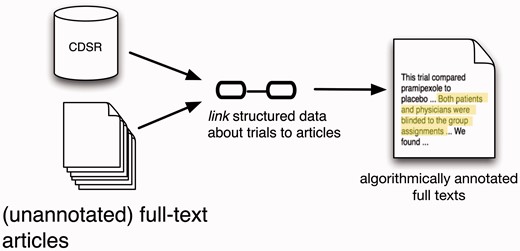
RobotReviewer: evaluation of a system for automatically assessing bias in clinical trials
Abstract. Objective To develop and evaluate RobotReviewer, a machine learning (ML) system that automatically assesses bias in clinical trials. From a (PDF-
Large Language Models and the Analyses of Adherence to Reporting Guidelines in Systematic Reviews and Overviews of Reviews (PRISMA 2020 and PRIOR)
In the context of Evidence-Based Practice (EBP), Systematic Reviews (SRs), Meta-Analyses (MAs) and overview of reviews have become cornerstones for the synthesis of research findings. The Preferred Reporting Items for Systematic Reviews and Meta-Analyses (PRISMA) 2020 and Preferred Reporting Items for Overviews of Reviews (PRIOR) statements have become major reporting guidelines for SRs/MAs and for overviews of reviews, respectively. In recent years, advances in Generative Artificial Intelligence (genAI) have been proposed as a potential major paradigm shift in scientific research. The main aim of this research was to examine the performance of four LLMs for the analysis of adherence to PRISMA 2020 and PRIOR, in a sample of 20 SRs and 20 overviews of reviews. We tested the free versions of four commonly used LLMs: ChatGPT (GPT-4o), DeepSeek (V3), Gemini (2.0 Flash) and Qwen (2.5 Max). Adherence to PRISMA 2020 and PRIOR was compared with scores defined previously by human experts, using several statistical tests. In our results, all the four LLMs showed a low performance for the analysis of adherence to PRISMA 2020, overestimating the percentage of adherence (from 23 to 30%). For PRIOR, the LLMs presented lower differences in the estimation of adherence (from 6 to 14%) and ChatGPT showed a performance similar to human experts. This is the first report of the performance of four commonly used LLMs for the analysis of adherence to PRISMA 2020 and PRIOR. Future studies of adherence to other reporting guidelines will be helpful in health sciences research.

ChatGPT for assessing risk of bias of randomized trials using the RoB 2.0 tool: A methods study
Abstract Background Internationally accepted standards for systematic reviews necessitate assessment of the risk of bias of primary studies. Assessing risk of bias, however, can be time- and resource-intensive. AI-based solutions may increase efficiency and reduce burden. Objective To evaluate the reliability of OpenAI’s ChatGPT for performing risk of bias assessments of randomized trials using the revised risk of bias tool for randomized trials (RoB 2.0). Methods We sampled recently published Cochrane systematic reviews of medical interventions (up to October 2023) that included randomized controlled trials and assessed risk of bias using the Cochrane-endorsed RoB 2.0. From each eligible review, we collected data on the risk of bias assessments for the first three reported outcomes. Using ChatGPT-4, we assessed the risk of bias for the same outcomes using three different prompts: a minimal prompt including limited instructions, a maximal prompt with extensive instructions, and an optimized prompt that was designed to yield the best risk of bias judgements. The agreement between ChatGPT’s assessments and those of Cochrane systematic reviewers was quantified using weighted kappa statistics. Results We included 34 systematic reviews with 157 unique trials. We found the agreement between ChatGPT and systematic review authors for assessment of overall risk of bias to be 0.16 (95% CI: 0.01 to 0.3) for the maximal ChatGPT prompt, 0.17 (95% CI: 0.02 to 0.32) for the optimized prompt, and 0.11 (95% CI: −0.04 to 0.27) for the minimal prompt. For the optimized prompt, agreement ranged between 0.11 (95% CI: −0.11 to 0.33) to 0.29 (95% CI: 0.14 to 0.44) across risk of bias domains, with the lowest agreement for the deviations from the intended intervention domain and the highest agreement for the missing outcome data domain. Conclusion Our results suggest that ChatGPT and systematic reviewers only have “slight” to “fair” agreement in risk of bias judgements for randomized trials. ChatGPT-4 cannot be relied upon to judge risk of bias and should not be used for this purpose. Since this study was completed, ChatGPT has advanced and OpenAI has released newer models with different capabilities. These may prove more adept at risk of bias evaluation. There may also be opportunities to use ChatGPT to streamline other aspects of systematic reviews, such as screening of search records or collection of data.
A new peer reviewer? Comparing AI with human performance in randomized controlled trial risk-of-bias assessment
Title abbreviation: Adv Clin Exp MedJournal Impact Factor (JIF 2025) – 2.5Journal Citation Indicator (JCI 2025) – 0.40Scopus CiteScore (2025) – 4.2Index Copernicus Value (ICV 2025) – 162.75MNiSW – 70 ptsISSN 1899–5276 (print), ISSN 2451-2680 (online)Periodicity – monthly
Assessing the methodologic quality of systematic reviews using generative large language models
INTRODUCTION: We aimed to evaluate whether generative large language models (LLMs) can accurately assess the methodologic quality of systematic reviews (SRs). METHODS: A total of 114 SRs from five leading urology journals were included in the study. Human reviewers graded each of the SRs in duplicate, with differences adjudicated by a third expert. We created a customized generative artificial intelligence (generative pretrained transformer [GPT]), “Urology AMSTAR 2 Quality Assessor,” and graded the 114 SRs in three iterations using a zero-shot method. We performed an enhanced trial focusing on critical criteria by giving GPT detailed, step-by-step instructions for each of the SRs using chain-of-thought method. Accuracy, sensitivity, specificity, and F1 score for each GPT trial were calculated against human results. Internal validity among three trials were computed. RESULTS: GPT had an overall congruence of 75%, with 77% in critical criteria and 73% in non-critical criteria when compared to human results. The average F1 score was 0.66. There was a high internal validity at 85% among three iterations. GPT accurately assigned 89% of studies into the correct overall category. When given specific, step-by-step instructions, congruence of critical criteria improved to 91%, and overall quality assessment accuracy to 93%. CONCLUSIONS: GPT showed promising ability to efficiently and accurately assess the quality of SRs in urology.
Position: The ML Community Must Build an AI-Augmented Peer-Review Ecosystem
Peer review, the bedrock of scientific advancement in machine learning (ML), is strained by a crisis of scale. Exponential growth in manuscript submissions to premier ML venues such as NeurIPS, ICML, and ICLR is outpacing the finite capacity of qualified reviewers, leading to concerns about review quality, consistency, and reviewer fatigue. This position paper argues that AI-assisted peer review must become an urgent research and infrastructure priority. We advocate for a comprehensive AI-augmented ecosystem, leveraging Large Language Models (LLMs) not as replacements for human judgment, but as sophisticated collaborators for authors, reviewers, and Area Chairs (ACs). We propose specific roles for AI in enhancing factual verification, guiding reviewer performance, assisting authors in quality improvement, and supporting ACs in decision-making. Crucially, we contend that the development of such systems hinges on access to more granular, structured, and ethically-sourced peer review process data. We outline a research agenda, including illustrative experiments, to develop and validate these AI assistants, and discuss significant technical and ethical challenges. We call upon the ML community to proactively build this AI-assisted future, ensuring the continued integrity and scalability of scientific validation, while maintaining high standards of peer review.

AI-Powered Systematic Review & Literature Review Platform
Rayyan is the pioneering AI-powered platform redefining evidence-based research & decision-making. Designed for efficient systematic literature review ...
Covidence - Where trusted evidence gets made.
The world's leading software for managing and streamlining your systematic review. Discover how to do a systematic review in less time, while maintaining quality and accuracy.

PREreview: Open preprint reviews. For all researchers.

Evaluating the Ability of Large Language Models to Identify Adherence to CONSORT Reporting Guidelines in Randomized Controlled Trials: A Methodological Evaluation Study
The Consolidated Standards of Reporting Trials statement is the global benchmark for transparent and high-quality reporting of randomized controlled trials. Manual verification of CONSORT adherence is a laborious, time-intensive process that constitutes a significant bottleneck in peer review and evidence synthesis. This study aimed to systematically evaluate the accuracy and reliability of contemporary LLMs in identifying the adherence of published RCTs to the CONSORT 2010 statement under a zero-shot setting. We constructed a golden standard dataset of 150 published RCTs spanning diverse medical specialties. The primary outcome was the macro-averaged F1-score for the three-class classification task, supplemented by item-wise performance metrics and qualitative error analysis. Overall model performance was modest. The top-performing models, Gemini-2.5-Flash and DeepSeek-R1, achieved nearly identical macro F1 scores of 0.634 and Cohen's Kappa coefficients of 0.280 and 0.282, respectively, indicating only fair agreement with expert consensus. A striking performance disparity was observed across classes: while most models could identify compliant items with high accuracy (F1 score > 0.850), they struggled profoundly with identifying non-compliant and not applicable items, where F1 scores rarely exceeded 0.400. Notably, some high-profile models like GPT-4o underperformed, achieving a macro F1-score of only 0.521. LLMs show potential as preliminary screening assistants for CONSORT checks, capably identifying well-reported items. However, their current inability to reliably detect reporting omissions or methodological flaws makes them unsuitable for replacing human expertise in the critical appraisal of trial quality.
Pre-review to Peer review: Pitfalls of Automating Reviews using Large Language Models
Large Language Models are versatile general-task solvers, and their capabilities can truly assist people with scholarly peer review as \textit{pre-review} agents, if not as fully autonomous \textit{peer-review} agents. While incredibly beneficial, automating academic peer-review, as a concept, raises concerns surrounding safety, research integrity, and the validity of the academic peer-review process. The majority of the studies performing a systematic evaluation of frontier LLMs generating reviews across science disciplines miss the mark on addressing the alignment/misalignment of reviews along with the utility of LLM generated reviews when compared against publication outcomes such as \textbf{Citations}, \textbf{Hit-papers}, \textbf{Novelty}, and \textbf{Disruption}. This paper presents an experimental study in which we gathered ground-truth reviewer ratings from OpenReview and used various frontier open-weight LLMs to generate reviews of papers to gauge the safety and reliability of incorporating LLMs into the scientific review pipeline. Our findings demonstrate the utility of frontier open-weight LLMs as pre-review screening agents despite highlighting fundamental misalignment risks when deployed as autonomous reviewers. Our results show that all models exhibit weak correlation with human peer reviewers (0.15), with systematic overestimation bias of 3-5 points and uniformly high confidence scores (8.0-9.0/10) despite prediction errors. However, we also observed that LLM reviews correlate more strongly with post-publication metrics than with human scores, suggesting potential utility as pre-review screening tools. Our findings highlight the potential and address the pitfalls of automating peer reviews with language models. We open-sourced our dataset $D_{LMRSD}$ to help the research community expand the safety framework of automating scientific reviews.
The Utility of AI Tools in Auditing Adherence to Pre-Analysis Plans
Pre-analysis plans (PAPs) can improve research reproducibility by reducing researchers’ degrees of freedom, but their value depends on adherence. We argue that large language models (LLMs) can provide an efficient, scalable, and systematic way for authors and reviewers to assess adherence to PAPs. In an application to our own research, an LLM systematically identifies precommitted design choices, evaluates deviations, and diagnoses gaps in pre-specification, substantially reducing the human labor required for these tasks. However, variability in audit output across LLMs underscores the continued importance of human judgment. We discuss implications for best practices in AI-assisted PAP auditing.
