

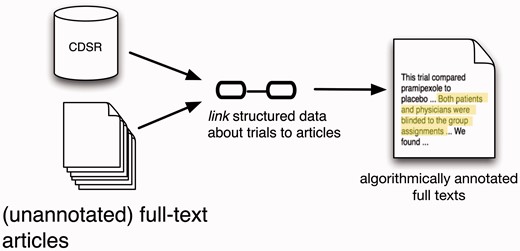
Abstract. Objective To develop and evaluate RobotReviewer, a machine learning (ML) system that automatically assesses bias in clinical trials. From a (PDF-
Machine learning to help researchers evaluate biases in clinical trials: a prospective, randomized user study
Assessing risks of bias in randomized controlled trials (RCTs) is an important but laborious task when conducting systematic reviews. RobotReviewer (RR), an open-source machine learning (ML) system, semi-automates bias assessments. We conducted a user study of RobotReviewer, evaluating time saved and usability of the tool.

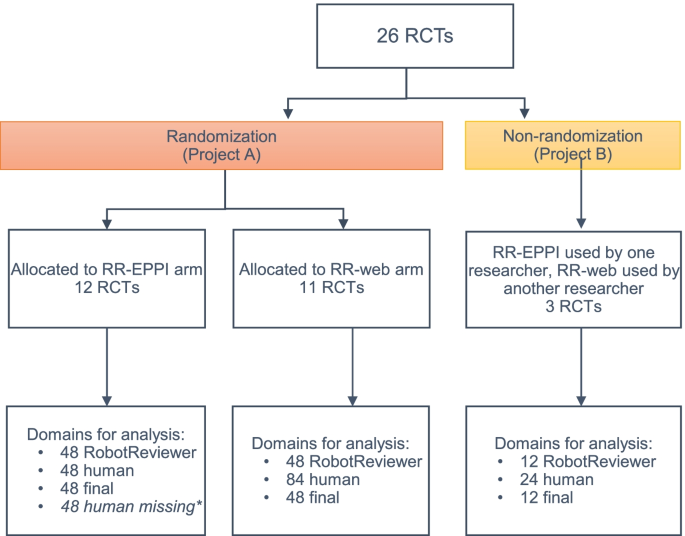
Automating risk of bias assessment in systematic reviews: a real-time mixed methods comparison of human researchers to a machine learning system
Machine learning and automation are increasingly used to make the evidence synthesis process faster and more responsive to policymakers’ needs. In systematic reviews of randomized controlled trials (RCTs), risk of bias assessment is a resource-intensive task that typically requires two trained reviewers. One function of RobotReviewer, an off-the-shelf machine learning system, is an automated risk of bias assessment.
Agreement in Risk of Bias Assessment Between RobotReviewer and Human Reviewers: An Evaluation Study on Randomised Controlled Trials in Nursing‐Related Cochrane Reviews
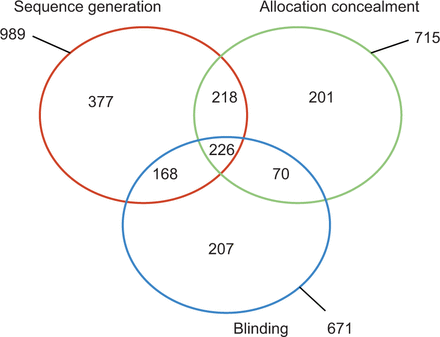
Abstract Purpose RobotReviewer is a machine learning system for semi‐automated assistance in risk of bias assessment. The tools’s performance in randomized controlled trials (RCTs) in the field of nursing remains unknown. We aimed therefore to evaluate the agreement in risk of bias assessment between RobotReviewer and human reviewers. Design Evaluation study using a retrospective diagnostic design. Methods We used RobotReviewer as the index test and human reviewers’ risk of bias assessment reported in Cochrane reviews as the reference test. A convenience sample of electronically available English‐language full texts of RCTs included in Cochrane reviews with nurs* in the title were eligible for inclusion. In this context, we assessed random sequence generation, allocation concealment, and blinding (personnel or participants and assessors) corresponding to Cochrane risk of bias version 2011. Two independent research teams performed and double‐checked data extraction and analysis. We calculated sensitivity, specificity, receiver operating characteristic (ROC) curve, the area under the ROC curve, predictive values, observed percentage of agreement, and Cohen’s kappa (including confidence intervals, if applicable). Findings The selection process yielded 190 RCTs published between 1958 and 2016 in 23 Cochrane reviews published between 2000 and 2018. Missing assessments of risk of bias domains in Cochrane reviews or RobotReviewer yielded varying sample sizes per risk of bias domain. Sensitivity ranged from 0.44 to 0.88 and specificity from 0.48 to 0.95. Positive predictive value was highest for allocation concealment (0.79) and lowest for blinding assessors (0.25). Cohen’s kappa was moderate for randomization (0.52), allocation concealment (0.60), and for blinding of personnel/patients (0.43). Blinding of outcome assessors had only slight agreement (0.04). Conclusions This is the first evaluation of risk of bias assessment by RobotReviewer in RCTs included in nursing‐related Cochrane reviews. It yielded a moderate degree of agreement with human reviewers for randomization and allocation concealment, and an adequate sensitivity for detecting low risk of selection bias. Clinical Relevance Based on our results, using the RobotReviewer for risk of bias assessment in RCTs can be supportive in some risk of bias domains. However, human reviewers should supervise the semi‐automated assessment process.

Machine learning to assist risk-of-bias assessments in systematic reviews
Abstract. Background: Risk-of-bias assessments are now a standard component of systematic reviews. At present, reviewers need to manually identify relevant
ChatGPT for assessing risk of bias of randomized trials using the RoB 2.0 tool: A methods study
Abstract Background Internationally accepted standards for systematic reviews necessitate assessment of the risk of bias of primary studies. Assessing risk of bias, however, can be time- and resource-intensive. AI-based solutions may increase efficiency and reduce burden. Objective To evaluate the reliability of OpenAI’s ChatGPT for performing risk of bias assessments of randomized trials using the revised risk of bias tool for randomized trials (RoB 2.0). Methods We sampled recently published Cochrane systematic reviews of medical interventions (up to October 2023) that included randomized controlled trials and assessed risk of bias using the Cochrane-endorsed RoB 2.0. From each eligible review, we collected data on the risk of bias assessments for the first three reported outcomes. Using ChatGPT-4, we assessed the risk of bias for the same outcomes using three different prompts: a minimal prompt including limited instructions, a maximal prompt with extensive instructions, and an optimized prompt that was designed to yield the best risk of bias judgements. The agreement between ChatGPT’s assessments and those of Cochrane systematic reviewers was quantified using weighted kappa statistics. Results We included 34 systematic reviews with 157 unique trials. We found the agreement between ChatGPT and systematic review authors for assessment of overall risk of bias to be 0.16 (95% CI: 0.01 to 0.3) for the maximal ChatGPT prompt, 0.17 (95% CI: 0.02 to 0.32) for the optimized prompt, and 0.11 (95% CI: −0.04 to 0.27) for the minimal prompt. For the optimized prompt, agreement ranged between 0.11 (95% CI: −0.11 to 0.33) to 0.29 (95% CI: 0.14 to 0.44) across risk of bias domains, with the lowest agreement for the deviations from the intended intervention domain and the highest agreement for the missing outcome data domain. Conclusion Our results suggest that ChatGPT and systematic reviewers only have “slight” to “fair” agreement in risk of bias judgements for randomized trials. ChatGPT-4 cannot be relied upon to judge risk of bias and should not be used for this purpose. Since this study was completed, ChatGPT has advanced and OpenAI has released newer models with different capabilities. These may prove more adept at risk of bias evaluation. There may also be opportunities to use ChatGPT to streamline other aspects of systematic reviews, such as screening of search records or collection of data.
A new peer reviewer? Comparing AI with human performance in randomized controlled trial risk-of-bias assessment
Title abbreviation: Adv Clin Exp MedJournal Impact Factor (JIF 2025) – 2.5Journal Citation Indicator (JCI 2025) – 0.40Scopus CiteScore (2025) – 4.2Index Copernicus Value (ICV 2025) – 162.75MNiSW – 70 ptsISSN 1899–5276 (print), ISSN 2451-2680 (online)Periodicity – monthly
How AI agents shape experts’ judgment calls
In a randomized trial, professional analysts working with an AI coding agent went with the option the agent was randomly assigned to favor 86% of the time. We look at what this means for human oversight of AI-assisted work.

Algorithmic Bias · Open Encyclopedia of Cognitive Science
Algorithmic bias refers to prejudicial, discriminatory, unjust, inaccurate, or otherwise disparate performance or outcomes from algorithmic systems based on racial, gender, or other attributes of an individual or a group. The concept of algorithmic bias emerged at the intersection of computer science, artificial intelligence (AI) research, critical data studies, human–computer interaction, law, philosophy, and similar disciplines. Although problems and discrepancies at the model level denote the most commonly studied form of bias, the term algorithmic bias is also used as a shorthand to describe a multitude of problems and challenges at various steps of the AI pipeline from ideation, problem framing, training data curation and processing, model training and validation, and deployment as well as emergent issues that arise from interaction with the real world. Potential sources of bias, appropriate metrics to define, measure, and mitigate bias, and the utility and merit of technical approaches to bias mitigation are fiercely debated in the current AI landscape.

Machine Bias — ProPublica
There’s software used across the country to predict future criminals. And it’s biased against blacks.

Benchmarking agreement between large language models and published clinical trial conclusions across four artificial intelligence platforms
Advanced large language models (LLMs) such as ChatGPT, Gemini, Grok3, and Claude offer new possibilities for medical research interpretation and clinical decision support. While these models demonstrate remarkable natural language processing capabilities, their ability to independently reason through clinical trial data and produce conclusions consistent with published trial interpretations remains underexplored. The objective was to evaluate the reliability of LLMs in interpreting numerical and statistical healthcare data. For this study, landmark randomized controlled trials (RCTs) were selected as a standardized domain to minimize bias from poor-quality research designs. Twenty landmark RCTs from the New England Journal of Medicine were analyzed in neurosurgical and cardiovascular intervention domains. Four AI platforms were evaluated using a structured prompt covering five domains: evidence interpretation, statistical understanding, clinical relevance, limitation recognition, and practical applicability. Two independent raters scored all AI outputs on a 0–5 scale per domain, and interobserver reliability was assessed. Primary outcomes included concordance with published trial conclusions, accuracy of primary outcome identification, and appropriateness of recommendations. Secondary outcomes included output pattern analysis, recognition of limitations, and handling of confounding factors. ChatGPT demonstrated the highest concordance with published conclusions at 100.0%, followed by Gemini at 84%, Grok3 at 72%, and Claude at 68%. However, these concordance scores should be interpreted cautiously, as the LLMs may have been trained on these published trials, potentially inflating alignment with published conclusions. ChatGPT and Gemini accurately identified limitations and confounding factors, while Grok3 and Claude struggled in these secondary outcomes. Interobserver reliability between raters was good (Cronbach’s α = 0.868), supporting the consistency of scoring. Certain LLMs, particularly ChatGPT and Gemini, can reliably interpret clinical trial data and align closely with human conclusions, suggesting a potential role in data summarization and evidence synthesis. These findings highlight the importance of selecting AI tools carefully and highlight potential applications in research and clinical workflows.

Underspecified Human Decision Experiments Considered Harmful
Decision-making with information displays is a key focus of research in areas like human-AI collaboration and data visualization. However, what constitutes a decision problem, and what is required for an experiment to conclude that decisions are flawed, remain imprecise. We present a widely applicable definition of a decision problem synthesized from statistical decision theory and information economics. We claim that to attribute loss in human performance to bias, an experiment must provide the information that a rational agent would need to identify the normative decision. We evaluate whether recent empirical research on AI-assisted decisions achieves this standard. We find that only 10 (26%) of 39 studies that claim to identify biased behavior presented participants with sufficient information to make this claim in at least one treatment condition. We motivate the value of studying well-defined decision problems by describing a characterization of performance losses they allow to be conceived.

General-purpose large language models outperform specialized clinical AI tools on medical benchmarks
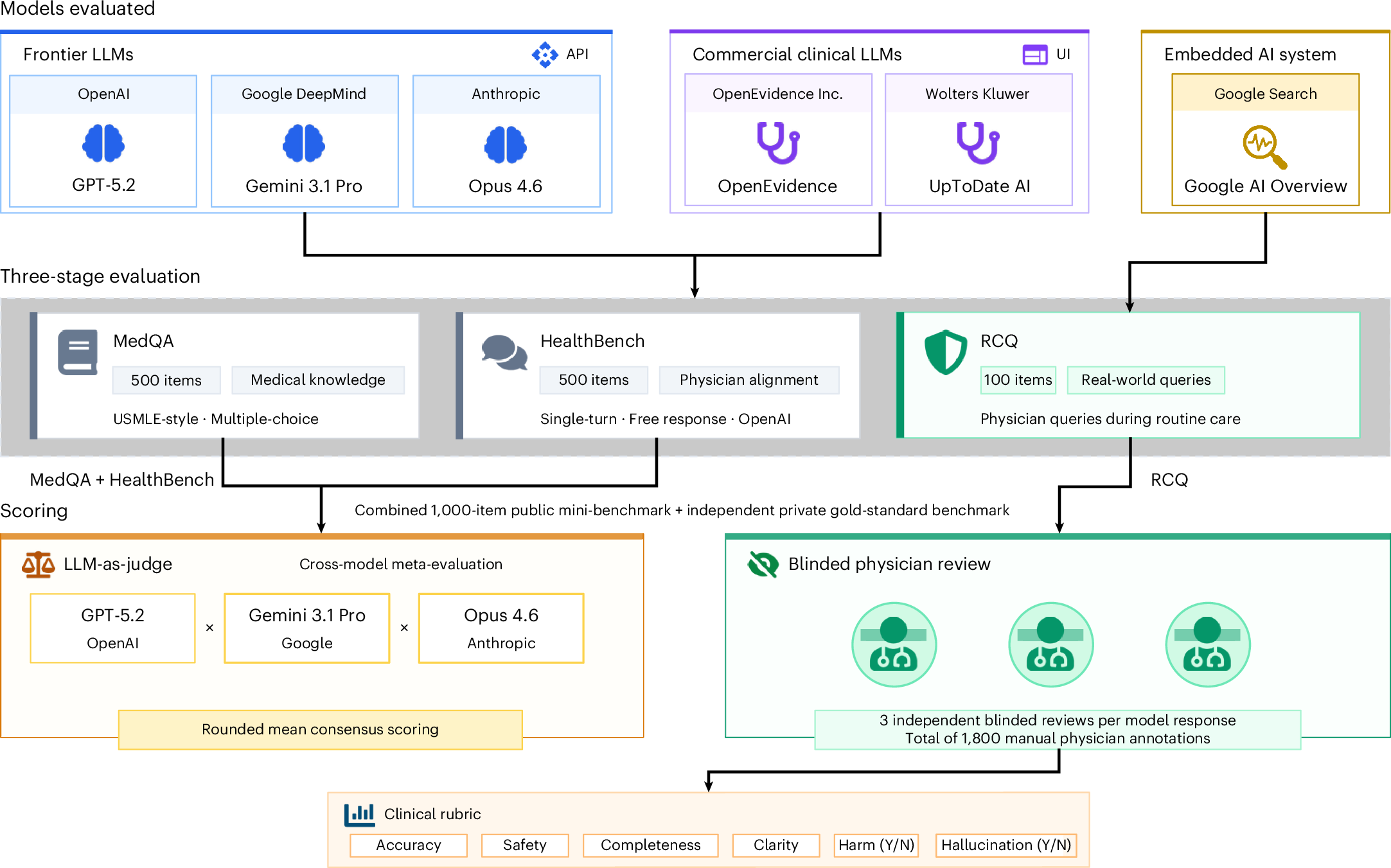
Specialized clinical artificial intelligence (AI) tools are entering medical practice despite scarce independent evaluation. We quantitatively evaluate two clinical AI tools, OpenEvidence and UpToDate Expert AI, built on large language models (LLMs) against three frontier LLMs: GPT-5.2, Gemini 3.1 Pro and Claude Opus 4.6. Our evaluation has three stages: (1) 500 MedQA questions testing medical knowledge, (2) 500 HealthBench items measuring alignment with clinicians and (3) the real clinical queries (RCQ) benchmark, built from 100 de-identified queries from physicians to a general-purpose language model in a live clinical environment. For the RCQ benchmark, 12 US clinicians performed randomized, blinded review of model outputs, producing 1,800 model–question annotations. Frontier LLMs outperformed clinical AI tools in all three evaluations. Clinical AI tools performed comparably to auto-enabled Google Search AI Overview on the RCQ. These findings highlight the need for independent, real-world evaluation of AI tools before they enter clinical settings.
Using AI Made Doctors Worse at Spotting Cancer Without Assistance
A new study offers the latest evidence of potential “deskilling” effects on AI users.

How human–AI feedback loops alter human perceptual, emotional and social judgements
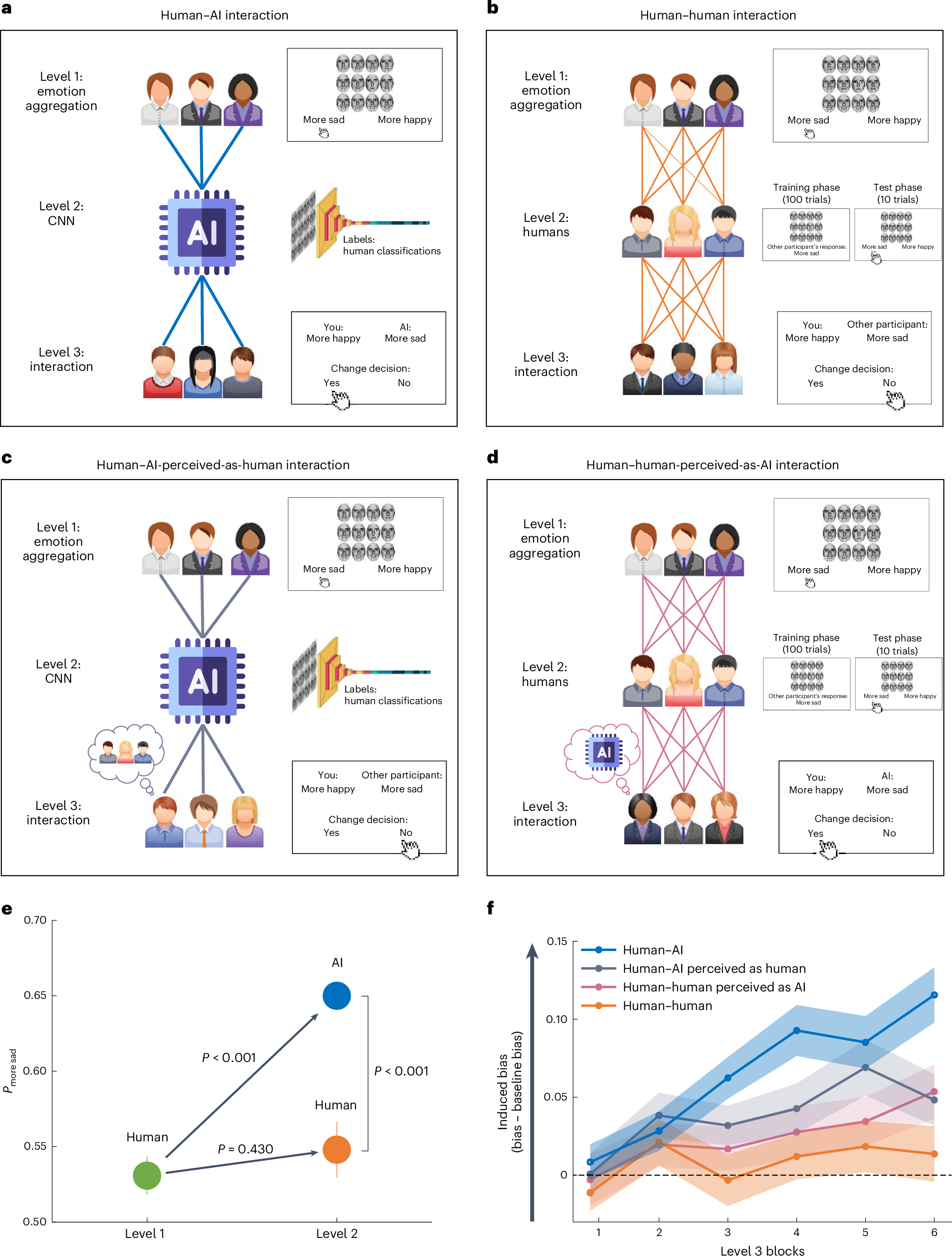
Artificial intelligence (AI) technologies are rapidly advancing, enhancing human capabilities across various fields spanning from finance to medicine. Despite their numerous advantages, AI systems can exhibit biased judgements in domains ranging from perception to emotion. Here, in a series of experiments (n = 1,401 participants), we reveal a feedback loop where human–AI interactions alter processes underlying human perceptual, emotional and social judgements, subsequently amplifying biases in humans. This amplification is significantly greater than that observed in interactions between humans, due to both the tendency of AI systems to amplify biases and the way humans perceive AI systems. Participants are often unaware of the extent of the AI’s influence, rendering them more susceptible to it. These findings uncover a mechanism wherein AI systems amplify biases, which are further internalized by humans, triggering a snowball effect where small errors in judgement escalate into much larger ones.
Cognitive Bias Lab | Learn to Make Better Decisions
Explore cognitive biases with interactive tests, simulations, and real-world examples. Free platform to sharpen decision-making and critical thinking — no sign-up needed.
Risk of bias tools - Current version of RoB 2
Current version Download the 22 August 2019 version: The full guidance document. The cribsheet summarizing the tool. A template for completing the assessment. An Excel tool to implement RoB 2 (contains macros; download to your computer before using; some text is slightly out of date). We have
