Abstract. Social media technologies have been criticized as ineffective sources of information because users seem to increase their subjective but not thei
Does news help us become knowledgeable or think we are knowledgeable? Examining a linkage of traditional and social media use with political knowledge
This study examines traditional and social media news use in relation to political knowledge from the perspective of the Dunning-Kruger effect. Data from a two-wave panel survey show that social me...

The Interplay of Knowledge Overestimation, Social Media Use, and Populist Ideas: Cross-Sectional and Experimental Evidence From Germany and Taiwan - Niels G. Mede, Adrian Rauchfleisch, Julia Metag, Mike S. Schäfer, 2024
Social media expose users to an abundance of information about various issues. But they also make it difficult for users to assess the quality of this informati...

Illusion of knowledge through Facebook news? Effects of snack news in a news feed on perceived knowledge, attitude strength, and willingness for discussions
Research indicates that using social network sites as a source for news increases perceived knowledge even if, objectively, people fail to acquire knowledge. This might result from the frequent repetition of topics in news posts caused by multiple news outlets posting about the same news topics and the algorithm that favors similar postings. These repeated encounters can have a positive effect on the perception of knowing more, even if actual learning hardly occurs. An experiment (N = 810, representative of German Internet users) tested these assumptions. Participants were assigned to one of four groups and received a news feed with no information, few news posts, many news posts, or a full-length news article. Results indicate that many news posts increased perceived knowledge that is not paralleled by a gain in factual knowledge. Perceived knowledge mediates effects of reading many news posts on more extreme attitudes and the willingness for discussions. Even if participants who read the news article gained factual knowledge, they did not feel more knowledgeable than participants who were exposed to a news feed containing news posts. The results emphasize the meaning of engaging with full news articles, both for learning facts and for more accurate knowledge assessments.
Cognitive Load and Social Media Advertising
Social media engagement requires cognitive resources, which subsequently impact the advertisements consumers see while browsing. For the most part, however, advertising practitioners and scholars s...

Consequences of Information Feed Integration on User Engagement and Contribution: A Natural Experiment in an Online Knowledge-Sharing Community
Many online communities that rely on effortful, voluntary content contributions offer additional content curation tools to facilitate social interactions and encourage user contributions. Any platform that offers two or more heterogeneous content types (e.g., expert knowledge and social posts) faces a choice about the presentation format: whether to display the content types separately or in an integrated information feed. We leverage a natural experiment on Zhihu, a Q&A platform that offers a social-interaction-oriented functionality called Ideas. Zhihu initially presented answers (expert knowledge content) and ideas (social posts) in two different information feeds, but the platform integrated ideas into the same information feed as answers in June 2019. We find that information feed integration significantly decreased user engagement with and contribution of both ideas and answers. We hypothesize that users decreased their engagement because the juxtaposition of incongruous types of content increased mindset switching and cognitive strain. This hypothesis is supported by an additional laboratory experiment. We also present evidence showing that contributions decreased both because of the decrease in engagement (weaker social recognition incentives) and because integration heightened concerns that posting ideas would dilute the contributor’s professional image. Our findings have important theoretical and practical implications for any platform that hosts heterogeneous content. History: Xiaoquan (Michael) Zhang served as the senior editor and Yili (Kevin) Hong served as associate editor for this article. Funding: Z. Cao acknowledges this research was funded by National Natural Science Foundation of China [Grants 72201238, 72192823]. G. Li acknowledges this research was funded by National Natural Science Foundation of China [Grant 72102047] and Shanghai Pujiang Program [Grant 21PJC006]. Supplemental Material: The e-companion is available at https://doi.org/10.1287/isre.2022.0043.
Searching for explanations: How the Internet inflates estimates of internal knowledge.
Experimental evidence of the effects of large language models versus web search on depth of learning
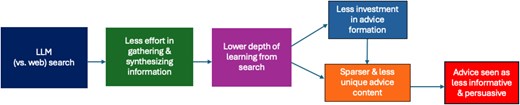
Abstract The effects of using large language models (LLMs) versus traditional web search on depth of learning are explored. A theory is proposed that when individuals learn about a topic from LLM syntheses, they risk developing shallower knowledge than when they learn through standard web search, even when the core facts in the results are the same. This shallower knowledge accrues from an inherent feature of LLMs—the presentation of results as summaries of vast arrays of information rather than individual search links—which inhibits users from actively discovering and synthesizing information sources themselves, as in traditional web search. Thus, when subsequently forming advice on the topic based on their search, those who learn from LLM syntheses (vs. traditional web links) feel less invested in forming their advice, and, more importantly, create advice that is sparser, less original, and ultimately less likely to be adopted by recipients. Results from seven online and laboratory experiments (n = 10,462) lend support for these predictions, and confirm, for example, that participants reported developing shallower knowledge from LLM summaries even when the results were augmented by real-time web links. Implications of the findings for recent research on the benefits and risks of LLMs, as well as limitations of the work, are discussed.
Following news on social media boosts knowledge, belief accuracy and trust
Many worry that news on social media leaves people uninformed or even misinformed. Here we conducted a preregistered two-wave online field experiment in France and Germany (N = 3,395) to estimate the effect of following the news on Instagram and WhatsApp. Participants were asked to follow two accounts for 2 weeks and activate the notifications. In the treatment condition, the accounts were those of news organizations, while in the control condition they covered cooking, cinema or art. The treatment enhanced current affairs knowledge, participants’ ability to discern true from false news stories and awareness of true news stories, as well as trust in the news. The treatment had no significant effects on feelings of being informed, political efficacy, affective polarization and interest in news or politics. These results suggest that, while some forms of social media use are harmful, others are beneficial and can be leveraged to foster a well-informed society.

Why Don’t We Learn from Social Media? Studying Effects of and Mechanisms behind Social Media News Use on General Surveillance Political Knowledge
Does exposure to news affect what people know about politics? This old question attracted new scholarly interest as the political information environment is changing rapidly. In particular, since c...

A perspective on friction interventions to curb the spread of misinformation
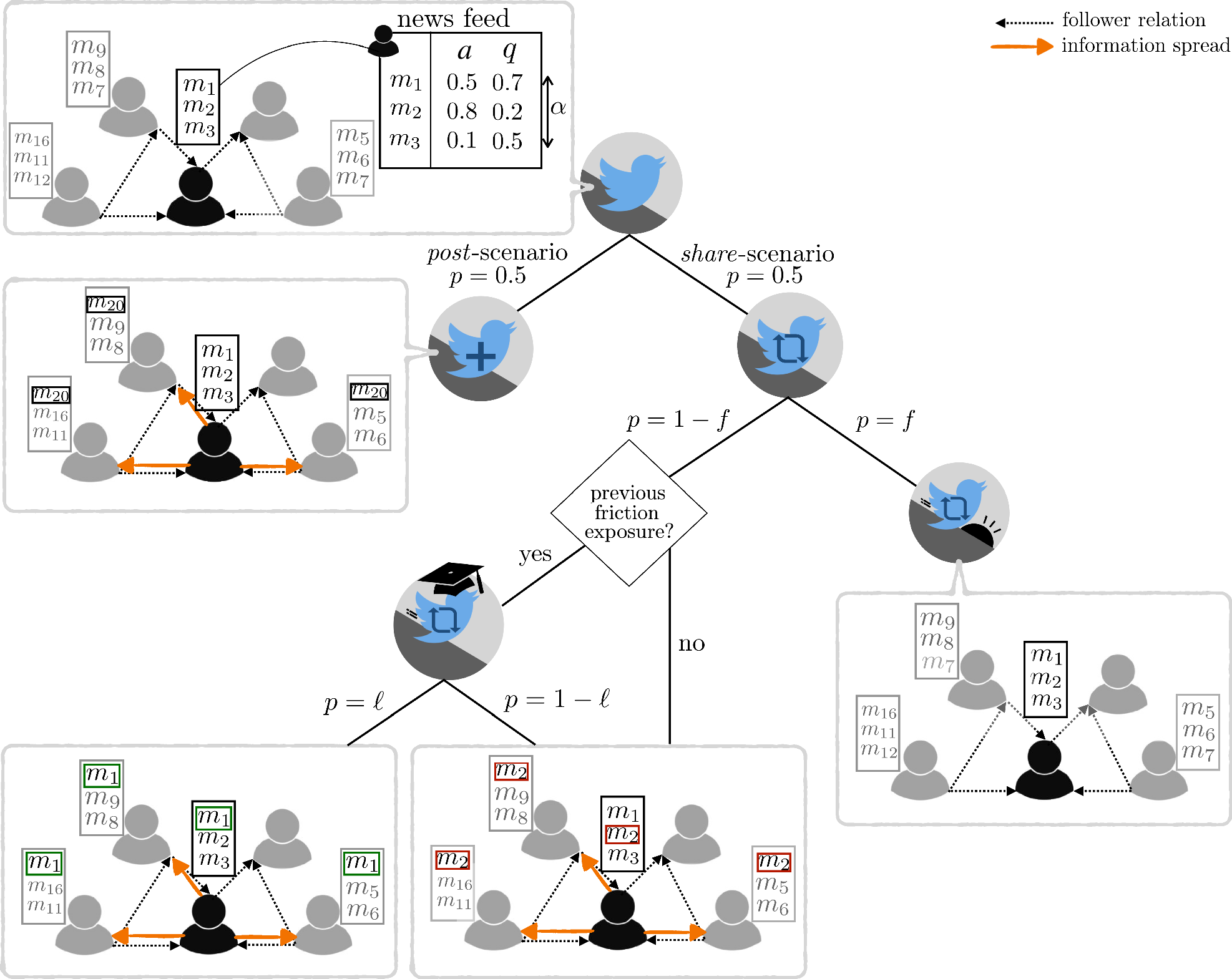
Social media has enabled the spread of information at unprecedented speeds and scales, and with it the proliferation of high-engagement, low-quality content. Friction—behavioral design measures that make the sharing of content more cumbersome—might be a way to raise the quality of what is spread online. In this perspective, we propose a scalable field experiment to study the effects of friction with a learning component to educate users on the platform’s community standards. Preliminary simulations from an agent-based model suggest that while friction alone may decrease the number of posts without improving their quality, it could significantly increase the average quality of posts when combined with learning. The model also suggests that too much friction could be counterproductive. Experimental interventions inspired by these findings would be minimally invasive.
The 'normal' response to the Social Web
How (mostly) 'normal' people respond to the ideas of the Social Web Marketing the Social Web is a headache. Only heightened by the clashing of heads as everyone offers an opinion. Picture those dinosaurs that have their skull on the outside. That's us. No wonder it's a headache.

Sharing news you didn't read can feel like expertise
Social media sharers believe that they are knowledgeable about the content they share, even if they have not read it or have only glanced at a headline.
Custodians of the Internet
A revealing and gripping investigation into how social media platforms police what we post online—and the large societal impact of these decisions Most use...
Sharing of misinformation is habitual, not just lazy or biased
Why do people share misinformation on social media? In this research ( N = 2,476), we show that the structure of online sharing built into social platforms is more important than individual deficits in critical reasoning and partisan bias—commonly cited drivers of misinformation. Due to the reward-based learning systems on social media, users form habits of sharing information that attracts others' attention. Once habits form, information sharing is automatically activated by cues on the platform without users considering response outcomes such as spreading misinformation. As a result of user habits, 30 to 40% of the false news shared in our research was due to the 15% most habitual news sharers. Suggesting that sharing of false news is part of a broader response pattern established by social media platforms, habitual users also shared information that challenged their own political beliefs. Finally, we show that sharing of false news is not an inevitable consequence of user habits: Social media sites could be restructured to build habits to share accurate information.

Sharing of misinformation is habitual, not just lazy or biased
Why do people share misinformation on social media? In this research ( N = 2,476), we show that the structure of online sharing built into social platforms is more important than individual deficits in critical reasoning and partisan bias—commonly cited drivers of misinformation. Due to the reward-based learning systems on social media, users form habits of sharing information that attracts others' attention. Once habits form, information sharing is automatically activated by cues on the platform without users considering response outcomes such as spreading misinformation. As a result of user habits, 30 to 40% of the false news shared in our research was due to the 15% most habitual news sharers. Suggesting that sharing of false news is part of a broader response pattern established by social media platforms, habitual users also shared information that challenged their own political beliefs. Finally, we show that sharing of false news is not an inevitable consequence of user habits: Social media sites could be restructured to build habits to share accurate information.
Introducing a network for thoughtful conversations
The quality of conversations on the Internet is terrible. Most platforms like Twitter, Facebook, Instagram, Reddit, etc. optimize for engagement as their key metric. This spawns and rewards behavior that leads to bragging of gameable metrics such as likes and followers, self-feeding thought bubbles, knee-jerk reactions, “if you’re not on our side, you’re on their side” mentality, and thought policing even by people who think they’re fighting for a good cause. Today’s Internet doesn’t incentiviz