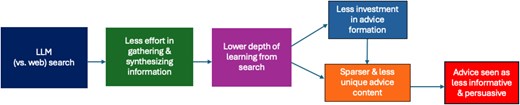
Abstract. The effects of using large language models (LLMs) versus traditional web search on depth of learning are explored. A theory is proposed that when
Experimental evidence of the effects of large language models versus web search on depth of learning
Abstract The effects of using large language models (LLMs) versus traditional web search on depth of learning are explored. A theory is proposed that when individuals learn about a topic from LLM syntheses, they risk developing shallower knowledge than when they learn through standard web search, even when the core facts in the results are the same. This shallower knowledge accrues from an inherent feature of LLMs—the presentation of results as summaries of vast arrays of information rather than individual search links—which inhibits users from actively discovering and synthesizing information sources themselves, as in traditional web search. Thus, when subsequently forming advice on the topic based on their search, those who learn from LLM syntheses (vs. traditional web links) feel less invested in forming their advice, and, more importantly, create advice that is sparser, less original, and ultimately less likely to be adopted by recipients. Results from seven online and laboratory experiments (n = 10,462) lend support for these predictions, and confirm, for example, that participants reported developing shallower knowledge from LLM summaries even when the results were augmented by real-time web links. Implications of the findings for recent research on the benefits and risks of LLMs, as well as limitations of the work, are discussed.
Curated retrieval versus open web search in public AI information...
Public institutions increasingly use large language models (LLMs) to answer citizens' questions, often pairing a curated knowledge base with live web search, yet whether the sources behind these...

Augmenting Research Ideation with Data: An Empirical Investigation...
Recent advancements in large language models (LLMs) demonstrate strong potential for generating novel research ideas, yet such ideas often struggle with feasibility and effectiveness. In this...
AI’s Memorization Crisis
Large language models don’t “learn”—they copy. And that could change everything for the tech industry.

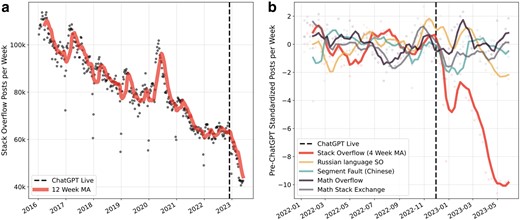
Large language models reduce public knowledge sharing on online Q&A platforms
Abstract. Large language models (LLMs) are a potential substitute for human-generated data and knowledge resources. This substitution, however, can present
Language models struggle with compartmentalization
In the training data used by large language models (LLMs), the same latent concept is often presented in multiple distinct ways: the same facts appear in English and Swahili; many functions can be expressed in both Python and Haskell; we can express propositions in both formal and natural language. We show that LLMs can exhibit compartmentalization, where they fail to identify and share statistical strength between distinct presentations of unified concepts. In the worst case, LLMs simply learn parallel internal representations of each presentation of the concept, saturating model capacity with redundancies and decreasing sample efficiency with the number of such presentations. We also demonstrate that synthetic parallel data can fail to improve this despite being easily learned itself. Under this framework, we find that, for small models, early multilingual learning is nearly entirely compartmentalized. Finally, all interventions that we study exhibit a phase transition in which their effectiveness depends on the number of distinct presentations, suggesting that the language modeling objective may only inconsistently unify representations.
Learning with AI falls short compared to old-fashioned web search
Doing the mental work of connecting the dots across multiple web queries appears to help people understand the material better compared to an AI summary.

Learning with AI falls short compared to old-fashioned web search
Doing the mental work of connecting the dots across multiple web queries appears to help people understand the material better compared to an AI summary.
How Large Language Models Actually Work
Artificial intelligences and human scientists exhibit...
We investigate the effectiveness of artificial intelligences (AI)-specifically large language models (LLMs)-relative to human scientists at high-level cognitive tasks in social science such as...
The Case Against LLMs as Rerankers
Authors: Apoorva Joshi, Zhenmei Shi, Akshay Goindani, Hong LiuResearch Leads: Zhenmei Shi, Akshay Goindani, Hong Liu Large language models are increasingly being used for a broad range of tasks, in…

How linguistics learned to stop worrying and love the language models
Language models (LMs) can produce fluent, grammatical text. Nonetheless, some maintain that language models don’t really learn language and also, even if they did, that would not be informative for the study of human learning and processing. On the other side, there have been claims that the success of LMs obviates the need for studying linguistic theory and structure. We argue that both extremes are wrong. LMs can contribute to fundamental questions about linguistic structure, language processing, and learning. They force us to rethink arguments and ways of thinking that have been foundational in linguistics. While they do not replace linguistic structure and theory, they serve as model systems and working proofs of concept for gradient, usage-based approaches to language. We offer an optimistic take on the relationship between language models and linguistics.

Scaling Laws Across Model Architectures: A Comparative Analysis of...
The scaling of large language models (LLMs) is a critical research area for the efficiency and effectiveness of model training and deployment. Our work investigates the transferability and...
Large language models are not the problem
If a Large Language Model (LLM) can replicate your scientific contribution, the problem is not the LLM. What does it say about our field that so much of the anxiety about AI comes down to the fear that a machine could do what we do? Perhaps it says we should be doing something better.

Mapping the Mind of a Large Language Model
We have identified how millions of concepts are represented inside Claude Sonnet, one of our deployed large language models. This is the first ever detailed look inside a modern, production-grade large language model.
LLMs and World Models, Part 1
How do Large Language Models Make Sense of Their “Worlds”?