

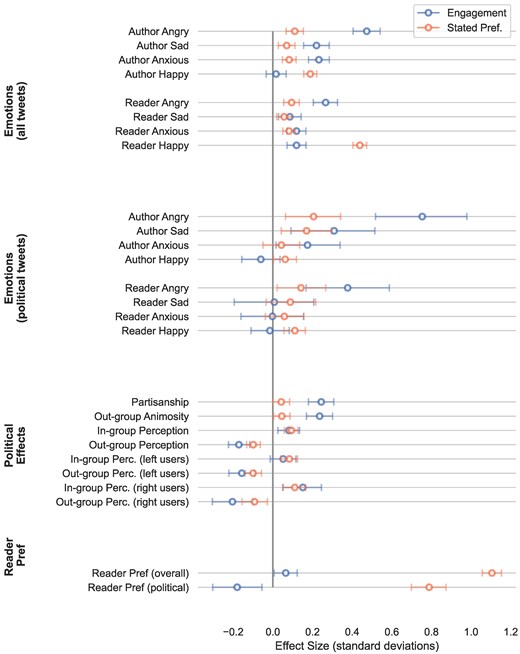
Abstract. Social media ranking algorithms typically optimize for users’ revealed preferences, i.e. user engagement such as clicks, shares, and likes. Many
Engagement, user satisfaction, and the amplification of divisive content on social media
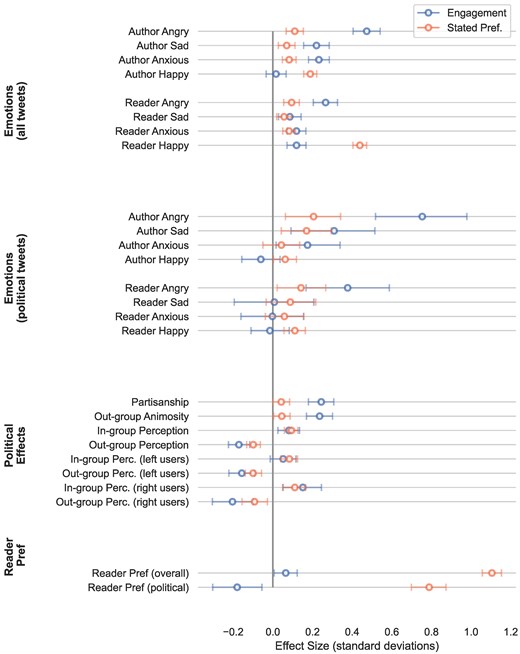
Abstract Social media ranking algorithms typically optimize for users’ revealed preferences, i.e. user engagement such as clicks, shares, and likes. Many have hypothesized that by focusing on users’ revealed preferences, these algorithms may exacerbate human behavioral biases. In a preregistered algorithmic audit, we found that, relative to a reverse-chronological baseline, Twitter’s engagement-based ranking algorithm amplifies emotionally charged, out-group hostile content that users say makes them feel worse about their political out-group. Furthermore, we find that users do not prefer the political tweets selected by the algorithm, suggesting that the engagement-based algorithm underperforms in satisfying users’ stated preferences. Finally, we explore the implications of an alternative approach that ranks content based on users’ stated preferences and find a reduction in angry, partisan, and out-group hostile content, but also a potential reinforcement of proattitudinal content. Overall, our findings suggest that greater integration of stated preferences into social media ranking algorithms could promote better online discourse, though potential trade-offs also warrant further investigation.
Social Media Feed Ranking Algorithms: Guide to Field Experiments
IC2S2'26 Tutorial | Social Media Feed Ranking Algorithms: Guide to Field Experiments
Top 100: The most popular social media platforms and what they can teach us
After seven essays in our Mapping Social Media series, we wanted to take a step back and evaluate our work so far. We thought a good way to do this would be to construct a list of the top 100 most popular social media platforms (a harder task than you might think!) and see what we could learn from it using the analytical framework we’ve developed over the course of this series. We also examined our analytical framework itself, comparing it to existing frameworks and exploring where it worked and where it fell short.

The Prosocial Ranking Challenge: Reducing Polarization on Social...
We report the first direct comparisons of multiple alternative social media algorithms on multiple platforms on outcomes of societal interest. We used a browser extension to modify which posts...

Bridging-Based Ranking
There is significant concern about the engagement-based ranking systems used by TikTok, Facebook, YouTube, etc. to recommend content. Bridging-based ranking systems can address one of the most dangerous aspects of such algorithmic recommendations—the push toward polarization and divisiveness that is tearing nations apart—and do so without reducing anonymity or increasing censorship. This report explores what bridging-based ranking is, how it helps (overcoming downsides of chronological feeds and middleware), addresses common objections, and provides early examples of its use and benefits in the wild. The report concludes by providing next steps for platforms, governments, funders, and researchers in order to accelerate the deployment of bridging.
Facebook Wrestles With the Features It Used to Define Social Networking (Published 2021)
Likes and shares made the social media site what it is. Now, company documents show, it’s struggling to deal with their effects.

Value misalignment in X’s feed algorithm is a reflection of value tensions in engagement
Social media feed algorithms rank content that is purported to be preferred by users, but the engagement behaviors that drive these algorithms are (at best) indirect proxies for users’ explicitly self-stated values. Are the resulting feeds value aligned, and if not, why? We investigate this question by annotating the basic human values expressed in participants’ X (Twitter) feeds (N = 715 US users), analyzing the relationship between the posts’ value expressions and the posts’ amplification in the ranked “For You” Page feed, and then comparing the amplified values to users’ own values. We observe that the inventory of posts from followed accounts reflects users’ self-stated values—but that there is an overall negative correlation (misalignment) between users’ explicit values and the value expressions the algorithm is more likely to amplify. We turn to engagement behavior to understand this misalignment and observe that users’ engagement behaviors can be misaligned with their stated values—likely causing the algorithm to learn and reflect these misaligned values. We also detect partisan differences consistent with this theory: While the algorithm amplifies values negatively correlated with both Democrats’ and Republicans’ self-stated values, they are more misaligned for Democrats. And in fact replying, a heavily weighted form of engagement, is associated with values that are less aligned for both Democrats’ and Republicans’ self-stated values, and is even more misaligned for Democrats. Taken together, these findings offer a glimpse into the tensions between the values that people hold and those that provoke reactions, and how these value tensions can produce misaligned outcomes.
Social media algorithms can be redesigned to bridge divides — here’s how
"It falls to both the tech companies that built these systems and an engaged public to create technologies designed for social cohesion."

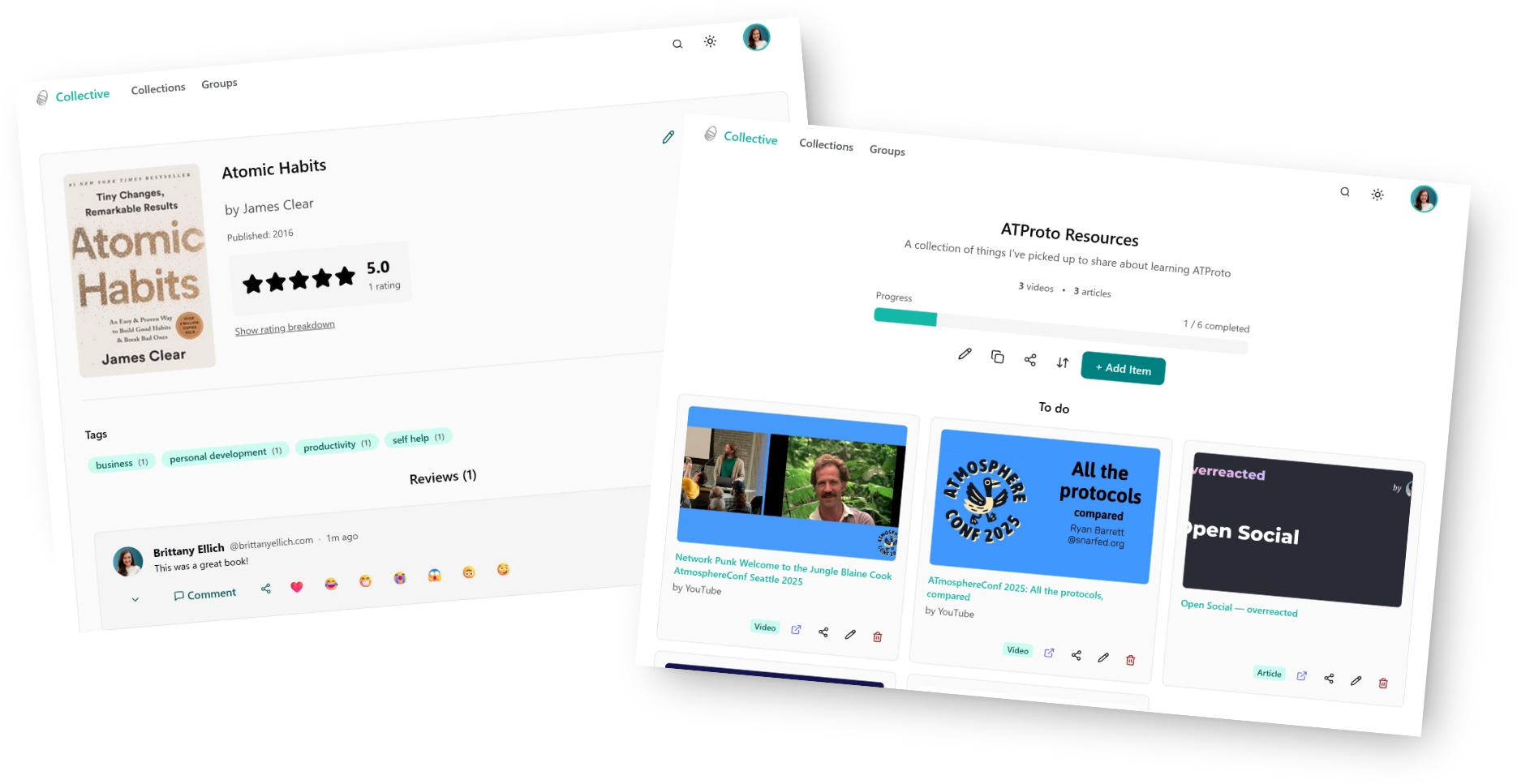
Collective Social | Track what you love. Share what matters.
Curate lists, track your progress, and share recommendations across books, movies, TV shows, and more — all on the open social web.
For You by @spacecowboy17.bsky.social
A personalized algorithmic feed based on your likes. It finds people who liked the same posts as you, and shows you what else they've liked recently. https://foryou.club

How is science clicked on Twitter? Click metrics for Bitly short links to scientific publications
Abstract To provide some context for the potential engagement behavior of Twitter users around science, this article investigates how Bitly short links to scientific publications embedded in scholarly Twitter mentions are clicked on Twitter. Based on the click metrics of over 1.1 million Bitly short links referring to Web of Science (WoS) publications, our results show that around 49.5% of them were not clicked by Twitter users. For those Bitly short links with clicks from Twitter, the majority of their Twitter clicks accumulated within a short period of time after they were first tweeted. Bitly short links to the publications in the field of Social Sciences and Humanities tend to attract more clicks from Twitter over other subject fields. This article also assesses the extent to which Twitter clicks are correlated with some other impact indicators. Twitter clicks are weakly correlated with scholarly impact indicators (WoS citations and Mendeley readers), but moderately correlated to other Twitter engagement indicators (total retweets and total likes). In light of these results, we highlight the importance of paying more attention to the click metrics of URLs in scholarly Twitter mentions, to improve our understanding about the more effective dissemination and reception of science information on Twitter.

Do our social media algorithms correctly reflect our values? Our new article published today in @pnas.org shows that the answer is often not, and that the content that gets promoted into their ranked feeds is often actively counter to our values.
Do our social media algorithms correctly reflect our values? Our new article published today in @pnas.org shows that the answer is often not, and that the content that gets promoted into their ranked feeds is often actively counter to our values.
✨New paper out @nature.com ✨ For 8 weeks around the 2024 US election, we randomly assigned 2,000 people to use social media algos we built ourselves. Do engagement-based algorithms amplify intergroup, moral & emotional (IME) content—and does that distort how we see political norms? 🧵🔗 👇
Social media is no longer social. Most of it is passive viewing of videos and pictures from people we've never met. But we're still studying social media like it's 2010. We've entered the post-social media era — and research needs to catch up. osf.io/preprints/socarxiv/6nue7_v1 preprint w/ Richard Rogers


