

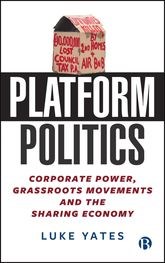
Abstract. This is a book about the power of grassroots movements, narratives and modern corporations to change the way everyday life is organised, provisio
Platform Politics
Available open access digitally under a CC-BY-NC-ND license. The 'sharing economy', powered by companies like Airbnb, Uber and Deliveroo, promised to revolutionize the way we work and live. But what changes have come about, and why? This book shows how platform capitalism is not only shaped by business decisions, but is a result of struggles involving social movements, consumer politics and state interventions. It focuses in particular on the controversial tactics used by platform giants to avoid regulation. Drawing on cutting-edge research and analysis, the book provides a critical overview of the struggles around platforms, examines platform power, and reflects on the different possible futures of the platform economy.

Delete Your Account: On the Theory of Platform Capitalism | Los Angeles Review of Books
The platform confuses capital-flow and social form, rearranging the relationship of profit to community and intelligence to organization.

Towards Platform Democracy: Policymaking Beyond Corporate CEOs and Partisan Pressure
Platforms can bring challenging and divisive policy issues to a new kind of democratic process, enabling a ‘people’s mandate’ for their policies and helping mitigate corporate and partisan power.

Platform co-op governance: deep democracy on scale
This article was written with new inspiration from many conversations around the the Platform Cooperatives conference in NYC in Nov 2017…

Writings and rehearsals by Nathan Schneider
Welcome. I’m a professor of media studies at the University of Colorado Boulder, where I direct the Media Economies Design Lab and teach and learn from our students. I’ve written a book each on online democracy, cooperative enterprise, the Occupy movement, and God, and I’ve edited ones about solidarity economies, crypto, and co-ops. Reporting articles for both magazines and academic journals keeps my notebooks filled. Working with others to build a democratic economy keeps me accountable.
Market Socialism
The Paper Pilot's digital garden of thoughts on philosophy, politics, and sociology. Reading time: ~4 minute read | Published: Jan 1, 2025 | Updated: Nov 16, 2025

The Case for a Public Social Media Platform - JSTOR Daily
Artist and writer Joshua Citarella explores why corporate platforms corrode democracy—and what a postal-service-style digital commons could do differently.

Activist Handbook | Campaigning guides for activists ✊
We write guides for activists. Learn how to become a social activist, plan a political campaign strategy, and start a grassroots movement.
The politics of ‘platforms’ - Tarleton Gillespie, 2010
Online content providers such as YouTube are carefully positioning themselves to users, clients, advertisers and policymakers, making strategic claims for what ...

Consensus
Peter Gelderloos Consensus A New Handbook for Grassroots Social, Political and Environmental Groups 2006

The Alternative to Capitalism Nobody Talks About | Eleanor Finley & Camila Vergara
Capitalism | The Paper Pilot
The Paper Pilot's digital garden of thoughts on philosophy, politics, and sociology
To understand right-wing media's power, study improv and theater of influencers | Opinion
Right-wing populism is leveraging online platforms' participatory nature. A counter-movement must amplify its constituents' values, with a commitment to truth.
Governable spaces: a feminist agenda for platform policy
A proposal, informed by feminist theory, for a policy agenda of “governable spaces” across the domains of social media, gig economies, and network infrastructure.

Preface | The World After Capital
Since publishing the previous version of The World After Capital, I have met with people across the political spectrum to discuss the ideas from the book. When I present these in person, I emphasize that the ideas are neither left nor right but forward (credit to Scott Santens who first used this phrase about Universal Basic Income). My writing, however, at times has alienated readers who identify as being more on the right. In this new edition, I am therefore making an extra effort to emphasize how both my diagnosis of where we are at and my suggestions for how to move forward do not map onto the existing political divides. Instead this is a new way of understanding our challenges and opportunities that can be the basis for movements and parties that are not trapped in Industrial Age ideology.

Robin Berjon


"For A Left Populism" by Chantal Mouffe Excellent first read of the year. A framework and a strategy for the change we need. If you're progressive and unsure of what to do, what politics should look like, this is a good short read to think it through