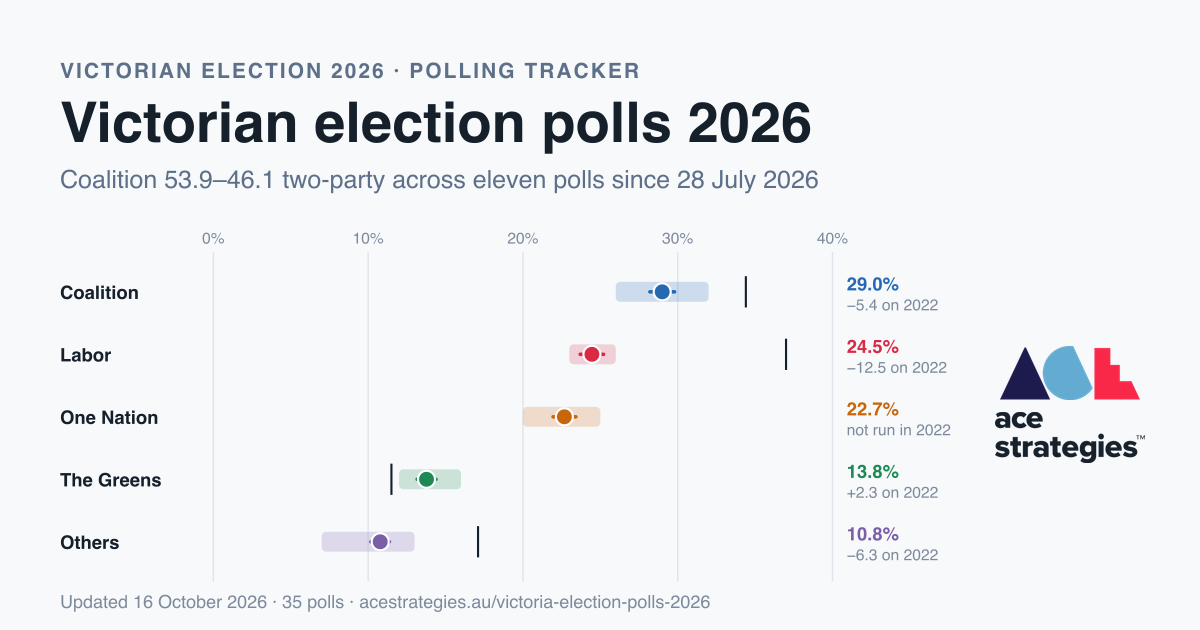
Updated 16 October 2026: the Coalition leads 53.9–46.1 across the eleven Victorian polls since the change of Premier, with One Nation on 22.7 per cent.
Victorian election polls 2026 — average and ledger — Australian Election Tracker
Victorian state election 2026 polls: sourced statewide primary votes and a transparent weighted average with uncertainty bands. Latest tracker average (as of 2026-10-10): Labor 24.5%, Coalition 29.1%, One Nation 22.6%, Greens 14.9%, Others 8.9%. Not a forecast.


Victorian polls have Coalition leading Labor by narrow to large margins
About three months out from the Victorian state election, the five polls released since the state got a new premier all show the Coalition in front.
Victorian state election 2026 candidates — sourced tracker — Australian Election Tracker
Victorian election 2026 candidate tracker: independently sourced announced, endorsed and nominated candidacies across 88 Assembly districts and 8 Council regions. Open JSON/CSV — not the VEC, not a forecast.
Poll tracker – VIC 2026 state election – The Swing Is On
Victorian state primary vote polling since the 2022 election.

Victorian election 2026
The Victorian state election on 28 November 2026 is a chance for Victorian decision-makers to take action so all Victorian renters can live with dignity in safe, secure and affordable homes.We’re calling on all political parties and candidates, both current and incoming, to commit to stronger protections for the 2 million Victorians who rent their homes.
One Nation’s wall — projected Victorian electoral funding
If One Nation’s latest Victorian polling holds, how much public and admin funding will it collect over the next five years?
Victorian polls: RedBridge Group and Resolve Strategic - The Poll Bludger
Amid an unclear picture overall, two Victorian state polls show encouraging results for the Greens.

2026 Victorian state election
A general election is scheduled to be held on 28 November 2026 to elect members of the 61st Parliament of Victoria. All 88 seats in the Legislative Assembly and all 40 seats in the Legislative Council will be up for election.

2026 Victorian state election - Parliament of Victoria
State elections in Victoria are held on the last Saturday in November every four years.

Victorian State Election November 28th 2026 - Vote Climate One
The disturbing rise of One Nation has radically changed the Australian political landscape. Vote Climate One is now forced to overhaul our strategic preferencing advice, not just federally, but for this state election as well. We now have the threat of the Liberal Party preferencing One Nation and a potential coalition between One Nation and …

Victoria Poll Briefing, August 2026
The first DemosAU/PremierNational Victorian poll since Ben Carroll replaced Jacinta Allan, with the Coalition leading 55–45 after preferences.

Victorian State Voting Intention: One Nation (26.5%) now ahead of ALP (25.5%) and L-NP Coalition (21.5%) on primary vote nine months before Victorian State Election - Roy Morgan Research
Only nine months before a State Election, Victorian electors are split with One Nation (26.5%) now ahead of the governing ALP (25.5%), and the official Opposition L-NP Coalition (21.5%). In addition, 13.5% support the Greens and a further 13% support other minor parties and Independents according to the special SMS Roy Morgan survey conducted from February 13-16, 2026, with a representative Victoria-wide cross-section of 2,462 electors.

The Performance of the Polls in the 2019 General Election - British Polling Council
The Performance of the Polls in the 2019 General Election
Victorian Election is ‘too close to call’ today: ALP/Greens (46 seats) narrowly ahead of L-NP/ONP (42 seats); One Nation set to win over 10 seats in Lower House - Roy Morgan Research
Before all candidates are locked in, before preference deals are done, and before the campaign begins in earnest in the next few weeks Roy Morgan has created a Winnability Score. It combines current State voting intention with how closely an electorate's voter profile aligns with each party's core support base. In other words, it measures not only who is currently voting for a party, but also which voters are most likely to be persuaded to support that party.