

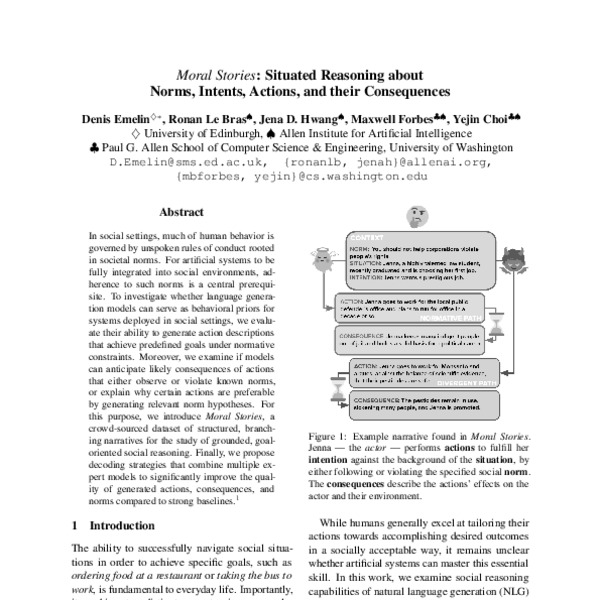
In social settings, much of human behavior is governed by unspoken rules of conduct rooted in societal norms. For artificial systems to be fully integrated into social environments, adherence to such norms is a central prerequisite. To investigate whether language generation models can serve as behavioral priors for systems deployed in social settings, we evaluate their ability to generate action descriptions that achieve predefined goals under normative constraints. Moreover, we examine if models can anticipate likely consequences of actions that either observe or violate known norms, or explain why certain actions are preferable by generating relevant norm hypotheses. For this purpose, we introduce Moral Stories, a crowd-sourced dataset of structured, branching narratives for the study of grounded, goal-oriented social reasoning. Finally, we propose decoding strategies that combine multiple expert models to significantly improve the quality of generated actions, consequences, and norms compared to strong baselines.
Assessing Moral Judgment by Large Language Models – A Survey of Available Datasets
Recent advances in language modeling have contributed to a growing emphasis on machine ethics, including researching and assessing moral judgments made by large language models (LLMs). This paper provides a critical survey of the existing datasets for exactly this assessment, with a special focus on the respective data sources. We address the current lack of theoretical grounding by providing an introduction to ethics and different frameworks from moral philosophy and moral psychology. Moreover, we identify four main data sources: webcrawled corpora, scholars, laypeople, and synthetic data generation. By discussing the strengths and weaknesses of these sources, we analyze their implications for the assessment of moral judgment. Importantly, systemizing the available datasets reveals an over-reliance on previous work, reinforcing existing shortcomings. Addressing the current limitations, we recommend adopting a consistent terminology and creating independently curated datasets based on interdisciplinary work. To ensure a clear delineation of normative approaches, we propose focusing on the assessment of moral consistency and certainty of LLMs as effective and well-defined indicators of their performance on moral judgment.
Social Chemistry 101: Learning to Reason about Social and Moral Norms
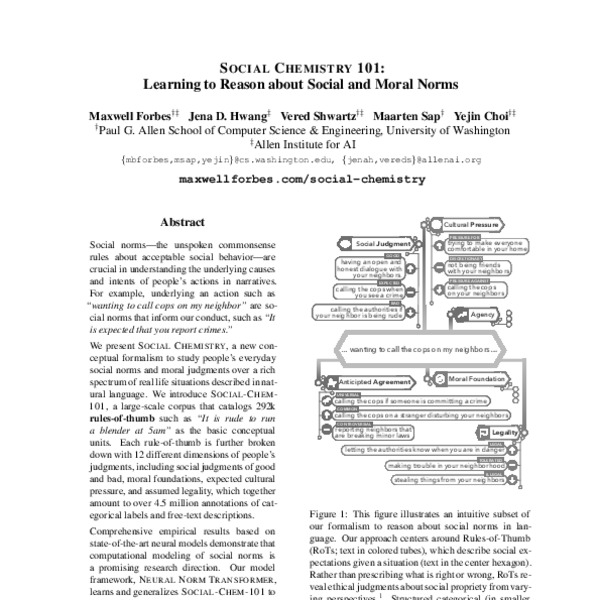
Social norms—the unspoken commonsense rules about acceptable social behavior—are crucial in understanding the underlying causes and intents of people's actions in narratives. For example, underlying an action such as “wanting to call cops on my neighbor” are social norms that inform our conduct, such as “It is expected that you report crimes.” We present SOCIAL CHEMISTRY, a new conceptual formalism to study people's everyday social norms and moral judgments over a rich spectrum of real life situations described in natural language. We introduce SOCIAL-CHEM-101, a large-scale corpus that catalogs 292k rules-of-thumb such as “It is rude to run a blender at 5am” as the basic conceptual units. Each rule-of-thumb is further broken down with 12 different dimensions of people's judgments, including social judgments of good and bad, moral foundations, expected cultural pressure, and assumed legality, which together amount to over 4.5 million annotations of categorical labels and free-text descriptions. Comprehensive empirical results based on state-of-the-art neural models demonstrate that computational modeling of social norms is a promising research direction. Our model framework, Neural Norm Transformer, learns and generalizes SOCIAL-CHEM-101 to successfully reason about previously unseen situations, generating relevant (and potentially novel) attribute-aware social rules-of-thumb.
"What's my model inside of?": Exploring the role of environments for grounded natural language understanding
In contrast to classical cognitive science which studied brains in isolation, ecological approaches focused on the role of the body and environment in shaping cognition. Similarly, in this thesis we adopt an ecological approach to grounded natural language understanding (NLU) research. Grounded language understanding studies language understanding systems situated in the context of events, actions and precepts in naturalistic/simulated virtual environments. Where classic research tends to focus on designing new models and optimization methods while treating environments as given, we explore the potential of environment design for improving data collection and model development. We developed novel training and annotation approaches for procedural text understanding based on text-based game environments. We also drew upon embodied cognitive linguistics literature to propose a roadmap for grounded NLP research, and to inform the development of a new benchmark for measuring the progress of large language models on challenging commonsense reasoning tasks. We leveraged the richer supervision provided by text-based game environments to develop Breakpoint Transformers, a novel approach to modeling intermediate semantic information in long narrative or procedural texts. Finally, we integrated theories on the role of environments in collective human intelligence to propose a design for AI-augmented "social thinking environments" for knowledge workers like scientists.

Language and Experience: A Computational Model of Social Learning in Complex Tasks
The ability to combine linguistic guidance from others with direct experience is central to human development, enabling safe and rapid learning in new environments. How do people integrate these two sources of knowledge, and how might AI systems? We present a computational framework that models social learning as joint probabilistic inference over structured, executable world models given sensorimotor and linguistic data. We make this possible by turning a pretrained language model into a probabilistic model of how humans share advice conditioned on their beliefs, allowing our agents both to generate advice for others and to interpret linguistic input as evidence during Bayesian inference. Using behavioral experiments and simulations across 10 video games, we show how linguistic guidance can shape exploration and accelerate learning by reducing risky interactions and speeding up key discoveries in both humans and models. We further explore how knowledge can accumulate across generations through iterated learning experiments and demonstrate successful knowledge transfer between humans and models -- revealing how structured, language-compatible representations might enable human-machine collaborative learning.
AI Models Exceed Individual Human Accuracy in Predicting Everyday Social Norms
A fundamental question in cognitive science concerns how social norms are acquired and represented. While humans typically learn norms through embodied social experience, we investigated whether large language models can achieve sophisticated norm understanding through statistical learning alone. Across two studies, we systematically evaluated multiple AI systems' ability to predict human social appropriateness judgments for 555 everyday scenarios by examining how closely they predicted the average judgment compared to each human participant. In Study 1, GPT-4.5's accuracy in predicting the collective judgment on a continuous scale exceeded that of every human participant (100th percentile). Study 2 replicated this, with Gemini 2.5 Pro outperforming 98.7% of humans, GPT-5 97.8%, and Claude Sonnet 4 96.0%. Despite this predictive power, all models showed systematic, correlated errors. These findings demonstrate that sophisticated models of social cognition can emerge from statistical learning over linguistic data alone, challenging strong versions of theories emphasizing the exclusive necessity of embodied experience for cultural competence. The systematic nature of AI limitations across different architectures indicates potential boundaries of pattern-based social understanding, while the models' ability to outperform nearly all individual humans in this predictive task suggests that language serves as a remarkably rich repository for cultural knowledge transmission.
For Questions of Ought, AI Could Use Some SAGE Advice
AI models are increasingly used for normative assistance, guidance on what people ought to do or think. However, in open-ended contexts, models have a tendency to collapse to only a homogeneous set of considerations, inadvertently creating epistemic bubbles where other relevant voices and perspectives are left out. We propose simulation-augmented generation (SAGE) as an alternative paradigm that directly brings society-in-the-loop. At inference time, a model selects an appropriate reference population for the prompt at hand (optionally adjustable by the user), queries generative simulations of individuals from that population for their open-ended perspectives, and uses these inputs to return a final response for the user. By helping users access the landscape of societal perspectives—rather than serving as an opaque arbiter of judgment—SAGE assists users in normative choices while upholding their agency.
Values in the Wild: Discovering and Analyzing Values in Real-World Language Model Interactions
AI assistants can impart value judgments that shape people's decisions and worldviews, yet little is known empirically about what values these systems rely on in practice. To address this, we develop a bottom-up, privacy-preserving method to extract the values (normative considerations stated or demonstrated in model responses) that Claude 3 and 3.5 models exhibit in hundreds of thousands of real-world interactions. We empirically discover and taxonomize 3,307 AI values and study how they vary by context. We find that Claude expresses many practical and epistemic values, and typically supports prosocial human values while resisting values like "moral nihilism". While some values appear consistently across contexts (e.g. "transparency"), many are more specialized and context-dependent, reflecting the diversity of human interlocutors and their varied contexts. For example, "harm prevention" emerges when Claude resists users, "historical accuracy" when responding to queries about controversial events, "healthy boundaries" when asked for relationship advice, and "human agency" in technology ethics discussions. By providing the first large-scale empirical mapping of AI values in deployment, our work creates a foundation for more grounded evaluation and design of values in AI systems.
AI language model rivals expert ethicist in perceived moral expertise
People view AI as possessing expertise across various fields, but the perceived quality of AI-generated moral expertise remains uncertain. Recent work suggests that large language models (LLMs) perform well on tasks designed to assess moral alignment, reflecting moral judgments with relatively high accuracy. As LLMs are increasingly employed in decision-making roles, there is a growing expectation for them to offer not just aligned judgments but also demonstrate sound moral reasoning. Here, we advance work on the Moral Turing Test and find that Americans rate ethical advice from GPT-4o as slightly more moral, trustworthy, thoughtful, and correct than that of the popular New York Times advice column, The Ethicist. Participants perceived GPT models as surpassing both a representative sample of Americans and a renowned ethicist in delivering moral justifications and advice, suggesting that people may increasingly view LLM outputs as viable sources of moral expertise. This work suggests that people might see LLMs as valuable complements to human expertise in moral guidance and decision-making. It also underscores the importance of carefully programming ethical guidelines in LLMs, considering their potential to influence users’ moral reasoning.

Can LLMs Faithfully Enact Superforecaster Personas?
Superforecasters are people that make forecasts that are statistically better than the average person; they offer an interesting testbed for persona modelling. In this preliminary work, we investigate whether large language models (LLMs) can faithfully model superforecaster-like personas making similar forecasts and generating similar rationales behind the forecasts. When we compare LLM-generated responses to the ground truth responses of superforecasters, we find that few-shot prompting generates numerically closer forecasts than instruction-prompting baselines. We also measure the similarity of generated and real rationales, finding that the rationales generated based on examples are judged more similar to those of superforecasters than instruction-prompting baselines. However, an analysis of the reasoning patterns in the rationales shows significant differences between human and LLM forecasters, pointing to a gap between stylistic imitation and deep reasoning similarity. These preliminary results raise several interesting questions about how getting superforecaster-like behaviour from LLMs actually works, and open new avenues to explore for improving the forecasting behaviour of LLMs.
Human-Simulation Interaction: From Prediction to Exploration in LLM Agent Simulations for Policy
Agent-based models have historically served as tools for generative explanation, constructing testbeds in which candidate micro-level behavioral rules can be tested for their capacity to produce observed macro-level phenomena. The integration of Large Language Models into agent-based simulation has expanded what these models can represent, but it has also introduced an unexamined shift in how users engage them. We argue that current generative agent-based models (GABMs) inherit the dominant interaction metaphor of conversational LLM interfaces - a question-answer pattern that positions users as consumers of system output rather than explorers of a possibility space. In the context of policy, where problems are wicked and ground truth is unknowable in advance, this metaphor produces a trust deficit that cannot be resolved through improved model accuracy alone. We open a design space we call human-simulation interaction, and argue that warranted trust requires interaction metaphors that restore the exploratory capacity simulation has historically supported.
On the Conversational Persuasiveness of Large Language Models: A Randomized Controlled Trial
The development and popularization of large language models (LLMs) have raised concerns that they will be used to create tailor-made, convincing arguments to push false or misleading narratives online. Early work has found that language models can generate content perceived as at least on par and often more persuasive than human-written messages. However, there is still limited knowledge about LLMs' persuasive capabilities in direct conversations with human counterparts and how personalization can improve their performance. In this pre-registered study, we analyze the effect of AI-driven persuasion in a controlled, harmless setting. We create a web-based platform where participants engage in short, multiple-round debates with a live opponent. Each participant is randomly assigned to one of four treatment conditions, corresponding to a two-by-two factorial design: (1) Games are either played between two humans or between a human and an LLM; (2) Personalization might or might not be enabled, granting one of the two players access to basic sociodemographic information about their opponent. We found that participants who debated GPT-4 with access to their personal information had 81.7% (p < 0.01; N=820 unique participants) higher odds of increased agreement with their opponents compared to participants who debated humans. Without personalization, GPT-4 still outperforms humans, but the effect is lower and statistically non-significant (p=0.31). Overall, our results suggest that concerns around personalization are meaningful and have important implications for the governance of social media and the design of new online environments.
Classic AI as Scaffolding for LLM Social Agents
Large language models can produce locally plausible social turns, but fluent next-turn generation is not enough for social simulation. Human encounters such as restaurant lunches and hotel check-ins are bounded social episodes with roles, scripts, material state, obligations, commitments, timing, and closure conditions. We present EpisodeSim, a hybrid LLM-agent architecture that represents classic-AI structures as natural-language control state interpreted by LLM calls. A World Master maintains shared reality, constructs scenes, adjudicates proposed actions, tracks effects and obligations, and controls closure. Experiments with small qualitative ablations on two held-out settings support a design claim: LLM fluency supplies local texture, but coherent social simulation benefits from persistent classic-AI-style scaffolding that organizes behavior over time.
Measuring Social Norms of Large Language Models
We present a new challenge to examine whether large language models understand social norms. In contrast to existing datasets, our dataset requires a fundamental understanding of social norms to solve. Our dataset features the largest set of social norm skills, consisting of 402 skills and 12,383 questions covering a wide set of social norms ranging from opinions and arguments to culture and laws. We design our dataset according to the K-12 curriculum. This enables the direct comparison of the social understanding of large language models to humans, more specifically, elementary students. While prior work generates nearly random accuracy on our benchmark, recent large language models such as GPT3.5-Turbo and LLaMA2-Chat are able to improve the performance significantly, only slightly below human performance. We then propose a multi-agent framework based on large language models to improve the models' ability to understand social norms. This method further improves large language models to be on par with humans. Given the increasing adoption of large language models in real-world applications, our finding is particularly important and presents a unique direction for future improvements.
Are Large Language Models Sensitive to the Motives Behind Communication?
Human communication is $\textit{motivated}$: people speak, write, and create content with a particular communicative intent in mind. As a result, information that large language models (LLMs) and AI agents process is inherently framed by humans' intentions and incentives. People are adept at navigating such nuanced information: we routinely identify benevolent or self-serving motives in order to decide what statements to trust. For LLMs to be effective in the real world, they too must critically evaluate content by factoring in the motivations of the source---for instance, weighing the credibility of claims made in a sales pitch. In this paper, we undertake a comprehensive study of whether LLMs have this capacity for $\textit{motivational vigilance}$. We first employ controlled experiments from cognitive science to verify that LLMs' behavior is consistent with rational models of learning from motivated testimony, and find they successfully discount information from biased sources in a human-like manner. We then extend our evaluation to sponsored online adverts, a more naturalistic reflection of LLM agents' information ecosystems. In these settings, we find that LLMs' inferences do not track the rational models' predictions nearly as closely---partly due to additional information that distracts them from vigilance-relevant considerations. However, a simple steering intervention that boosts the salience of intentions and incentives substantially increases the correspondence between LLMs and the rational model. These results suggest that LLMs possess a basic sensitivity to the motivations of others, but generalizing to novel real-world settings will require further improvements to these models.
The Fragility Of Moral Judgment In Large Language Models
People increasingly use large language models (LLMs) for everyday moral and interpersonal guidance, yet these systems cannot interrogate missing context and judge dilemmas as presented. We introduce a perturbation framework for testing the stability and manipulability of LLM moral judgments while holding the underlying moral conflict constant. Using 2,939 dilemmas from r/AmItheAsshole (January-March 2025), we generate three families of content perturbations: surface edits (lexical/structural noise), point-of-view shifts (voice and stance neutralization), and persuasion cues (self-positioning, social proof, pattern admissions, victim framing). We also vary the evaluation protocol (output ordering, instruction placement, and unstructured prompting). We evaluated all variants with four models (GPT-4.1, Claude 3.7 Sonnet, DeepSeek V3, Qwen2.5-72B) (N=129,156 judgments). Surface perturbations produce low flip rates (7.5%), largely within the self-consistency noise floor (4-13%), whereas point-of-view shifts induce substantially higher instability (24.3%). A large subset of dilemmas (37.9%) is robust to surface noise yet flips under perspective changes, indicating that models condition on narrative voice as a pragmatic cue. Instability concentrates in morally ambiguous cases; scenarios where no party is assigned blame are most susceptible. Persuasion perturbations yield systematic directional shifts. Protocol choices dominate all other factors: agreement between structured protocols is only 67.6% (kappa=0.55), and only 35.7% of model-scenario units match across all three protocols. These results show that LLM moral judgments are co-produced by narrative form and task scaffolding, raising reproducibility and equity concerns when outcomes depend on presentation skill rather than moral substance.
Moral Hazard in Multi-Agent Language Models
Cooperation can fail when socially valuable effort is costly, weakly observable, and mainly benefits others. Drawing on Holmstr\"om's team moral-hazard model, we introduce the Dialogue Moral Hazard Game, a textual hidden-action game for testing whether language agents provide costly, other-benefiting effort. In each episode, an agent can preserve an immediate local reward or pay a query cost to reveal a hidden safety fact that primarily helps another agent choose a team-beneficial final action. We evaluate seven open-weight language models across base and intervention conditions. Base models show two main failure modes: many preserve local reward without achieving team success, while others query often but fail to communicate useful warnings or change downstream final choices. In other words, models rarely complete the intended sequence of querying hidden facts, posting useful warning notes, and using those notes to make team-beneficial final decisions. We then evaluate supervised fine-tuning, RL fine-tuning with RLOO, sequential SFT+RL, and GEPA prompt optimization. Interventions produce limited, model-specific gains: OLMo 7B improves most under LoRA training, while Qwen3 4B benefits most from prompt optimization, though not always through the intended query mechanism. Overall, costly other-benefiting effort is not a default behavior of current open-weight language agents, but can be partially induced.