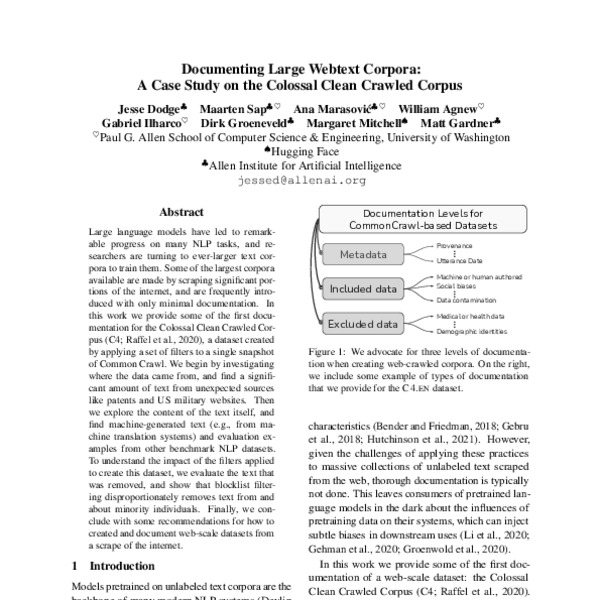
Large language models have led to remarkable progress on many NLP tasks, and researchers are turning to ever-larger text corpora to train them. Some of the largest corpora available are made by scraping significant portions of the internet, and are frequently introduced with only minimal documentation. In this work we provide some of the first documentation for the Colossal Clean Crawled Corpus (C4; Raffel et al., 2020), a dataset created by applying a set of filters to a single snapshot of Common Crawl. We begin by investigating where the data came from, and find a significant amount of text from unexpected sources like patents and US military websites. Then we explore the content of the text itself, and find machine-generated text (e.g., from machine translation systems) and evaluation examples from other benchmark NLP datasets. To understand the impact of the filters applied to create this dataset, we evaluate the text that was removed, and show that blocklist filtering disproportionately removes text from and about minority individuals. Finally, we conclude with some recommendations for how to created and document web-scale datasets from a scrape of the internet.
Is Misinformation More Open? A Study of robots.txt Gatekeeping on the Web
Web scraping, the automated process of extracting information from websites, has long played a foundational role in the Internet ecosystem (Gray, 1995). It supports services such as search engine indexing, price comparison tools, and competitive intelligence. More recently, it has become a core component in the development of large-scale generative AI models. These Large Language Models (LLMs) require enormous volumes of training data, often in the terabyte range (Kaplan et al., 2020; Lehane, 2025), and the public web remains a low-cost, attractive source. Major model developers, including those behind OpenAI’s Chat-GPT (OpenAI, 2025), Google’s Bard (now known as Gemini) & Vertex AI (Romain, Danielle, 2023), and Anthropic’s Claude (Romain, Danielle, 2025), openly acknowledge the use of web scraping to construct their training corpora (Abdin et al., 2024; Brown et al., 2020; Chowdhery et al., 2023; Grattafiori et al., 2024; Team et al., 2024; Touvron et al., 2023).
People who frequently use ChatGPT for writing tasks are accurate and robust detectors of AI-generated text
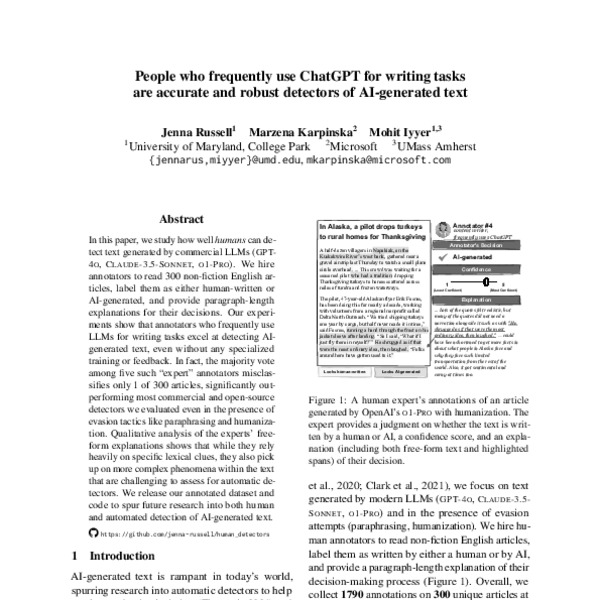
In this paper, we study how well humans can detect text generated by commercial LLMs (GPT-4o, Claude, o1). We hire annotators to read 300 non-fiction English articles, label them as either human-written or AI-generated, and provide paragraph-length explanations for their decisions. Our experiments show that annotators who frequently use LLMs for writing tasks excel at detecting AI-generated text, even without any specialized training or feedback. In fact, the majority vote among five such “expert” annotators misclassifies only 1 of 300 articles, significantly outperforming most commercial and open-source detectors we evaluated even in the presence of evasion tactics like paraphrasing and humanization. Qualitative analysis of the experts' free-form explanations shows that while they rely heavily on specific lexical clues (`AI vocabulary'), they also pick up on more complex phenomena within the text (e.g., formality, originality, clarity) that are challenging to assess for automatic detectors. We release our annotated dataset and code to spur future research into both human and automated detection of AI-generated text.
People who frequently use ChatGPT for writing tasks are accurate and robust detectors of AI-generated text
In this paper, we study how well humans can detect text generated by commercial LLMs (GPT-4o, Claude, o1). We hire annotators to read 300 non-fiction English articles, label them as either human-written or AI-generated, and provide paragraph-length explanations for their decisions. Our experiments show that annotators who frequently use LLMs for writing tasks excel at detecting AI-generated text, even without any specialized training or feedback. In fact, the majority vote among five such “expert” annotators misclassifies only 1 of 300 articles, significantly outperforming most commercial and open-source detectors we evaluated even in the presence of evasion tactics like paraphrasing and humanization. Qualitative analysis of the experts' free-form explanations shows that while they rely heavily on specific lexical clues (`AI vocabulary'), they also pick up on more complex phenomena within the text (e.g., formality, originality, clarity) that are challenging to assess for automatic detectors. We release our annotated dataset and code to spur future research into both human and automated detection of AI-generated text.
Deep-Research Agents Can Be Poisoned via User-Generated Content
Deep-research agents, i.e., systems that rely on multi-agent pipelines to iteratively retrieve, synthesize, and cite Web content in order to produce structured reports, are rapidly replacing traditional search for both routine and complex information needs. These agents issue many related queries during a single research session. We show that for many common search topics, they repeatedly retrieve the same user-generated content (UGC) pages from platforms such as Reddit and Wikipedia. Next, we argue that this retrieval overlap creates a concentrated attack surface: an adversary who appends a short, crafted text to a single, frequently retrieved UGC page can cause the agent to cite attacker-chosen content and promote attacker-chosen entities across many related queries. We evaluate this attack on three representative deep-research systems (STORM, Co-STORM, and OmniThink) across multiple query clusters. We also study defenses at different stages of the pipeline, including source-level filtering and output-based detection. Our findings highlight a fundamental vulnerability in how deep-research agents retrieve and integrate web content.

A large-scale audit of dataset licensing and attribution in AI
The race to train language models on vast, diverse and inconsistently documented datasets raises pressing legal and ethical concerns. To improve data transparency and understanding, we convene a multi-disciplinary effort between legal and machine learning experts to systematically audit and trace more than 1,800 text datasets. We develop tools and standards to trace the lineage of these datasets, including their source, creators, licences and subsequent use. Our landscape analysis highlights sharp divides in the composition and focus of data licenced for commercial use. Important categories including low-resource languages, creative tasks and new synthetic data all tend to be restrictively licenced. We observe frequent miscategorization of licences on popular dataset hosting sites, with licence omission rates of more than 70% and error rates of more than 50%. This highlights a crisis in misattribution and informed use of popular datasets driving many recent breakthroughs. Our analysis of data sources also explains the application of copyright law and fair use to finetuning data. As a contribution to continuing improvements in dataset transparency and responsible use, we release our audit, with an interactive user interface, the Data Provenance Explorer, to enable practitioners to trace and filter on data provenance for the most popular finetuning data collections: www.dataprovenance.org.

Technical Report on the Pangram AI-Generated Text Classifier
We present Pangram Text, a transformer-based neural network trained to distinguish text written by large language models from text written by humans. Pangram Text outperforms zero-shot methods such as DetectGPT as well as leading commercial AI detection tools with over 38 times lower error rates on a comprehensive benchmark comprised of 10 text domains (student writing, creative writing, scientific writing, books, encyclopedias, news, email, scientific papers, short-form Q&A) and 8 open- and closed-source large language models. We propose a training algorithm, hard negative mining with synthetic mirrors, that enables our classifier to achieve orders of magnitude lower false positive rates on high-data domains such as reviews. Finally, we show that Pangram Text is not biased against nonnative English speakers and generalizes to domains and models unseen during training.
Exploring the Limits of Transfer Learning with a Unified Text-to-Text Transformer
Transfer learning, where a model is first pre-trained on a data-rich task before being fine-tuned on a downstream task, has emerged as a powerful technique in natural language processing (NLP). The effectiveness of transfer learning has given rise to a diversity of approaches, methodology, and practice. In this paper, we explore the landscape of transfer learning techniques for NLP by introducing a unified framework that converts all text-based language problems into a text-to-text format. Our systematic study compares pre-training objectives, architectures, unlabeled data sets, transfer approaches, and other factors on dozens of language understanding tasks. By combining the insights from our exploration with scale and our new “Colossal Clean Crawled Corpus”, we achieve state-of-the-art results on many benchmarks covering summarization, question answering, text classification, and more. To facilitate future work on transfer learning for NLP, we release our data set, pre-trained models, and code.
SILO Language Models: Isolating Legal Risk In a Nonparametric Datastore
The legality of training language models (LMs) on copyrighted or otherwise restricted data is under intense debate. However, as we show, model performance significantly degrades if trained only on low-risk text (e.g., out-of-copyright books or government documents), due to its limited size and domain coverage. We present SILO, a new language model that manages this risk-performance tradeoff during inference. SILO is built by (1) training a parametric LM on the Open License Corpus (OLC), a new corpus we curate with 228B tokens of public domain and permissively licensed text and (2) augmenting it with a more general and easily modifiable nonparametric datastore (e.g., containing copyrighted books or news) that is only queried during inference. The datastore allows use of high-risk data without training on it, supports sentence-level data attribution, and enables data producers to opt out from the model by removing content from the store. These capabilities can foster compliance with data-use regulations such as the fair use doctrine in the United States and the GDPR in the European Union. Our experiments show that the parametric LM struggles on its own with domains not covered by OLC. However, access to the datastore greatly improves out of domain performance, closing 90% of the performance gap with an LM trained on the Pile, a more diverse corpus with mostly high-risk text. We also analyze which nonparametric approach works best, where the remaining errors lie, and how performance scales with datastore size. Our results suggest that it is possible to build high quality language models while mitigating legal risk.
Large Language Models Require Curated Context for Reliable Political Fact-Checking—Even with Reasoning and Web Search
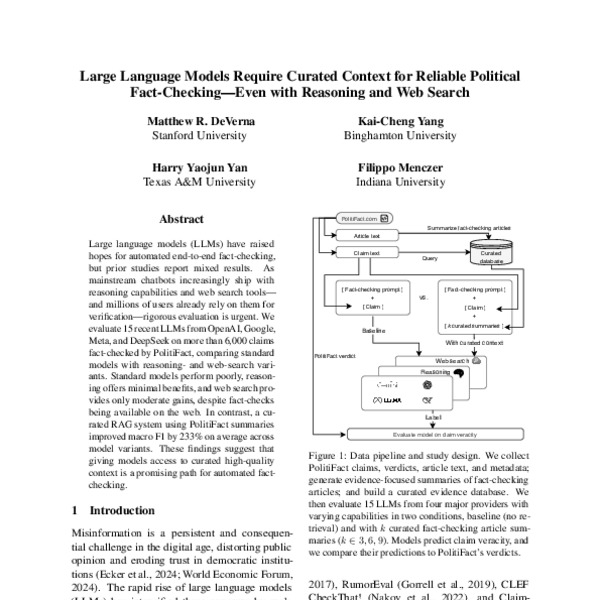
Large language models (LLMs) have raised hopes for automated end-to-end fact-checking, but prior studies report mixed results. As mainstream chatbots increasingly ship with reasoning capabilities and web search tools—and millions of users already rely on them for verification—rigorous evaluation is urgent. We evaluate 15 recent LLMs from OpenAI, Google, Meta, and DeepSeek on more than 6,000 claims fact-checked by PolitiFact, comparing standard models with reasoning- and web-search variants. Standard models perform poorly, reasoning offers minimal benefits, and web search provides only moderate gains, despite fact-checks being available on the web. In contrast, a curated RAG system using PolitiFact summaries improved macro F1 by 233% on average across model variants. These findings suggest that giving models access to curated high-quality context is a promising path for automated fact-checking.
Large-scale online deanonymization with LLMs
We show that large language models can be used to perform at-scale deanonymization. With full Internet access, our agent can re-identify Hacker News users and Anthropic Interviewer participants at high precision, given pseudonymous online profiles and conversations alone, matching what would take hours for a dedicated human investigator. We then design attacks for the closed-world setting. Given two databases of pseudonymous individuals, each containing unstructured text written by or about that individual, we implement a scalable attack pipeline that uses LLMs to: (1) extract identity-relevant features, (2) search for candidate matches via semantic embeddings, and (3) reason over top candidates to verify matches and reduce false positives. Compared to classical deanonymization work (e.g., on the Netflix prize) that required structured data, our approach works directly on raw user content across arbitrary platforms. We construct three datasets with known ground-truth data to evaluate our attacks. The first links Hacker News to LinkedIn profiles, using cross-platform references that appear in the profiles. Our second dataset matches users across Reddit movie discussion communities; and the third splits a single user's Reddit history in time to create two pseudonymous profiles to be matched. In each setting, LLM-based methods substantially outperform classical baselines, achieving up to 68% recall at 90% precision compared to near 0% for the best non-LLM method. Our results show that the practical obscurity protecting pseudonymous users online no longer holds and that threat models for online privacy need to be reconsidered.
Artificial Writing and Automated Detection
Artificial intelligence (AI) tools are increasingly used for written deliverables. This has created demand for distinguishing human-generated text from AI-generated text at scale, e.g., ensuring assignments were completed by students, product reviews written by actual customers, etc. A decision-maker aiming to implement a detector in practice must consider two key statistics: the False Negative Rate (FNR), which corresponds to the proportion of AI-generated text that is falsely classified as human, and the False Positive Rate (FPR), which corresponds to the proportion of human-written text that is falsely classified as AI-generated. We evaluate three leading commercial detectors—Pangram, OriginalityAI, GPTZero—and an open-source one —RoBERTa—on their performance in minimizing these statistics using a large corpus spanning genres, lengths, and models. Commercial detectors outperform open-source, with Pangram achieving near-zero FNR and FPR rates that remain robust across models, threshold rules, ultra-short passages, "stubs" (≤ 50 words) and ’humanizer’ tools. A decision-maker may weight one type of error (Type I vs. Type II) as more important than the other. To account for such a preference, we introduce a framework where the decision-maker sets a policy cap—a detector-independent metric reflecting tolerance for false positives or negatives. We show that Pangram is the only tool to satisfy a strict cap (FPR ≤ 0.005) without sacrificing accuracy. This framework is especially relevant given the uncertainty surrounding how AI may be used at different stages of writing, where certain uses may be encouraged (e.g., grammar correction) but may be difficult to separate from other uses.

Can Language Models Play the Wikipedia Game?
Language models increasingly support or automate information retrieval from document collections too large to index. This task is difficult when it requires specialist linguistic or scientific knowledge. We used the Wikipedia Game to test language models on an analogous information retrieval task. In the game, players must reach a target article using only article links. We compared sentence embedding models and LLMs across five Wikipedia languages and five academic-literature datasets. We construct very large local graphs of Wikipedia pages and of paper citations using OpenAlex and provide code to build and navigate them. This allows the study of language models' navigation capabilities without relying on third-party APIs. We compared the models with human and TF-IDF benchmarks. The Wikipedia Game format enables robust comparisons across techniques, languages, and domains. No model significantly outperformed humans, although the best models (GPT-o3 mini, GPT-4o, QwQ:32B, and DeepSeek-R1:70B) achieved comparable success. Performance and rankings varied across languages and topics, with implications for practitioners utilising these techniques.
SlopShape: Identifying AI-Generated Commercial Web Content
Word-level detectors identify unedited AI-generated text almost perfectly, but the literature documents their brittleness under rewording, and a word-level score neither characterizes a text nor identifies which AI model wrote it. We ask whether AI-generated text can be identified one level deeper, from structural signatures: how information is presented, in what order, with what evidence, and in what voice. We replicate StoryScope (Russell et al., 2026), which showed such patterns for AI-generated fiction, on commercial content: 2,250 pre-ChatGPT human blog posts from 268 company domains against 11,250 AI mirrors from five frontier models. A 203-feature instrument, applied by an LLM and validated in a human gold-annotation session (human-human kappa 0.939, human-model 0.951), detects AI posts from its 176 structural features alone at 97.0 macro-F1 on held-out companies, nearly unchanged (96.1) when every AI post is reworded by its own model. The signal characterizes and attributes: AI posts share a tidy, self-announcing shape, 68.6% are attributed to the correct source against a 16.7% chance rate, and human posts occupy rare structural configurations. All effects replicate StoryScope's, consistent in direction and at least as large in magnitude. We release pipeline, instrument, prompts, code, and aggregate artifacts.
WASA: WAtermark-based Source Attribution for Large Language Model-Generated Data
The impressive performances of Large Language Models (LLMs) and their immense potential for commercialization have given rise to serious concerns over the Intellectual Property (IP) of their training data. In particular, the synthetic texts generated by LLMs may infringe the IP of the data being used to train the LLMs. To this end, it is imperative to be able to perform source attribution by identifying the data provider who contributed to the generation of a synthetic text by an LLM. In this paper, we show that this problem can be tackled by watermarking, i.e., by enabling an LLM to generate synthetic texts with embedded watermarks that contain information about their source(s). We identify the key properties of such watermarking frameworks (e.g., source attribution accuracy, robustness against adversaries), and propose a source attribution framework that satisfies these key properties due to our algorithmic designs. Our framework enables an LLM to learn an accurate mapping from the generated texts to data providers, which sets the foundation for effective source attribution. Extensive empirical evaluations show that our framework achieves effective source attribution.