

Enhancing repository-level code completion with selective retrieval
Self-supervised method for learning when to retrieve contextual information from a code repository speeds up code completion times by 70% while increasing accuracy.

Retrieval-Augmented Code Generation: A Survey with Focus on Repository-Level Approaches
Recent advancements in large language models (LLMs) have substantially improved automated code generation. While function-level and file-level generation have achieved promising results, real-world software development typically requires reasoning across entire repositories. This gives rise to the challenging task of Repository-Level Code Generation (RLCG), where models must capture long-range dependencies, ensure global semantic consistency, and generate coherent code spanning multiple files or modules. To address these challenges, Retrieval-Augmented Generation (RAG) has emerged as a powerful paradigm that integrates external retrieval mechanisms with LLMs, enhancing context-awareness and scalability. In this survey, we provide a comprehensive review of research on Retrieval-Augmented Code Generation (RACG), with an emphasis on repository-level approaches. We categorize existing work along several dimensions, including generation strategies, retrieval modalities, model architectures, training paradigms, and evaluation protocols. Furthermore, we summarize widely used datasets and benchmarks, analyze current limitations, and outline key challenges and opportunities for future research. Our goal is to establish a unified analytical framework for understanding this rapidly evolving field and to inspire continued progress in AI-powered software engineering.
Stanford CS336 Language Modeling from Scratch I 2025
Hypothesis generation and updating in large language models
Large language models (LLMs) increasingly help people solve problems, from debugging code to repairing machinery. This process requires generating plausible hypotheses from partial descriptions,...

Semble: Fast and Accurate Code Search for Agents
Fast and Accurate Code Search for Agents. Uses ~98% fewer tokens than grep+read
Prime Agent: A self-improving RLM agent
Prime Agent is our open-source, self-improving coding harness built around two abstractions: the Recursive Language Model (RLM) and the Continual Harness. With Opus 5, it achieves 95.5% on ARC-AGI-3, surpassing the reported human expert baseline.
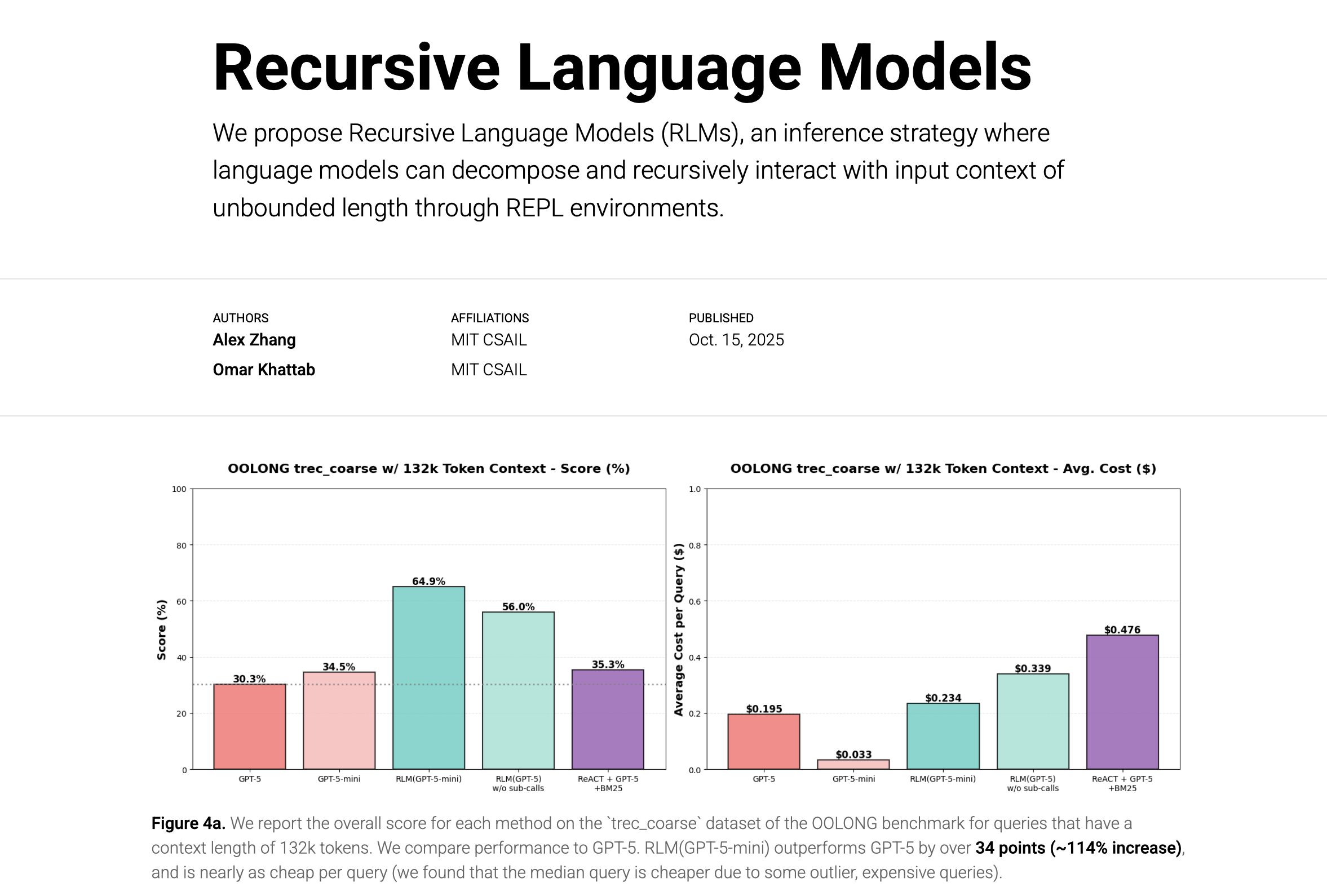
Recursive Language Models
We propose Recursive Language Models (RLMs), an inference strategy where language models can decompose and recursively interact with input context of unbounded length through REPL environments.
Evaluating AGENTS.md: Are Repository-Level Context Files Helpful for Coding Agents?
A widespread practice in software development is to tailor coding agents to repositories using context files, such as AGENTS.md, by either manually or automatically generating them. Although this practice is strongly encouraged by agent developers, there is currently no rigorous investigation into whether such context files are actually effective for real-world tasks. In this work, we study this question and evaluate coding agents' task completion performance in two complementary settings: established SWE-bench tasks from popular repositories, with LLM-generated context files following agent-developer recommendations, and a novel collection of issues from repositories containing developer-committed context files. Across multiple coding agents and LLMs, we find that context files tend to reduce task success rates compared to providing no repository context, while also increasing inference cost by over 20%. Behaviorally, both LLM-generated and developer-provided context files encourage broader exploration (e.g., more thorough testing and file traversal), and coding agents tend to respect their instructions. Ultimately, we conclude that unnecessary requirements from context files make tasks harder, and human-written context files should describe only minimal requirements.
Words that Work: Using Large Language Models to Generate and Refine Hypotheses from Text
In this paper, we introduce a data-driven framework for generating and refining hypotheses from text. Our three-step approach–Hypothesize, Intervene, and Predic

Back-to-basics approach can match or outperform AI in language analysis
A new study led by Dr Andrea Nini at The University of Manchester has found that a grammar-based approach to language analysis can match or outperform advanced AI systems in identifying who wrote a text. The method, called LambdaG, uses patterns in grammar and sentence construction rather than large-scale AI models, offering comparable accuracy ...
SlopCodeBench: Benchmarking How Coding Agents Degrade Over Long-Horizon Iterative Tasks
Software development is iterative, yet agentic coding benchmarks overwhelmingly evaluate single-shot solutions against complete specifications. Code can pass the test suite but become progressively harder to extend. Recent iterative benchmarks attempt to close this gap, but constrain the agent’s design decisions too tightly to faithfully measure how code quality shapes future extensions. We introduce SlopCodeBench, a language-agnostic benchmark comprising 20 problems and 93 checkpoints, in which agents repeatedly extend their own prior solutions under evolving specifications that force architectural decisions without prescribing internal structure. We track two trajectory-level quality signals: verbosity, the fraction of redundant or duplicated code, and structural erosion, the share of complexity mass concentrated in high-complexity functions. No agent solves any problem end-to-end across 11 models; the highest checkpoint solve rate is 17.2%. Quality degrades steadily: erosion rises in 80% of trajectories and verbosity in 89.8%. Against 48 open-source Python repositories, agent code is 2.2x more verbose and markedly more eroded. Tracking 20 of those repositories over time shows that human code stays flat, while agent code deteriorates with each iteration. A prompt-intervention study shows that initial quality can be improved, but it does not halt degradation. These results demonstrate that pass-rate benchmarks systematically undermeasure extension robustness, and that current agents lack the design discipline iterative software development demands.
AI Code Review | Greptile | Merge 4X Faster, Catch 3X More Bugs
AI Code Reviews that understand your entire codebase. Automate PR reviews, catch bugs faster, improve code quality with AI-driven analysis. Try Greptile free!
Documenting Large Webtext Corpora: A Case Study on the Colossal Clean Crawled Corpus
Large language models have led to remarkable progress on many NLP tasks, and researchers are turning to ever-larger text corpora to train them. Some of the largest corpora available are made by scraping significant portions of the internet, and are frequently introduced with only minimal documentation. In this work we provide some of the first documentation for the Colossal Clean Crawled Corpus (C4; Raffel et al., 2020), a dataset created by applying a set of filters to a single snapshot of Common Crawl. We begin by investigating where the data came from, and find a significant amount of text from unexpected sources like patents and US military websites. Then we explore the content of the text itself, and find machine-generated text (e.g., from machine translation systems) and evaluation examples from other benchmark NLP datasets. To understand the impact of the filters applied to create this dataset, we evaluate the text that was removed, and show that blocklist filtering disproportionately removes text from and about minority individuals. Finally, we conclude with some recommendations for how to created and document web-scale datasets from a scrape of the internet.
Does Code Cleanliness Affect Coding Agents? A Controlled Minimal-Pair Study
As autonomous coding agents see rapid adoption, their evaluation has primarily focused on task completion rates holding the target codebase fixed. This leaves a critical question unanswered: does the structural and stylistic quality, or ``cleanliness'' of the underlying code affect an agent's ability to navigate and modify it? To isolate the effect of code cleanliness from agent capability, we introduce an evaluation protocol built around minimal pairs: repositories that match on architecture, dependencies, and external behaviour, but differ on static-analysis rule violations and cognitive complexity. The pairs are constructed in both directions, by agent pipelines that either degrade a clean repository or clean a messy one. We author 33 tasks across six such pairs, evaluated through hidden tests at the application's public surface. Across 660 trials with Claude Code, code cleanliness does not change the agent's pass rate. However, it substantially alters the agent's operational footprint: agents working on cleaner code use 7 to 8% fewer tokens and reduce file revisitations by 34%. Our findings suggest that traditional maintainability principles remain highly relevant in the era of AI-driven development, shaping the computational cost and navigational efficiency of coding agents. Code cleanliness joins model choice, harness, and prompting as a factor that materially affects agent behaviours.
Fengji Zhang, Bei Chen, Yue Zhang, Jacky Keung, Jin Liu, Daoguang Zan, Yi Mao, Jian-Guang Lou, Weizhu Chen. Proceedings of the 2023 Conference on Empirical Methods in Natural Language Processing. 2023.