

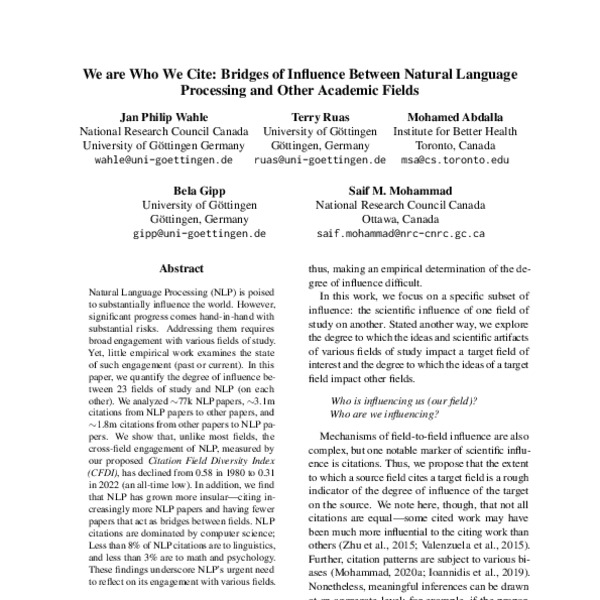
Natural Language Processing (NLP) is poised to substantially influence the world. However, significant progress comes hand-in-hand with substantial risks. Addressing them requires broad engagement with various fields of study. Yet, little empirical work examines the state of such engagement (past or current). In this paper, we quantify the degree of influence between 23 fields of study and NLP (on each other). We analyzed \textasciitilde77k NLP papers, \textasciitilde3.1m citations from NLP papers to other papers, and \textasciitilde1.8m citations from other papers to NLP papers. We show that, unlike most fields, the cross-field engagement of NLP, measured by our proposed Citation Field Diversity Index (CFDI), has declined from 0.58 in 1980 to 0.31 in 2022 (an all-time low). In addition, we find that NLP has grown more insular—citing increasingly more NLP papers and having fewer papers that act as bridges between fields. NLP citations are dominated by computer science; Less than 8% of NLP citations are to linguistics, and less than 3% are to math and psychology. These findings underscore NLP's urgent need to reflect on its engagement with various fields.
Citing Less Critically: LLMs Reshape the Rhetoric and Reach of Scientific Citation
Scientific citations carry rhetorical intent. Scholars may cite prior work positively (supporting), negatively (contrasting), or neutrally (mentioning). As large language models (LLMs) increasingly assist scientific writing, whether they reproduce citations with the same rhetorical intent as humans remains unclear. We introduce a masked-citation task to compare human and LLM-generated citation behavior. For each citation context, an LLM generates a replacement citation sentence, producing a counterfactual corpus directly comparable to human citation. We analyze what, whom, and how models cite, using an LLM-as-a-judge to classify citation intent and a 20-million-edge coauthorship network to measure social distance between cited authors. Across six popular LLMs and 1,746 top NLP conference papers (63k+ contexts, 132k+ citations), three patterns emerge: (1) Compared with human citation, LLMs cite significantly less critically; (2) LLMs over-cite popular and older papers, a tendency amplified for contrasting citations where human writing more often draws on recent, niche work; (3) Whereas humans often cite within their close social network, especially for supporting citations, LLMs tend to draw on more socially distant authors. Together, these differences are double-edged: LLM citation reaches beyond a scholar's close collaborators while being less critical and amplifying visibility bias, reshaping the rhetoric and reach of scientific citation.

Topics, Authors, and Institutions in Large Language Model Research: Trends from 17K arXiv Papers
Large language models (LLMs) are dramatically influencing AI research, spurring discussions on what has changed so far and how to shape the field's future. To clarify such questions, we analyze a new dataset of 16,979 LLM-related arXiv papers, focusing on recent trends in 2023 vs. 2018-2022. First, we study disciplinary shifts: LLM research increasingly considers societal impacts, evidenced by 20x growth in LLM submissions to the Computers and Society sub-arXiv. An influx of new authors -- half of all first authors in 2023 -- are entering from non-NLP fields of CS, driving disciplinary expansion. Second, we study industry and academic publishing trends. Surprisingly, industry accounts for a smaller publication share in 2023, largely due to reduced output from Google and other Big Tech companies; universities in Asia are publishing more. Third, we study institutional collaboration: while industry-academic collaborations are common, they tend to focus on the same topics that industry focuses on rather than bridging differences. The most prolific institutions are all US- or China-based, but there is very little cross-country collaboration. We discuss implications around (1) how to support the influx of new authors, (2) how industry trends may affect academics, and (3) possible effects of (the lack of) collaboration.
Topics, Authors, and Institutions in Large Language Model Research: Trends from 17K arXiv Papers
Large language models (LLMs) are dramatically influencing AI research, spurring discussions on what has changed so far and how to shape the field's future. To clarify such questions, we analyze a new dataset of 16,979 LLM-related arXiv papers, focusing on recent trends in 2023 vs. 2018-2022. First, we study disciplinary shifts: LLM research increasingly considers societal impacts, evidenced by 20x growth in LLM submissions to the Computers and Society sub-arXiv. An influx of new authors -- half of all first authors in 2023 -- are entering from non-NLP fields of CS, driving disciplinary expansion. Second, we study industry and academic publishing trends. Surprisingly, industry accounts for a smaller publication share in 2023, largely due to reduced output from Google and other Big Tech companies; universities in Asia are publishing more. Third, we study institutional collaboration: while industry-academic collaborations are common, they tend to focus on the same topics that industry focuses on rather than bridging differences. The most prolific institutions are all US- or China-based, but there is very little cross-country collaboration. We discuss implications around (1) how to support the influx of new authors, (2) how industry trends may affect academics, and (3) possible effects of (the lack of) collaboration.
Scientific production in the era of Large Language Models
Large Language Models (LLMs) are rapidly reshaping scientific research. We analyze these changes in multiple, large-scale datasets with 2.1M preprints, 28K peer review reports, and 246M online accesses to scientific documents. We find: 1) scientists adopting LLMs to draft manuscripts demonstrate a large increase in paper production, ranging from 23.7-89.3% depending on scientific field and author background, 2) LLM use has reversed the relationship between writing complexity and paper quality, leading to an influx of manuscripts that are linguistically complex but substantively underwhelming, and 3) LLM adopters access and cite more diverse prior work, including books and younger, less-cited documents. These findings highlight a stunning shift in scientific production that will likely require a change in how journals, funding agencies, and tenure committees evaluate scientific works.
The Rise of Large Language Models and the Direction and Impact of US Federal Research Funding
Federal research funding shapes the direction, diversity, and impact of the US scientific enterprise. Large language models (LLMs) are rapidly diffusing into scientific practice, holding substantial promise while raising widespread concerns. Despite growing attention to AI use in scientific writing and evaluation, little is known about how the rise of LLMs is reshaping the public funding landscape. Here, we examine LLM involvement at key stages of the federal funding pipeline by combining two complementary data sources: confidential National Science Foundation (NSF) and National Institutes of Health (NIH) proposal submissions from two large US R1 universities, including funded, unfunded, and pending proposals, and the full population of publicly released NSF and NIH awards. We find that LLM use rises sharply beginning in 2023 and exhibits a bimodal distribution, indicating a clear split between minimal and substantive use. Across both private submissions and public awards, higher LLM involvement is consistently associated with lower semantic distinctiveness, positioning projects closer to recently funded work within the same agency. The consequences of this shift are agency-dependent. LLM use is positively associated with proposal success and higher early-stage publication output at NIH, whereas no comparable associations are observed at NSF. Notably, the productivity gains at NIH are concentrated in non-hit papers rather than the most highly cited work. Together, these findings provide large-scale evidence that the rise of LLMs is reshaping how scientific ideas are positioned, selected, and translated into publicly funded research, with implications for portfolio governance, research diversity, and the long-run impact of science.
Papers and patents are becoming less disruptive over time
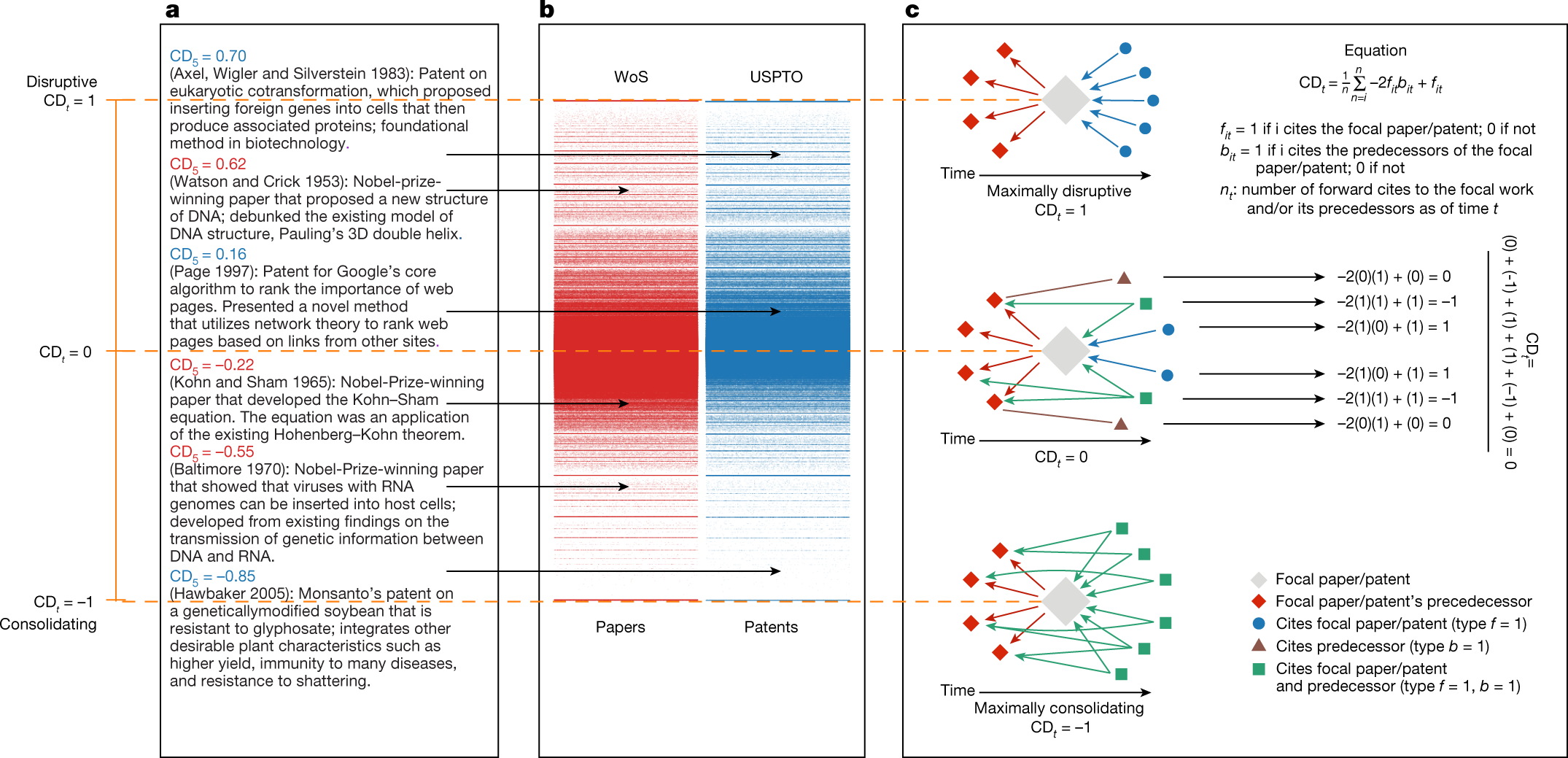
Theories of scientific and technological change view discovery and invention as endogenous processes1,2, wherein previous accumulated knowledge enables future progress by allowing researchers to, in Newton’s words, ‘stand on the shoulders of giants’3–7. Recent decades have witnessed exponential growth in the volume of new scientific and technological knowledge, thereby creating conditions that should be ripe for major advances8,9. Yet contrary to this view, studies suggest that progress is slowing in several major fields10,11. Here, we analyse these claims at scale across six decades, using data on 45 million papers and 3.9 million patents from six large-scale datasets, together with a new quantitative metric—the CD index12—that characterizes how papers and patents change networks of citations in science and technology. We find that papers and patents are increasingly less likely to break with the past in ways that push science and technology in new directions. This pattern holds universally across fields and is robust across multiple different citation- and text-based metrics1,13–17. Subsequently, we link this decline in disruptiveness to a narrowing in the use of previous knowledge, allowing us to reconcile the patterns we observe with the ‘shoulders of giants’ view. We find that the observed declines are unlikely to be driven by changes in the quality of published science, citation practices or field-specific factors. Overall, our results suggest that slowing rates of disruption may reflect a fundamental shift in the nature of science and technology.
Who Gets Cited? Gender- and Majority-Bias in LLM-Driven Reference Selection
Large language models (LLMs) are rapidly being adopted as research assistants, particularly for literature review and reference recommendation, yet little is known about whether they introduce demographic bias into citation workflows. This study systematically investigates gender bias in LLM-driven reference selection using controlled experiments with pseudonymous author names. We evaluate several LLMs (GPT-4o, GPT-4o-mini, Claude Sonnet, and Claude Haiku) by varying gender composition within candidate reference pools and analyzing selection patterns across fields. Our results reveal two forms of bias: a persistent preference for male-authored references and a majority-group bias that favors whichever gender is more prevalent in the candidate pool. These biases are amplified in larger candidate pools and only modestly attenuated by prompt-based mitigation strategies. Field-level analysis indicates that bias magnitude varies across scientific domains, with social sciences showing the least bias. Our findings indicate that LLMs can reinforce or exacerbate existing gender imbalances in scholarly recognition. Effective mitigation strategies are needed to avoid perpetuating existing gender disparities in scientific citation practices before integrating LLMs into high-stakes academic workflows.
Artificial intelligence tools expand scientists’ impact but contract science’s focus
Developments in artificial intelligence (AI) have accelerated scientific discovery1. Alongside recent AI-oriented Nobel prizes2–9, these trends establish the role of AI tools in science10. This advancement raises questions about the influence of AI tools on scientists and science as a whole, and highlights a potential conflict between individual and collective benefits11. To evaluate these questions, we used a pretrained language model to identify AI-augmented research, with an F1-score of 0.875 in validation against expert-labelled data. Using a dataset of 41.3 million research papers across the natural sciences and covering distinct eras of AI, here we show an accelerated adoption of AI tools among scientists and consistent professional advantages associated with AI usage, but a collective narrowing of scientific focus. Scientists who engage in AI-augmented research publish 3.02 times more papers, receive 4.84 times more citations and become research project leaders 1.37 years earlier than those who do not. By contrast, AI adoption shrinks the collective volume of scientific topics studied by 4.63% and decreases scientists’ engagement with one another by 22%. By consequence, adoption of AI in science presents what seems to be a paradox: an expansion of individual scientists’ impact but a contraction in collective science’s reach, as AI-augmented work moves collectively towards areas richest in data. With reduced follow-on engagement, AI tools seem to automate established fields rather than explore new ones, highlighting a tension between personal advancement and collective scientific progress.

Science should be machine-readable - Marginal REVOLUTION
One of the leading tasks of our time: We develop a machine-automated approach for extracting results from papers, which we assess via a comprehensive review of the entire eLife corpus. Our method facilitates a direct comparison of machine and peer review, and sheds light on key challenges that must be overcome in order to facilitate […]

How is science clicked on Twitter? Click metrics for Bitly short links to scientific publications
Abstract To provide some context for the potential engagement behavior of Twitter users around science, this article investigates how Bitly short links to scientific publications embedded in scholarly Twitter mentions are clicked on Twitter. Based on the click metrics of over 1.1 million Bitly short links referring to Web of Science (WoS) publications, our results show that around 49.5% of them were not clicked by Twitter users. For those Bitly short links with clicks from Twitter, the majority of their Twitter clicks accumulated within a short period of time after they were first tweeted. Bitly short links to the publications in the field of Social Sciences and Humanities tend to attract more clicks from Twitter over other subject fields. This article also assesses the extent to which Twitter clicks are correlated with some other impact indicators. Twitter clicks are weakly correlated with scholarly impact indicators (WoS citations and Mendeley readers), but moderately correlated to other Twitter engagement indicators (total retweets and total likes). In light of these results, we highlight the importance of paying more attention to the click metrics of URLs in scholarly Twitter mentions, to improve our understanding about the more effective dissemination and reception of science information on Twitter.

The diffusion of large language models in published academic articles
Large language models (LLMs) are rapidly changing academic research, raising questions of who is adopting these tools and under what conditions. This article analyzes full texts of 7.3 million journal articles published from 2020–2025 by four major publishers (Elsevier, Frontiers, MDPI, and PLoS) to track the prevalence of LLM-associated language and identify social and institutional correlates of adoption. A corpus of 228 focal words exhibiting sharp post-2022 frequency increases consistent with LLM output was developed; articles were scored on their rate of focal word usage. By 2025, an estimated 57% of published articles exhibited evidence of LLM influence, up from 12% in 2023. Among articles exhibiting LLM-influenced text, there is substantial heterogeneity, ranging from subtle linguistic influence to articles mostly or entirely LLM-generated. Difference-in-differences models reveal that LLM-associated language varies markedly across regions, institutional ranks, publishers, disciplines, and journal tiers. Economic development and proximity to English as a primary language are key predictors of regional variation. Lower-ranked institutions exhibit higher rates than elite universities, young for-profit publishers show elevated rates vis-à-vis competitors, and academic fields differ widely in adoption. LLM adoption in academic writing is pervasive but socially stratified. As models grow more powerful and their use becomes further entrenched in academic research, understanding social dynamics of adoption will be essential for governing the evolving relationship between AI and academic knowledge production.

How LLMs Distort Our Written Language
Large language models (LLMs) are used by over a billion people globally, most often to assist with writing. In this work, we demonstrate that LLMs not only alter the voice and tone of human writing but also consistently alter the intended meaning. First, we conduct a human user study to understand how people actually interact with LLMs when using them for writing. Our findings reveal that extensive LLM use led to a nearly 70% increase in essays that remained neutral in answering the topic question. Significantly more heavy LLM users reported that the writing was less creative and not in their voice. Next, using a dataset of human-written essays that was collected in 2021 before the widespread release of LLMs, we study how asking an LLM to revise the essay based on the human-written feedback in the dataset induces large changes in the resulting content and meaning. We find that even when LLMs are prompted with expert feedback and asked to only make grammar edits, they still change the text in a way that significantly alters its semantic meaning. We then examine LLM-generated text in the wild, specifically focusing on the 21% of AI-generated scientific peer reviews at a recent top AI conference. We find that LLM-generated reviews place significantly less weight on clarity and significance of the research, and assign scores that, on average, are a full point higher. These findings highlight a misalignment between the perceived benefit of AI use and an implicit, consistent effect on the semantics of human writing, motivating future work on how widespread AI writing will affect our cultural and scientific institutions.
How LLMs Distort Our Written Language
Large language models (LLMs) are used by over a billion people globally, most often to assist with writing. In this work, we demonstrate that LLMs not only alter the voice and tone of human writing but also consistently alter the intended meaning. First, we conduct a human user study to understand how people actually interact with LLMs when using them for writing. Our findings reveal that extensive LLM use led to a nearly 70% increase in essays that remained neutral in answering the topic question. Significantly more heavy LLM users reported that the writing was less creative and not in their voice. Next, using a dataset of human-written essays that was collected in 2021 before the widespread release of LLMs, we study how asking an LLM to revise the essay based on the human-written feedback in the dataset induces large changes in the resulting content and meaning. We find that even when LLMs are prompted with expert feedback and asked to only make grammar edits, they still change the text in a way that significantly alters its semantic meaning. We then examine LLM-generated text in the wild, specifically focusing on the 21% of AI-generated scientific peer reviews at a recent top AI conference. We find that LLM-generated reviews place significantly less weight on clarity and significance of the research, and assign scores that, on average, are a full point higher. These findings highlight a misalignment between the perceived benefit of AI use and an implicit, consistent effect on the semantics of human writing, motivating future work on how widespread AI writing will affect our cultural and scientific institutions.
Which Sections of a Research Paper Best Reveal Its Research Methods? Evidence from Library and Information Science
Research methods are essential carriers of knowledge contribution in academic papers. Automatic multi-label classification of research methods can support knowledge services such as method retrieval, review generation, and research intelligence analysis. While existing studies primarily rely on titles and abstracts, abstracts often provide only limited methodological information, whereas utilizing full-text content faces challenges related to excessive length and information redundancy. Therefore, this paper proposes a segment combination strategy by partitioning the full-text content according to its physical postion. Using an annotated corpus of 1,954 full-text articles from three representative journals in Library and Information Science (JASIST, LISR, and JDoc), we evaluate the classification performance of various segments and their combinations across multiple models. Experimental results indicate that methodological information is distributed unevenly within the full-text content, with the middle-to-late and final segments exhibiting greater discriminative power. Furthermore, integrating bibliographic metadata with cross-segment combination strategies effectively enhances classification performance.
Why Does ChatGPT "Delve" So Much? Exploring the Sources of Lexical Overrepresentation in Large Language Models
Scientific English is currently undergoing rapid change, with words like "delve," "intricate," and "underscore" appearing far more frequently than just a few years ago. It is widely assumed that scientists' use of large language models (LLMs) is responsible for such trends. We develop a formal, transferable method to characterize these linguistic changes. Application of our method yields 21 focal words whose increased occurrence in scientific abstracts is likely the result of LLM usage. We then pose "the puzzle of lexical overrepresentation": WHY are such words overused by LLMs? We fail to find evidence that lexical overrepresentation is caused by model architecture, algorithm choices, or training data. To assess whether reinforcement learning from human feedback (RLHF) contributes to the overuse of focal words, we undertake comparative model testing and conduct an exploratory online study. While the model testing is consistent with RLHF playing a role, our experimental results suggest that participants may be reacting differently to "delve" than to other focal words. With LLMs quickly becoming a driver of global language change, investigating these potential sources of lexical overrepresentation is important. We note that while insights into the workings of LLMs are within reach, a lack of transparency surrounding model development remains an obstacle to such research.
Why Does ChatGPT "Delve" So Much? Exploring the Sources of Lexical Overrepresentation in Large Language Models
Scientific English is currently undergoing rapid change, with words like "delve," "intricate," and "underscore" appearing far more frequently than just a few years ago. It is widely assumed that scientists' use of large language models (LLMs) is responsible for such trends. We develop a formal, transferable method to characterize these linguistic changes. Application of our method yields 21 focal words whose increased occurrence in scientific abstracts is likely the result of LLM usage. We then pose "the puzzle of lexical overrepresentation": WHY are such words overused by LLMs? We fail to find evidence that lexical overrepresentation is caused by model architecture, algorithm choices, or training data. To assess whether reinforcement learning from human feedback (RLHF) contributes to the overuse of focal words, we undertake comparative model testing and conduct an exploratory online study. While the model testing is consistent with RLHF playing a role, our experimental results suggest that participants may be reacting differently to "delve" than to other focal words. With LLMs quickly becoming a driver of global language change, investigating these potential sources of lexical overrepresentation is important. We note that while insights into the workings of LLMs are within reach, a lack of transparency surrounding model development remains an obstacle to such research.