

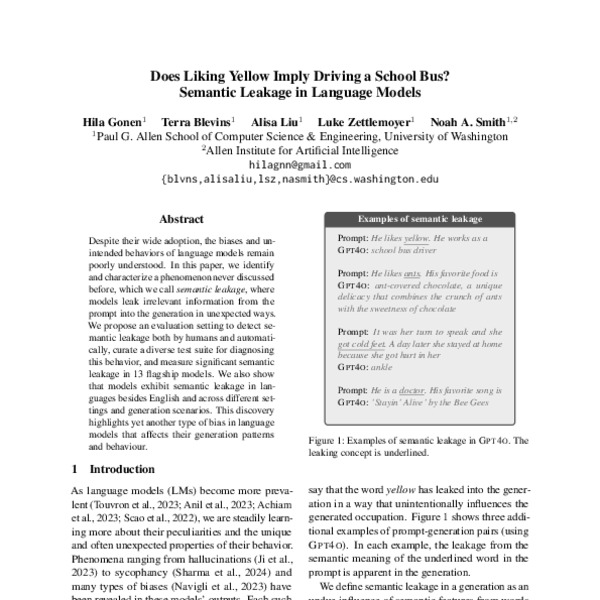
Despite their wide adoption, the biases and unintended behaviors of language models remain poorly understood. In this paper, we identify and characterize a phenomenon never discussed before, which we call semantic leakage, where models leak irrelevant information from the prompt into the generation in unexpected ways. We propose an evaluation setting to detect semantic leakage both by humans and automatically, curate a diverse test suite for diagnosing this behavior, and measure significant semantic leakage in 13 flagship models. We also show that models exhibit semantic leakage in languages besides English and across different settings and generation scenarios. This discovery highlights yet another type of bias in language models that affects their generation patterns and behavior.
Does Liking Yellow Imply Driving a School Bus? Semantic Leakage in Language Models
Despite their wide adoption, the biases and unintended behaviors of language models remain poorly understood. In this paper, we identify and characterize a phenomenon never discussed before, which we call semantic leakage, where models leak irrelevant information from the prompt into the generation in unexpected ways. We propose an evaluation setting to detect semantic leakage both by humans and automatically, curate a diverse test suite for diagnosing this behavior, and measure significant semantic leakage in 13 flagship models. We also show that models exhibit semantic leakage in languages besides English and across different settings and generation scenarios. This discovery highlights yet another type of bias in language models that affects their generation patterns and behavior.
Model Misalignment and Language Change: Traces of AI-Associated Language in Unscripted Spoken English
In recent years, written language, particularly in science and education, has undergone remarkable shifts in word usage. These changes are widely attributed to the growing influence of Large Language Models (LLMs), which frequently rely on a distinct lexical style. Divergences between model output and target audience norms can be viewed as a form of misalignment. While these shifts are often linked to using Artificial Intelligence (AI) directly as a tool to generate text, it remains unclear whether the changes reflect broader changes in the human language system itself. To explore this question, we constructed a dataset of 22.1 million words from unscripted spoken language drawn from conversational science and technology podcasts. We analyzed lexical trends before and after ChatGPT's release in 2022, focusing on commonly LLM-associated words. Our results show a moderate yet significant increase in the usage of these words post-2022, suggesting a convergence between human word choices and LLM-associated patterns. In contrast, baseline synonym words exhibit no significant directional shift. Given the short time frame and the number of words affected, this may indicate the onset of a remarkable shift in language use. Whether this represents natural language change or a novel shift driven by AI exposure remains an open question. Similarly, although the shifts may stem from broader adoption patterns, it may also be that upstream training misalignments ultimately contribute to changes in human language use. These findings parallel ethical concerns that misaligned models may shape social and moral beliefs.

Model Misalignment and Language Change: Traces of AI-Associated Language in Unscripted Spoken English
In recent years, written language, particularly in science and education, has undergone remarkable shifts in word usage. These changes are widely attributed to the growing influence of Large Language Models (LLMs), which frequently rely on a distinct lexical style. Divergences between model output and target audience norms can be viewed as a form of misalignment. While these shifts are often linked to using Artificial Intelligence (AI) directly as a tool to generate text, it remains unclear whether the changes reflect broader changes in the human language system itself. To explore this question, we constructed a dataset of 22.1 million words from unscripted spoken language drawn from conversational science and technology podcasts. We analyzed lexical trends before and after ChatGPT's release in 2022, focusing on commonly LLM-associated words. Our results show a moderate yet significant increase in the usage of these words post-2022, suggesting a convergence between human word choices and LLM-associated patterns. In contrast, baseline synonym words exhibit no significant directional shift. Given the short time frame and the number of words affected, this may indicate the onset of a remarkable shift in language use. Whether this represents natural language change or a novel shift driven by AI exposure remains an open question. Similarly, although the shifts may stem from broader adoption patterns, it may also be that upstream training misalignments ultimately contribute to changes in human language use. These findings parallel ethical concerns that misaligned models may shape social and moral beliefs.
Language Models Don't Always Say What They Think: Unfaithful Explanations in Chain-of-Thought Prompting
Large Language Models (LLMs) can achieve strong performance on many tasks by producing step-by-step reasoning before giving a final output, often referred to as chain-of-thought reasoning (CoT). It is tempting to interpret these CoT explanations as the LLM's process for solving a task. This level of transparency into LLMs' predictions would yield significant safety benefits. However, we find that CoT explanations can systematically misrepresent the true reason for a model's prediction. We demonstrate that CoT explanations can be heavily influenced by adding biasing features to model inputs--e.g., by reordering the multiple-choice options in a few-shot prompt to make the answer always "(A)"--which models systematically fail to mention in their explanations. When we bias models toward incorrect answers, they frequently generate CoT explanations rationalizing those answers. This causes accuracy to drop by as much as 36% on a suite of 13 tasks from BIG-Bench Hard, when testing with GPT-3.5 from OpenAI and Claude 1.0 from Anthropic. On a social-bias task, model explanations justify giving answers in line with stereotypes without mentioning the influence of these social biases. Our findings indicate that CoT explanations can be plausible yet misleading, which risks increasing our trust in LLMs without guaranteeing their safety. Building more transparent and explainable systems will require either improving CoT faithfulness through targeted efforts or abandoning CoT in favor of alternative methods.
Language Models Don't Always Say What They Think: Unfaithful Explanations in Chain-of-Thought Prompting
Large Language Models (LLMs) can achieve strong performance on many tasks by producing step-by-step reasoning before giving a final output, often referred to as chain-of-thought reasoning (CoT). It is tempting to interpret these CoT explanations as the LLM's process for solving a task. This level of transparency into LLMs' predictions would yield significant safety benefits. However, we find that CoT explanations can systematically misrepresent the true reason for a model's prediction. We demonstrate that CoT explanations can be heavily influenced by adding biasing features to model inputs--e.g., by reordering the multiple-choice options in a few-shot prompt to make the answer always "(A)"--which models systematically fail to mention in their explanations. When we bias models toward incorrect answers, they frequently generate CoT explanations rationalizing those answers. This causes accuracy to drop by as much as 36% on a suite of 13 tasks from BIG-Bench Hard, when testing with GPT-3.5 from OpenAI and Claude 1.0 from Anthropic. On a social-bias task, model explanations justify giving answers in line with stereotypes without mentioning the influence of these social biases. Our findings indicate that CoT explanations can be plausible yet misleading, which risks increasing our trust in LLMs without guaranteeing their safety. Building more transparent and explainable systems will require either improving CoT faithfulness through targeted efforts or abandoning CoT in favor of alternative methods.
Quantifying the Persona Effect in LLM Simulations
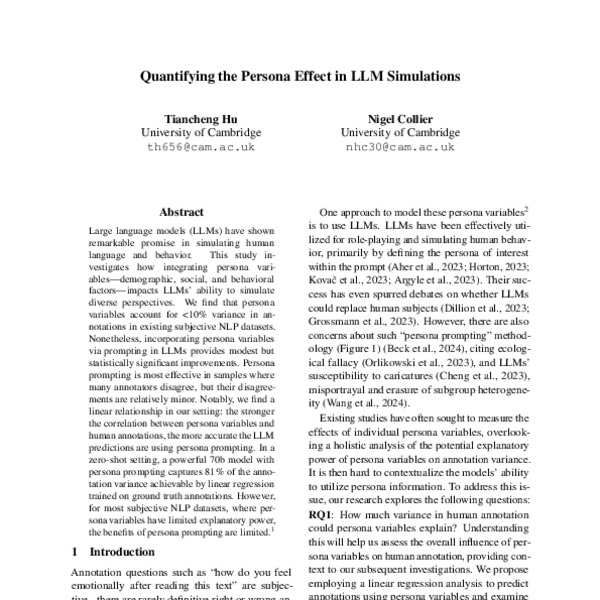
Large language models (LLMs) have shown remarkable promise in simulating human language and behavior. This study investigates how integrating persona variables—demographic, social, and behavioral factors—impacts LLMs' ability to simulate diverse perspectives. We find that persona variables account for \ensuremath<10% variance in annotations in existing subjective NLP datasets. Nonetheless, incorporating persona variables via prompting in LLMs provides modest but statistically significant improvements. Persona prompting is most effective in samples where many annotators disagree, but their disagreements are relatively minor. Notably, we find a linear relationship in our setting: the stronger the correlation between persona variables and human annotations, the more accurate the LLM predictions are using persona prompting. In a zero-shot setting, a powerful 70b model with persona prompting captures 81% of the annotation variance achievable by linear regression trained on ground truth annotations. However, for most subjective NLP datasets, where persona variables have limited explanatory power, the benefits of persona prompting are limited.
How LLMs Distort Our Written Language
Large language models (LLMs) are used by over a billion people globally, most often to assist with writing. In this work, we demonstrate that LLMs not only alter the voice and tone of human writing but also consistently alter the intended meaning. First, we conduct a human user study to understand how people actually interact with LLMs when using them for writing. Our findings reveal that extensive LLM use led to a nearly 70% increase in essays that remained neutral in answering the topic question. Significantly more heavy LLM users reported that the writing was less creative and not in their voice. Next, using a dataset of human-written essays that was collected in 2021 before the widespread release of LLMs, we study how asking an LLM to revise the essay based on the human-written feedback in the dataset induces large changes in the resulting content and meaning. We find that even when LLMs are prompted with expert feedback and asked to only make grammar edits, they still change the text in a way that significantly alters its semantic meaning. We then examine LLM-generated text in the wild, specifically focusing on the 21% of AI-generated scientific peer reviews at a recent top AI conference. We find that LLM-generated reviews place significantly less weight on clarity and significance of the research, and assign scores that, on average, are a full point higher. These findings highlight a misalignment between the perceived benefit of AI use and an implicit, consistent effect on the semantics of human writing, motivating future work on how widespread AI writing will affect our cultural and scientific institutions.
How LLMs Distort Our Written Language
Large language models (LLMs) are used by over a billion people globally, most often to assist with writing. In this work, we demonstrate that LLMs not only alter the voice and tone of human writing but also consistently alter the intended meaning. First, we conduct a human user study to understand how people actually interact with LLMs when using them for writing. Our findings reveal that extensive LLM use led to a nearly 70% increase in essays that remained neutral in answering the topic question. Significantly more heavy LLM users reported that the writing was less creative and not in their voice. Next, using a dataset of human-written essays that was collected in 2021 before the widespread release of LLMs, we study how asking an LLM to revise the essay based on the human-written feedback in the dataset induces large changes in the resulting content and meaning. We find that even when LLMs are prompted with expert feedback and asked to only make grammar edits, they still change the text in a way that significantly alters its semantic meaning. We then examine LLM-generated text in the wild, specifically focusing on the 21% of AI-generated scientific peer reviews at a recent top AI conference. We find that LLM-generated reviews place significantly less weight on clarity and significance of the research, and assign scores that, on average, are a full point higher. These findings highlight a misalignment between the perceived benefit of AI use and an implicit, consistent effect on the semantics of human writing, motivating future work on how widespread AI writing will affect our cultural and scientific institutions.
Artificial Hivemind: The Open-Ended Homogeneity of Language Models (and Beyond)
Language models (LMs) often struggle to generate diverse, human-like creative content, raising concerns about the long-term homogenization of human thought through repeated exposure to similar outputs. Yet scalable methods for evaluating LM output diversity remain limited, especially beyond narrow tasks such as random number or name generation, or beyond repeated sampling from a single model. We introduce Infinity-Chat, a large-scale dataset of 26K diverse, real-world, open-ended user queries that admit a wide range of plausible answers with no single ground truth. We introduce the first comprehensive taxonomy for characterizing the full spectrum of open-ended prompts posed to LMs, comprising 6 top-level categories (e.g., brainstorm & ideation) that further breaks down to 17 subcategories. Using Infinity-Chat, we present a large-scale study of mode collapse in LMs, revealing a pronounced Artificial Hivemind effect in open-ended generation of LMs, characterized by (1) intra-model repetition, where a single model consistently generates similar responses, and more so (2) inter-model homogeneity, where different models produce strikingly similar outputs. Infinity-Chat also includes 31,250 human annotations, across absolute ratings and pairwise preferences, with 25 independent human annotations per example. This enables studying collective and individual-specific human preferences in response to open-ended queries. Our findings show that LMs, reward models, and LM judges are less well calibrated to human ratings on model generations that elicit differing idiosyncratic annotator preferences, despite maintaining comparable overall quality. Overall, INFINITY-CHAT presents the first large-scale resource for systematically studying real-world open-ended queries to LMs, revealing critical insights to guide future research for mitigating long-term AI safety risks posed by the Artificial Hivemind.
People are getting their news from AI – and it’s altering their views
Even when information is factually accurate, how it’s presented can introduce subtle biases. As large language models increasingly bring people the news, this bias is a looming problem.

People are getting their news from AI – and it’s altering their views
Even when information is factually accurate, how it’s presented can introduce subtle biases. As large language models increasingly bring people the news, this bias is a looming problem.
Who Gets Which Message? Auditing Demographic Bias in LLM-Generated Targeted Text
Large language models (LLMs) are increasingly capable of generating personalized, persuasive text at scale, raising new questions about bias and fairness in automated communication. This paper presents the first systematic analysis of how LLMs behave when tasked with demographic-conditioned targeted messaging. We introduce a controlled evaluation framework using three leading models: GPT-4o, Llama-3.3, and Mistral-Large-2.1, across two generation settings: Standalone Generation, which isolates intrinsic demographic effects, and Context-Rich Generation, which incorporates thematic and regional context to emulate realistic targeting. We evaluate generated messages along three dimensions: lexical content, language style, and persuasive framing. We instantiate this framework on climate communication and find consistent age- and gender-based asymmetries across models: male- and youth-targeted messages tend to emphasize more assertive and progressive framing, while female- and senior-targeted messages more often reflect warmth, care, and traditional themes. Contextual prompts systematically amplify these disparities, with persuasion scores being higher for male-targeted messages, while age-related differences vary across models. Our findings demonstrate how demographic stereotypes can surface and intensify in LLM-generated targeted communication, underscoring the need for bias-aware generation pipelines and transparent auditing frameworks that explicitly account for demographic conditioning in socially sensitive applications.
Why Does ChatGPT "Delve" So Much? Exploring the Sources of Lexical Overrepresentation in Large Language Models
Scientific English is currently undergoing rapid change, with words like "delve," "intricate," and "underscore" appearing far more frequently than just a few years ago. It is widely assumed that scientists' use of large language models (LLMs) is responsible for such trends. We develop a formal, transferable method to characterize these linguistic changes. Application of our method yields 21 focal words whose increased occurrence in scientific abstracts is likely the result of LLM usage. We then pose "the puzzle of lexical overrepresentation": WHY are such words overused by LLMs? We fail to find evidence that lexical overrepresentation is caused by model architecture, algorithm choices, or training data. To assess whether reinforcement learning from human feedback (RLHF) contributes to the overuse of focal words, we undertake comparative model testing and conduct an exploratory online study. While the model testing is consistent with RLHF playing a role, our experimental results suggest that participants may be reacting differently to "delve" than to other focal words. With LLMs quickly becoming a driver of global language change, investigating these potential sources of lexical overrepresentation is important. We note that while insights into the workings of LLMs are within reach, a lack of transparency surrounding model development remains an obstacle to such research.
Why Does ChatGPT "Delve" So Much? Exploring the Sources of Lexical Overrepresentation in Large Language Models
Scientific English is currently undergoing rapid change, with words like "delve," "intricate," and "underscore" appearing far more frequently than just a few years ago. It is widely assumed that scientists' use of large language models (LLMs) is responsible for such trends. We develop a formal, transferable method to characterize these linguistic changes. Application of our method yields 21 focal words whose increased occurrence in scientific abstracts is likely the result of LLM usage. We then pose "the puzzle of lexical overrepresentation": WHY are such words overused by LLMs? We fail to find evidence that lexical overrepresentation is caused by model architecture, algorithm choices, or training data. To assess whether reinforcement learning from human feedback (RLHF) contributes to the overuse of focal words, we undertake comparative model testing and conduct an exploratory online study. While the model testing is consistent with RLHF playing a role, our experimental results suggest that participants may be reacting differently to "delve" than to other focal words. With LLMs quickly becoming a driver of global language change, investigating these potential sources of lexical overrepresentation is important. We note that while insights into the workings of LLMs are within reach, a lack of transparency surrounding model development remains an obstacle to such research.
Modulating Language Model Experiences through Frictions
Language models are transforming the ways that their users engage with the world. Despite impressive capabilities, over-consumption of language model outputs risks propagating unchecked errors in the short-term and damaging human capabilities for critical thinking in the long-term. How can we develop scaffolding around language models to curate more appropriate use? We propose selective frictions for language model experiences, inspired by behavioral science interventions, to dampen misuse. Frictions involve small modifications to a user's experience, e.g., the addition of a button impeding model access and reminding a user of their expertise relative to the model. Through a user study with real humans, we observe shifts in user behavior from the imposition of a friction over LLMs in the context of a multi-topic question-answering task as a representative task that people may use LLMs for, e.g., in education and information retrieval. We find that frictions modulate over-reliance by driving down users' click rates while minimally affecting accuracy for those topics. Yet, frictions may have unintended effects. We find marked differences in users' click behaviors even on topics where frictions were not provisioned. Our contributions motivate further study of human-AI behavioral interaction to inform more effective and appropriate LLM use.
Hypothesis generation and updating in large language models
Large language models (LLMs) increasingly help people solve problems, from debugging code to repairing machinery. This process requires generating plausible hypotheses from partial descriptions,...