

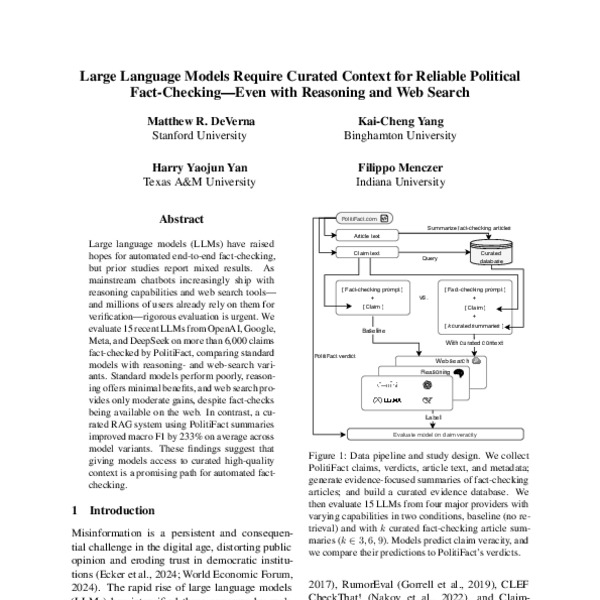
Large language models (LLMs) have raised hopes for automated end-to-end fact-checking, but prior studies report mixed results. As mainstream chatbots increasingly ship with reasoning capabilities and web search tools—and millions of users already rely on them for verification—rigorous evaluation is urgent. We evaluate 15 recent LLMs from OpenAI, Google, Meta, and DeepSeek on more than 6,000 claims fact-checked by PolitiFact, comparing standard models with reasoning- and web-search variants. Standard models perform poorly, reasoning offers minimal benefits, and web search provides only moderate gains, despite fact-checks being available on the web. In contrast, a curated RAG system using PolitiFact summaries improved macro F1 by 233% on average across model variants. These findings suggest that giving models access to curated high-quality context is a promising path for automated fact-checking.
RealFactBench: A Benchmark for Evaluating Large Language Models in Real-World Fact-Checking
Large Language Models (LLMs) hold significant potential for advancing fact-checking by leveraging their capabilities in reasoning, evidence retrieval, and explanation generation. However, existing benchmarks fail to comprehensively evaluate LLMs and Multimodal Large Language Models (MLLMs) in realistic misinformation scenarios. To bridge this gap, we introduce RealFactBench, a comprehensive benchmark designed to assess the fact-checking capabilities of LLMs and MLLMs across diverse real-world tasks, including Knowledge Validation, Rumor Detection, and Event Verification. RealFactBench consists of 6K high-quality claims drawn from authoritative sources, encompassing multimodal content and diverse domains. Our evaluation framework further introduces the Unknown Rate (UnR) metric, enabling a more nuanced assessment of models' ability to handle uncertainty and balance between over-conservatism and over-confidence. Extensive experiments on 7 representative LLMs and 4 MLLMs reveal their limitations in real-world fact-checking and offer valuable insights for further research. RealFactBench is publicly available at https://github.com/kalendsyang/RealFactBench.git.

RealFactBench: A Benchmark for Evaluating Large Language Models in Real-World Fact-Checking
Large Language Models (LLMs) hold significant potential for advancing fact-checking by leveraging their capabilities in reasoning, evidence retrieval, and explanation generation. However, existing benchmarks fail to comprehensively evaluate LLMs and Multimodal Large Language Models (MLLMs) in realistic misinformation scenarios. To bridge this gap, we introduce RealFactBench, a comprehensive benchmark designed to assess the fact-checking capabilities of LLMs and MLLMs across diverse real-world tasks, including Knowledge Validation, Rumor Detection, and Event Verification. RealFactBench consists of 6K high-quality claims drawn from authoritative sources, encompassing multimodal content and diverse domains. Our evaluation framework further introduces the Unknown Rate (UnR) metric, enabling a more nuanced assessment of models' ability to handle uncertainty and balance between over-conservatism and over-confidence. Extensive experiments on 7 representative LLMs and 4 MLLMs reveal their limitations in real-world fact-checking and offer valuable insights for further research. RealFactBench is publicly available at https://github.com/kalendsyang/RealFactBench.git.
Language agents achieve superhuman synthesis of scientific knowledge
Language models are known to hallucinate incorrect information, and it is unclear if they are sufficiently accurate and reliable for use in scientific research. We developed a rigorous human-AI comparison methodology to evaluate language model agents on real-world literature search tasks covering information retrieval, summarization, and contradiction detection tasks. We show that PaperQA2, a frontier language model agent optimized for improved factuality, matches or exceeds subject matter expert performance on three realistic literature research tasks without any restrictions on humans (i.e., full access to internet, search tools, and time). PaperQA2 writes cited, Wikipedia-style summaries of scientific topics that are significantly more accurate than existing, human-written Wikipedia articles. We also introduce a hard benchmark for scientific literature research called LitQA2 that guided design of PaperQA2, leading to it exceeding human performance. Finally, we apply PaperQA2 to identify contradictions within the scientific literature, an important scientific task that is challenging for humans. PaperQA2 identifies 2.34 +/- 1.99 contradictions per paper in a random subset of biology papers, of which 70% are validated by human experts. These results demonstrate that language model agents are now capable of exceeding domain experts across meaningful tasks on scientific literature.
GermanPartiesQA: Benchmarking Commercial Large Language Models and AI Companions for Political Alignment and Sycophancy
Large language models (LLMs) are increasingly shaping citizens’ information ecosystems. Products incorporating LLMs, such as chatbots and AI Companions, are now widely used for decision support and information retrieval, including in sensitive domains, raising concerns about hidden biases and growing potential to shape individual decisions and public opinion. This paper introduces GermanPartiesQA, a benchmark of 418 political statements from German Voting Advice Applications across 11 elections to evaluate six commercial LLMs. We evaluate their political alignment based on role-playing experiments with political personas. Our evaluation reveals three specific findings: (1) Factual limitations: LLMs show limited ability to accurately generate factual party positions, particularly for centrist parties. (2) Model-specific ideological alignment: We identify consistent alignment patterns and degree of political steerability for each model across temperature settings and experiments. (3) Claim of sycophancy: While models adjust to political personas during role-play, we find this reflects persona-based steerability rather than the increasingly popular, yet contested concept of sycophancy. Our study contributes to evaluating the political alignment of closed-source LLMs that are increasingly embedded in electoral decision support tools and AI Companion chatbots.
GermanPartiesQA: Benchmarking Commercial Large Language Models and AI Companions for Political Alignment and Sycophancy
Large language models (LLMs) are increasingly shaping citizens’ information ecosystems. Products incorporating LLMs, such as chatbots and AI Companions, are now widely used for decision support and information retrieval, including in sensitive domains, raising concerns about hidden biases and growing potential to shape individual decisions and public opinion. This paper introduces GermanPartiesQA, a benchmark of 418 political statements from German Voting Advice Applications across 11 elections to evaluate six commercial LLMs. We evaluate their political alignment based on role-playing experiments with political personas. Our evaluation reveals three specific findings: (1) Factual limitations: LLMs show limited ability to accurately generate factual party positions, particularly for centrist parties. (2) Model-specific ideological alignment: We identify consistent alignment patterns and degree of political steerability for each model across temperature settings and experiments. (3) Claim of sycophancy: While models adjust to political personas during role-play, we find this reflects persona-based steerability rather than the increasingly popular, yet contested concept of sycophancy. Our study contributes to evaluating the political alignment of closed-source LLMs that are increasingly embedded in electoral decision support tools and AI Companion chatbots.
Relying on AI chatbots for historical facts can influence your political beliefs, new study shows
A recent study in PNAS Nexus suggests that reading history summaries generated by artificial intelligence can subtly shift your political opinions. Even when factually accurate, chatbots carry hidden biases that influence how people view the world.

AI Fact-Checking in the Wild: A Field Evaluation of LLM-Written Community Notes on X
Large language models (LLMs) show promising capabilities for fact-checking, yet prior work evaluates them only in controlled offline settings using benchmarks or crowdworker judgments. Success in real-world fact-checking depends also on how content is judged within a live platform environment. We present the first field evaluation of LLM fact-checking deployed on a live social media platform, testing performance directly through X Community Notes’ “AI writer” feature over a three-month period. Our LLM writer, a multi-step pipeline that handles multimodal content, conducts web and platform-native search, and writes contextual notes, was deployed to write 1,614 notes on 1,597 tweets and compared against 1,332 human-written notes on the same tweets using 108,169 ratings from 42,521 raters. Direct comparison of note-level platform outcomes is complicated by differences in submission timing and exposure between LLM and human notes; we therefore pursue two analysis strategies: a rating-level analysis modeling individual rater evaluations, and a note-level analysis that relies on common raters who rated all notes on the same post. Rating-level analysis shows that LLM notes receive more positive ratings than human notes across raters with different political viewpoints, and note-level analysis shows LLM notes achieve significantly higher helpfulness scores among common raters. Rater-provided tags suggest that people consider LLM notes to use more neutral language and cite better sources. These findings provide field evidence that LLMs can contribute broadly helpful fact-checking notes at scale, while showing that their evaluation is shaped by platform dynamics absent from controlled offline settings.
Can Language Models Play the Wikipedia Game?
Language models increasingly support or automate information retrieval from document collections too large to index. This task is difficult when it requires specialist linguistic or scientific knowledge. We used the Wikipedia Game to test language models on an analogous information retrieval task. In the game, players must reach a target article using only article links. We compared sentence embedding models and LLMs across five Wikipedia languages and five academic-literature datasets. We construct very large local graphs of Wikipedia pages and of paper citations using OpenAlex and provide code to build and navigate them. This allows the study of language models' navigation capabilities without relying on third-party APIs. We compared the models with human and TF-IDF benchmarks. The Wikipedia Game format enables robust comparisons across techniques, languages, and domains. No model significantly outperformed humans, although the best models (GPT-o3 mini, GPT-4o, QwQ:32B, and DeepSeek-R1:70B) achieved comparable success. Performance and rankings varied across languages and topics, with implications for practitioners utilising these techniques.
Measuring short-form factuality in large language models
We present SimpleQA, a benchmark that evaluates the ability of language models to answer short, fact-seeking questions. We prioritized two properties in designing this eval. First, SimpleQA is challenging, as it is adversarially collected against GPT-4 responses. Second, responses are easy to grade, because questions are created such that there exists only a single, indisputable answer. Each answer in SimpleQA is graded as either correct, incorrect, or not attempted. A model with ideal behavior would get as many questions correct as possible while not attempting the questions for which it is not confident it knows the correct answer. SimpleQA is a simple, targeted evaluation for whether models "know what they know," and our hope is that this benchmark will remain relevant for the next few generations of frontier models. SimpleQA can be found at https://github.com/openai/simple-evals.
Measuring short-form factuality in large language models
We present SimpleQA, a benchmark that evaluates the ability of language models to answer short, fact-seeking questions. We prioritized two properties in designing this eval. First, SimpleQA is challenging, as it is adversarially collected against GPT-4 responses. Second, responses are easy to grade, because questions are created such that there exists only a single, indisputable answer. Each answer in SimpleQA is graded as either correct, incorrect, or not attempted. A model with ideal behavior would get as many questions correct as possible while not attempting the questions for which it is not confident it knows the correct answer. SimpleQA is a simple, targeted evaluation for whether models "know what they know," and our hope is that this benchmark will remain relevant for the next few generations of frontier models. SimpleQA can be found at https://github.com/openai/simple-evals.
Just Asking Questions: Doing Our Own Research on Conspiratorial Ideation by Generative AI Chatbots
Interactive chat systems that build on artificial intelligence frameworks are increasingly ubiquitous and embedded into search engines, Web browsers, and operating systems, or are available on websites and apps. Researcher efforts have sought to understand the limitations and potential for harm of generative AI, which we contribute to here. Conducting a systematic review of six AI-powered chat systems (ChatGPT 3.5; ChatGPT 4 Mini; Microsoft Copilot in Bing; Google Search AI; Perplexity; and Grok in Twitter/X), this study examines how these leading products respond to questions related to conspiracy theories. This follows the platform policy implementation audit approach established by Glazunova et al. (2023). We select five well-known and comprehensively debunked conspiracy theories and four emerging conspiracy theories that relate to breaking news events at the time of data collection. Our findings demonstrate that the extent of safety guardrails against conspiratorial ideation in generative AI chatbots differs markedly, depending on chatbot model and conspiracy theory. Our observations indicate that safety guardrails in AI chatbots are often very selectively designed: generative AI companies appear to focus especially on ensuring that their products are not seen to be racist; they also appear to pay particular attention to conspiracy theories that address topics of substantial national trauma such as 9/11 or relate to well-established political issues. Future work should include an ongoing effort extended to further platforms, multiple languages, and a range of conspiracy theories extending well beyond the United States.
Just Asking Questions: Doing Our Own Research on Conspiratorial Ideation by Generative AI Chatbots
Interactive chat systems that build on artificial intelligence frameworks are increasingly ubiquitous and embedded into search engines, Web browsers, and operating systems, or are available on websites and apps. Researcher efforts have sought to understand the limitations and potential for harm of generative AI, which we contribute to here. Conducting a systematic review of six AI-powered chat systems (ChatGPT 3.5; ChatGPT 4 Mini; Microsoft Copilot in Bing; Google Search AI; Perplexity; and Grok in Twitter/X), this study examines how these leading products respond to questions related to conspiracy theories. This follows the platform policy implementation audit approach established by Glazunova et al. (2023). We select five well-known and comprehensively debunked conspiracy theories and four emerging conspiracy theories that relate to breaking news events at the time of data collection. Our findings demonstrate that the extent of safety guardrails against conspiratorial ideation in generative AI chatbots differs markedly, depending on chatbot model and conspiracy theory. Our observations indicate that safety guardrails in AI chatbots are often very selectively designed: generative AI companies appear to focus especially on ensuring that their products are not seen to be racist; they also appear to pay particular attention to conspiracy theories that address topics of substantial national trauma such as 9/11 or relate to well-established political issues. Future work should include an ongoing effort extended to further platforms, multiple languages, and a range of conspiracy theories extending well beyond the United States.
The levers of political persuasion with conversational artificial intelligence
There are widespread fears that conversational artificial intelligence (AI) could soon exert unprecedented influence over human beliefs. In this work, in three large-scale experiments ( N = 76,977 participants), we deployed 19 large language models (LLMs)—including some post-trained explicitly for persuasion—to evaluate their persuasiveness on 707 political issues. We then checked the factual accuracy of 466,769 resulting LLM claims. We show that the persuasive power of current and near-future AI is likely to stem more from post-training and prompting methods—which boosted persuasiveness by as much as 51 and 27%, respectively—than from personalization or increasing model scale, which had smaller effects. We further show that these methods increased persuasion by exploiting LLMs’ ability to rapidly access and strategically deploy information and that, notably, where they increased AI persuasiveness, they also systematically decreased factual accuracy. , Editor’s summary Many fear that we are on the precipice of unprecedented manipulation by large language models (LLMs), but techniques driving their persuasiveness are poorly understood. In the initial “pretrained” phase, LLMs may exhibit flawed reasoning. Their power unlocks during vital “posttraining,” when developers refine pretrained LLMs to sharpen their reasoning and align with users’ needs. Posttraining also enables LLMs to maintain logical, sophisticated conversations. Hackenburg et al . examined which techniques made diverse, conversational LLMs most persuasive across 707 British political issues (see the Perspective by Argyle). LLMs were most persuasive after posttraining, especially when prompted to use facts and evidence (information) to argue. However, information-dense LLMs produced the most inaccurate claims, raising concerns about the spread of misinformation during rollouts of future models. —Ekeoma Uzogara , INTRODUCTION Rapid advances in artificial intelligence (AI) have sparked widespread concerns about its potential to influence human beliefs. One possibility is that conversational AI could be used to manipulate public opinion on political issues through interactive dialogue. Despite extensive speculation, however, fundamental questions about the actual mechanisms, or “levers,” responsible for driving advances in AI persuasiveness—e.g., computational power or sophisticated training techniques—remain largely unanswered. In this work, we systematically investigate these levers and chart the horizon of persuasiveness with conversational AI. RATIONALE We considered multiple factors that could enhance the persuasiveness of conversational AI: raw computational power (model scale), specialized post-training methods for persuasion, personalization to individual users, and instructed rhetorical strategies. Across three large-scale experiments with 76,977 total UK participants, we deployed 19 large language models (LLMs) to persuade on 707 political issues while varying these factors independently. We also analyzed more than 466,000 AI-generated claims, examining the relationship between persuasiveness and truthfulness. RESULTS We found that the most powerful levers of AI persuasion were methods for post-training and rhetorical strategy (prompting), which increased persuasiveness by as much as 51 and 27%, respectively. These gains were often larger than those obtained from substantially increasing model scale. Personalizing arguments on the basis of user data had a comparatively small effect on persuasion. We observe that a primary mechanism driving AI persuasiveness was information density: Models were most persuasive when they packed their arguments with a high volume of factual claims. Notably, however, we documented a concerning trade-off between persuasion and accuracy: The same levers that made AI more persuasive—including persuasion post-training and information-focused prompting—also systematically caused the AI to produce information that was less factually accurate. CONCLUSION Our findings suggest that the persuasive power of current and near-future AI is likely to stem less from model scale or personalization and more from post-training and prompting techniques that mobilize an LLM’s ability to rapidly generate information during conversation. Further, we reveal a troubling trade-off: When AI systems are optimized for persuasion, they may increasingly deploy misleading or false information. This research provides an empirical foundation for policy-makers and technologists to anticipate and address the challenges of AI-driven persuasion, and it highlights the need for safeguards that balance AI’s legitimate uses in political discourse with protections against manipulation and misinformation. Persuasiveness of conversational AI increases with model scale. The persuasive impact in percentage points on the y axis is plotted against effective pretraining compute [floating-point operations (FLOPs)] on the x axis. Point estimates are persuasive effects of different AI models. Colored lines show trends for models that we uniformly chat-tuned for open-ended conversation (purple) versus those that were post-trained using heterogeneous, opaque methods by AI developers (green). pp, percentage points; CI, confidence interval.

Large language models can outperform humans in social situational judgments
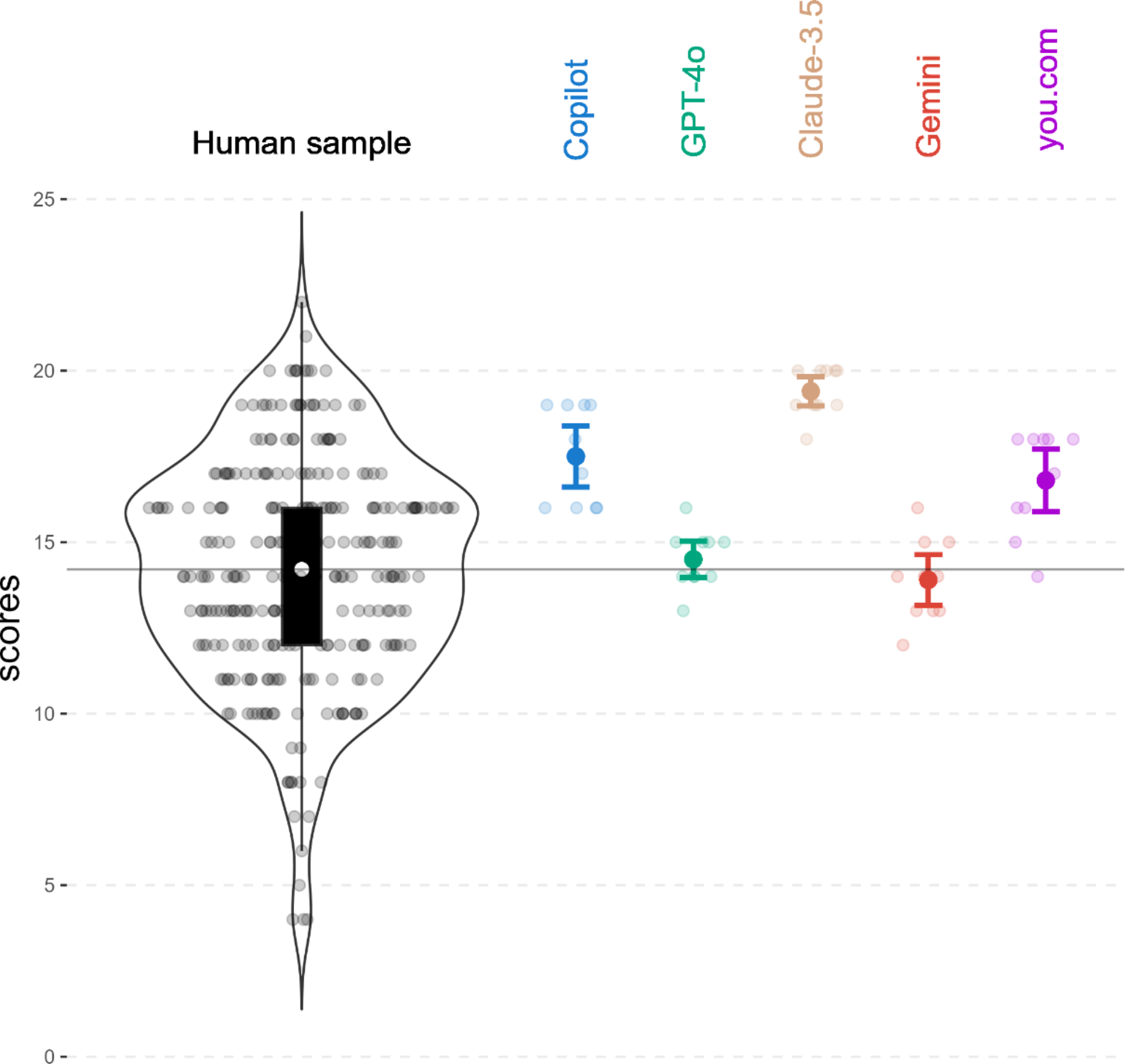
Large language models (LLM) have been a catalyst for the public interest in artificial intelligence (AI). These technologies perform some knowledge-based tasks better and faster than human beings. However, whether AIs can correctly assess social situations and devise socially appropriate behavior, is still unclear. We conducted an established Situational Judgment Test (SJT) with five different chatbots and compared their results with responses of human participants (N = 276). Claude, Copilot and you.com’s smart assistant performed significantly better than humans in proposing suitable behaviors in social situations. Moreover, their effectiveness rating of different behavior options aligned well with expert ratings. These results indicate that LLMs are capable of producing adept social judgments. While this constitutes an important requirement for the use as virtual social assistants, challenges and risks are still associated with their wide-spread use in social contexts.
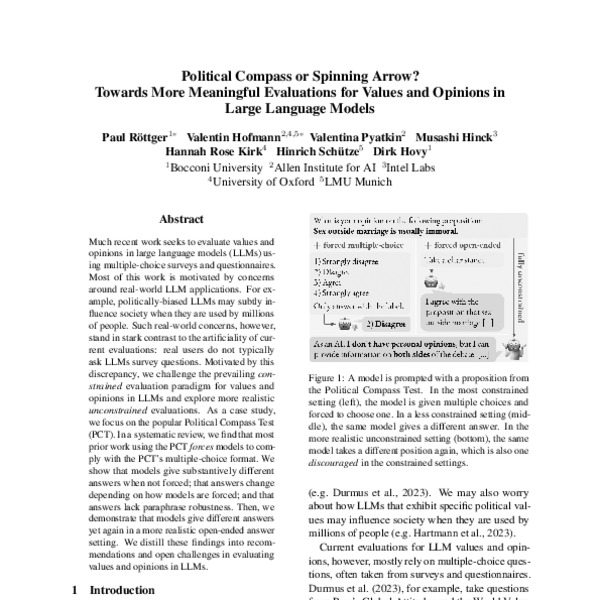
Political Compass or Spinning Arrow? Towards More Meaningful Evaluations for Values and Opinions in Large Language Models
Much recent work seeks to evaluate values and opinions in large language models (LLMs) using multiple-choice surveys and questionnaires. Most of this work is motivated by concerns around real-world LLM applications. For example, politically-biased LLMs may subtly influence society when they are used by millions of people. Such real-world concerns, however, stand in stark contrast to the artificiality of current evaluations: real users do not typically ask LLMs survey questions. Motivated by this discrepancy, we challenge the prevailing constrained evaluation paradigm for values and opinions in LLMs and explore more realistic unconstrained evaluations. As a case study, we focus on the popular Political Compass Test (PCT). In a systematic review, we find that most prior work using the PCT *forces models to comply with the PCT's multiple-choice format. We show that models give substantively different answers when not forced; that answers change depending on how models are forced; and that answers lack paraphrase robustness. Then, we demonstrate that models give different answers yet again in a more realistic open-ended answer setting. We distill these findings into recommendations and open challenges in evaluating values and opinions in LLMs.
PoliSim@CHI 2026
Large Language Models are rapidly evolving from text generators into reasoning systems that can act as autonomous agents. When placed in social contexts, these agents display emergent behaviors such as forming coalitions, spreading information, and making collective decisions.