

The ever increasing importance of machine learning in Natural Language Processing is accompanied by an equally increasing need in large-scale training and evaluation corpora. Due to its size, its openness and relative quality, the Wikipedia has already been a source of such data, but on a limited scale. This paper introduces the DBpedia Abstract Corpus, a large-scale, open corpus of annotated Wikipedia texts in six languages, featuring over 11 million texts and over 97 million entity links. The properties of the Wikipedia texts are being described, as well as the corpus creation process, its format and interesting use-cases, like Named Entity Linking training and evaluation.
Extracting Training Data from Large Language Models
Nicholas Carlini, Google; Florian Tramèr, Stanford University; Eric Wallace, UC Berkeley; Matthew Jagielski, Northeastern University; Ariel Herbert-Voss, OpenAI and Harvard University; Katherine Lee and Adam Roberts, Google; Tom Brown, OpenAI; Dawn Song, UC Berkeley; Úlfar Erlingsson, Apple; Alina Oprea, Northeastern University; Colin Raffel, Google
Cross-Lingual Exploration for Parametric Knowledge | Idan Szpektor
Accepted to EMNLP Findings! While Large Language Models encode vast amounts of multicultural and factual information, this parametric knowledge is often unevenly accessible across languages. Standard inference frequently fails to surface localized facts, creating persistent gaps in cross-lingual knowledge transfer and consistency. We address this challenge in our paper "Cross-Lingual Exploration for Parametric Knowledge" (https://lnkd.in/drf36bV7), a collaboration between Elisha Diskind, Itamar Trainin, and Omri Abend from The Hebrew University of Jerusalem, Leshem Choshen from the Weizmann Institute of Science, alongside Uri Shaham and myself from our Google Research IL group. We formalize cross-lingual exploration as a structured search process across four core dimensions: language selection, exploration routing, answer aggregation, and inference budget. Evaluating across 17 typologically diverse languages on the ECLeKTic and CLIKE benchmarks, we show that allowing models to autonomously navigate alternative linguistic paths yields up to a 21% gain in knowledge transfer and a 16% boost in factual recall over native baselines, surpassing both standard English-pivot routing and native-language reasoning. Crucially, cross-lingual exploration defines a significantly more efficient compute Pareto frontier than scaling within the native query language, while driving intrinsic cross-lingual consistency gains beyond what accuracy improvements alone explain. Technically, this moves the needle for multilingual inference and knowledge elicitation pipelines, demonstrating that strategic language switching is a powerful, training-free mechanism for unlocking latent parametric knowledge.

Learning to Route Languages for Multilingual Policy Optimization
Large language models~(LLMs) are trained on heterogeneous multilingual corpora, yet existing policy optimization methods often implicitly restrict each training question to a single response language or rely on a fixed dominant language for supervision. We propose language-routed policy optimization (LRPO), an online policy optimization framework that treats language as a selectable variable. LRPO elicits multilingual rollouts for each training question and integrates their relative quality into preference-based policy updates, increasing the diversity and informativeness of training signals under the fixed rollout budget. To adaptively determine which languages to explore during reinforcement learning, we introduce a trainable language router formulated as a multi-armed bandit, balancing exploration of underutilized languages with exploitation of more informative ones. Extensive experiments show that LRPO consistently improves multilingual performance, demonstrating that adaptive language routing enables effective cross-lingual knowledge exploitation for training. We release all the resources at https://github.com/Guochry/LRPO.

Targeted Multilingual Adaptation for Low-resource Language Families
The "massively-multilingual" training of multilingual models is known to limit their utility in any one language, and they perform particularly poorly on low-resource languages. However, there is evid
MCIF: Multimodal Crosslingual Instruction-Following Benchmark from Scientific Talks
Recent advances in large language models have laid the foundation for multimodal LLMs (MLLMs), which unify text, speech, and vision within a single framework. As these models are rapidly evolving toward general-purpose instruction following across diverse and complex tasks, a key frontier is evaluating their crosslingual and multimodal capabilities over both short- and long-form inputs. However, existing benchmarks fall short in evaluating these dimensions jointly: they are often limited to English, mostly focus on a single modality at a time, rely on short-form inputs, or lack human annotations--hindering comprehensive assessment of model performance across languages, modalities, and task complexity. To address these gaps, we introduce MCIF (Multimodal Crosslingual Instruction Following), the first crosslingual human-annotated benchmark based on scientific talks on NLP and beyond. MCIF evaluates instruction following in crosslingual, multimodal settings over different input lengths and spans four macro-tasks: recognition, translation, question answering, and summarization. It covers three core modalities (speech, vision, and text) and four diverse languages (English, German, Italian, and Chinese), fully aligned across all dimensions. This parallel design enables a systematic evaluation of MLLMs' abilities to interpret instructions across languages and effectively integrate multimodal contextual information. Our benchmarking and analysis of 23 models highlight universal challenges across modalities and tasks, indicating substantial room for improvement in future MLLMs development. MCIF is released under CC-BY 4.0 license to promote open research.
Exploring the Limits of Transfer Learning with a Unified Text-to-Text Transformer
Transfer learning, where a model is first pre-trained on a data-rich task before being fine-tuned on a downstream task, has emerged as a powerful technique in natural language processing (NLP). The effectiveness of transfer learning has given rise to a diversity of approaches, methodology, and practice. In this paper, we explore the landscape of transfer learning techniques for NLP by introducing a unified framework that converts all text-based language problems into a text-to-text format. Our systematic study compares pre-training objectives, architectures, unlabeled data sets, transfer approaches, and other factors on dozens of language understanding tasks. By combining the insights from our exploration with scale and our new “Colossal Clean Crawled Corpus”, we achieve state-of-the-art results on many benchmarks covering summarization, question answering, text classification, and more. To facilitate future work on transfer learning for NLP, we release our data set, pre-trained models, and code.
Stanford CS336 Language Modeling from Scratch I 2025
Wiki-40B: Multilingual Language Model Dataset
We propose a new multilingual language model benchmark that is composed of 40+ languages spanning several scripts and linguistic families. With around 40 billion characters, we hope this new resource will accelerate the research of multilingual modeling. We train monolingual causal language models using a state-of-the-art model (Transformer-XL) establishing baselines for many languages. We also introduce the task of multilingual causal language modeling where we train our model on the combined text of 40+ languages from Wikipedia with different vocabulary sizes and evaluate on the languages individually. We released the cleaned-up text of 40+ Wikipedia language editions, the corresponding trained monolingual language models, and several multilingual language models with different fixed vocabulary sizes.
What Language is This? Ask Your Tokenizer
Language Identification (LID) is an important component of many multilingual natural language processing pipelines, where it facilitates corpus curation, training data analysis, and cross-lingual evaluation of large language models. Despite near-perfect performance on high-resource languages, existing systems remain brittle in low-resource and closely related language settings. We introduce UniLID, a simple and efficient LID method based on the UnigramLM tokenization algorithm, leveraging its probabilistic framing, parameter estimation technique and inference strategy. In short, to predict a string's language label, we simply ask: under which language's unigram distribution is this string most likely? Our formulation is data- and compute-efficient, supports incremental addition of new languages without retraining existing models, and can naturally be integrated into existing language model tokenization pipelines. Empirical evaluations against widely used baselines, including fastText, GlotLID and CLD3, show that UniLID achieves competitive performance on standard benchmarks, substantially improves sample efficiency in low-resource settings -- reaching ~70% accuracy with as few as five labeled samples per language -- and delivers large gains on fine-grained dialect identification.
Attention Is All You Need
The dominant sequence transduction models are based on complex recurrent or convolutional neural networks in an encoder-decoder configuration. The best performing models also connect the encoder and decoder through an attention mechanism. We propose a new simple network architecture, the Transformer, based solely on attention mechanisms, dispensing with recurrence and convolutions entirely. Experiments on two machine translation tasks show these models to be superior in quality while being more parallelizable and requiring significantly less time to train. Our model achieves 28.4 BLEU on the WMT 2014 English-to-German translation task, improving over the existing best results, including ensembles by over 2 BLEU. On the WMT 2014 English-to-French translation task, our model establishes a new single-model state-of-the-art BLEU score of 41.8 after training for 3.5 days on eight GPUs, a small fraction of the training costs of the best models from the literature. We show that the Transformer generalizes well to other tasks by applying it successfully to English constituency parsing both with large and limited training data.
Post-Training Language Models for Crosslingual Consistency
Language models often respond inconsistently to translation-equivalent prompts across languages, undermining the reliability of multilingual systems. To quantify this, we give an information-theoretic definition of crosslingual consistency as a divergence bound between a model's response distribution and its round-trip pushforward across languages. We then introduce penalized consistency optimization (PCO), a post-training procedure that couples this divergence with a Kullback-Leibler penalty to a fixed reference language model. Because direct optimization of PCO requires expensive on-policy roll-outs, we propose a tractable surrogate, direct consistency optimization (DCO), which can be optimized off-policy. Across diverse language models and 26 languages, DCO significantly improves crosslingual consistency, outperforms existing methods, and enables targeted alignment of low-resource languages.
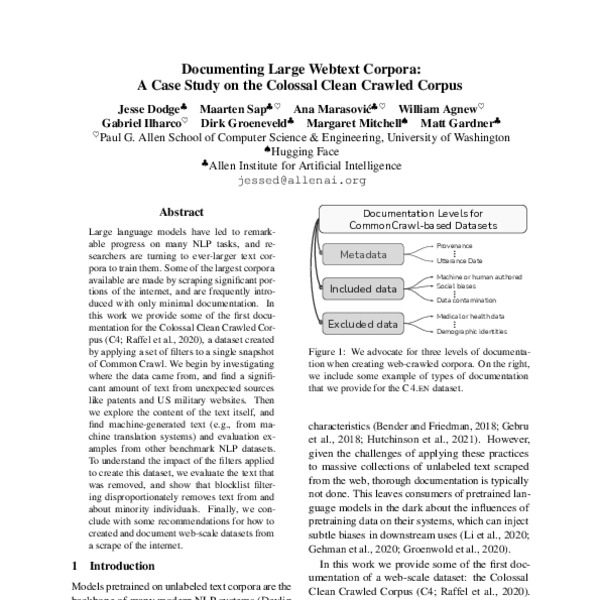
Documenting Large Webtext Corpora: A Case Study on the Colossal Clean Crawled Corpus
Large language models have led to remarkable progress on many NLP tasks, and researchers are turning to ever-larger text corpora to train them. Some of the largest corpora available are made by scraping significant portions of the internet, and are frequently introduced with only minimal documentation. In this work we provide some of the first documentation for the Colossal Clean Crawled Corpus (C4; Raffel et al., 2020), a dataset created by applying a set of filters to a single snapshot of Common Crawl. We begin by investigating where the data came from, and find a significant amount of text from unexpected sources like patents and US military websites. Then we explore the content of the text itself, and find machine-generated text (e.g., from machine translation systems) and evaluation examples from other benchmark NLP datasets. To understand the impact of the filters applied to create this dataset, we evaluate the text that was removed, and show that blocklist filtering disproportionately removes text from and about minority individuals. Finally, we conclude with some recommendations for how to created and document web-scale datasets from a scrape of the internet.
RomanSetu: Efficiently unlocking multilingual capabilities of Large Language Models via Romanization
This study addresses the challenge of extending Large Language Models (LLMs) to non-English languages, specifically those using non-Roman scripts. We propose an approach that utilizes the romanized form of text as an interface for LLMs, hypothesizing that its frequent informal use and shared tokens with English enhance cross-lingual alignment. Our approach involve the continual pretraining of a English LLM like Llama 2 on romanized text of non-English, non-Roman script languages, followed by instruction tuning on romanized data. The results indicate that romanized text not only reduces token fertility by 2x-4x but also matches if not outperforms native script representation across various NLU, NLG and MT tasks. Moreover, the embeddings computed on romanized text exhibit closer alignment with their English translations than those from the native script. Our approach presents a promising direction for leveraging the power of English LLMs in languages traditionally underrepresented in NLP research.
The Stanford NLP Group
Performing groundbreaking Natural Language Processing research since 1999.

Improving Cross-Lingual Factual Recall via Consistency-Driven Reinforcement Learning
Large language models (LLMs) trained predominantly on English data encode substantial world knowledge, yet often fail to express it reliably in other languages, a phenomenon known as cross-lingual...