


This is Part IIIb of our four-and-three-quarters part series (I, II, IIIa) on what we’re calling the Fremen Mirage. Last week, we traced the origins of this idea in the Greek and Roman ethnog…
Collections: The Fremen Mirage Part IIIa: …by the Princess Irulan
This is Part IIIa of our four-part series (I, II) looking at what I’ve termed the ‘Fremen Mirage.’ We defined the core tenets of this pop-historical notion in more detail in the f…

Collections: The Fremen Mirage, Part IV: Desert Power
This is Part IV of our four-and-three-quarters part series (I, II, IIIa, IIIb, interlude) on the Fremen Mirage. We began by sketching out the basic outline of this pop theory of history: that a lac…

Collections: The Fremen Mirage, Part I: War at the Dawn of Civilization
This week’s post is the first in a four part series (II, IIIa, IIIb, interlude, IV) looking at what I’m going to term the Fremen Mirage (a play on Le Mirage Spartiate, which we’ve…

Collections: The Fremen Mirage, Part II: Water Spilled on the Sand
This is part II of our four-part series (I, IIIa, IIIb, interlude, IV) looking at what I’ve termed ‘the Fremen mirage,’ after the fiction people from the science fiction novel Dun…

Collections: The Fremen Mirage, Interlude: Ways of the Fremen
This week we’re breaking out of the main series of posts on the Fremen Mirage (I, II, IIIa, IIIb) to answer a brewing discussion that has been running in the comments: does Dune exist within …

Pappus of Alexandria Book 7 of the Collection
The seventh book of Pappus's Collection, his commentary on the Domain (or Treasury) of Analysis, figures prominently in the history of both ancient and modern mathematics: as our chief source of information concerning several lost works of the Greek geometers Euclid and Apollonius, and as a book that inspired later mathematicians, among them Viete, Newton, and Chasles, to original discoveries in their pursuit of the lost science of antiquity. This presentation of it is concerned solely with recovering what can be learned from Pappus about Greek mathematics. The main part of it comprises a new edition of Book 7; a literal translation; and a commentary on textual, historical, and mathematical aspects of the book. It proved to be convenient to divide the commentary into two parts, the notes to the text and translation, and essays about the lost works that Pappus discusses. The first function of an edition of this kind is, not to expose new discoveries, but to present a reliable text and organize the accumulated knowledge about it for the reader's convenience. Nevertheless there are novelties here. The text is based on a fresh transcription of Vat. gr. 218, the archetype of all extant manuscripts, and in it I have adopted numerous readings, on manuscript authority or by emendation, that differ from those of the old edition of Hultsch. Moreover, many difficult parts of the work have received little or no commentary hitherto.

Blades of Mirage - Official Playtest Release Window Trailer | The MIX Summer Game Showcase 2026 - IGN
Get a look at the Playtest Release Window Trailer for Blades of Mirage, an isometric action-adventure game developed by Agate. Players will embody Mira to use her ability to create water-based weapons and explore ancient ruins scattered across unique islands. Confront corrupted, powerful creatures and solve intricate puzzles to secure the ancient relics. Blades of Mirage is coming soon to PC (Steam), with a playtest launching in July 2026 on Steam.

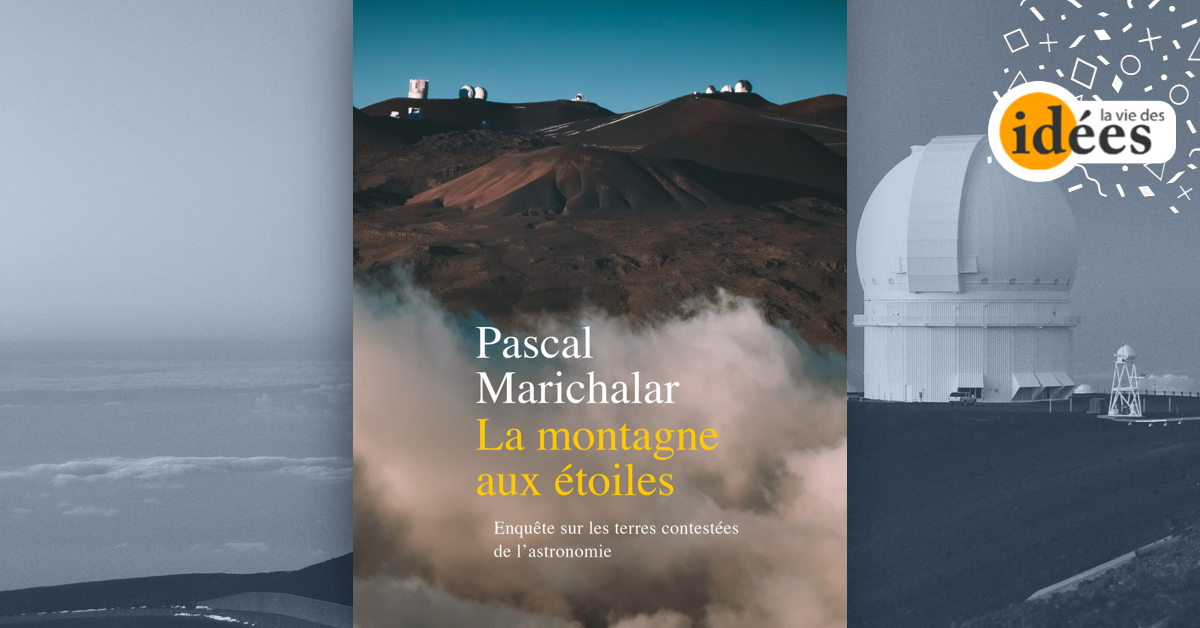
La face cachée des télescopes
À propos de : Pascal Marichalar, La Montagne aux étoiles, La Découverte
Legends of the Ancient Web
This is the text version of a talk I gave on May 24, 2017, at the Front Trends conference in Warsaw.
Allegory of the Cave - Legion
«Oui, ça ira». Une conversation fleuve avec Patrick Boucheron, co-auteur de la cérémonie d’ouverture des JO de Paris 2024 | Le Grand Continent
« On nous dit que nous sommes hors sol — mais le sol, il est là. » Succès planétaire, au cœur des polémiques, la cérémonie d’ouverture de Paris 2024 a fait date. Dans une prise de parole unique, extrêmement fouillée, l’historien Patrick Boucheron nous fait entrer dans le secret de la fabrique à images de la cérémonie qu’il a co-écrite — d’Aya Nakamura en duo avec la garde républicaine à la cavalière sur la Seine en passant par la décapitation de Marie-Antoinette ou la « Cène subliminale », jusqu’à la Tour Eiffel où Céline Dion entonne l’Hymne à l’amour, nous comprenons ses intentions, sa genèse, sa signification et les perspectives qu'elle ouvre.

L’histoire par les textes - APHG
Antiquité Moyen Âge Période moderne Période contemporaine Thèmes transversaux Historiographie Liens utiles N.B. Les documents portant sur les séquences intermédiaires entre plusieurs ères (antiquité tardive, transition Moyen Âge / première modernité, période révolutionnaire) peuvent se trouver dans les deux pages concernées. Principes du projet et avertissements Pour valoriser et partager ces efforts conséquents, cette page […]
Fireside Friday, February 23, 2024 (On the Military Failures of Fascism)
Fireside this week! We’ll pick up looking at some of the successes of Hellenistic armies next week. Percy, having found a use for some of my books. And of course, less I miss a chance to note…

Parmenides: Pre-Socratic Philosophy
The Friendly Orange Glow: The Untold Story of the PLATO…
The remarkable untold story of PLATO, the computer prog…

Face of a Bird, Legs of an Eagle: The Hybrid Venus in Medieval Texts of Image Magic and the So-Called Talisman of Catherine de’ Medici
This article examines the imagery of the goddess Venus in medieval sources of astrological magic, focusing on a zoomorphic hybrid Venus characterized by avian features. Furthermore, the article examines the transmission of this motif into early modern printed sources and talismans. The most renowned among surviving items related to the hybrid Venus is the 18th-century medallion known as Catherine de Medici’s talisman, depicting on one side a classical Venus figure, and on the other, a seated Jupiter alongside a hybrid with the head and feet of a bird. In previous scholarship it has been argued that the hybrid figure, interpreted as Venus, derives from Cornelius Agrippa and the medieval magical compendium Picatrix. The study demonstrates that the same hybrid Venus appears in several other medieval sources predating Agrippa and independent of the Picatrix. These sources, explored in this article in detail, offer a new insight into the evolution of the zoomorphic Venus, providing a deeper understanding of the ways in which non-Christian and non-classical astrological iconography was transformed and found pathways within medieval literature. Based on the findings of this research, De sigillis attributed to Arnoldus Saxo, seems to provide the most direct model for depicting two distinct Venus figures within the same talisman. The article further argues that the avian hybrid Venus was a dynamic figure among non-classical hybrids, appearing in a relatively wide range of sources, including contexts where astrological hybrids were a rarity.