


🌎 A Sharkish microblogging platform 🚀
Opal
Convert your microblog posts from Twitter, Mastodon, Threads, and Nostr to AT Protocol Bluesky posts. Free, open-source, runs in your browser.
Platform Stats — blogs.social
Discover and follow blogs across Bluesky, Mastodon, RSS, and the open social web.
Shifts in U.S. Social Media Use, 2020–2024: Decline, Fragmentation, and Enduring Polarization
The social media ecosystem appears to be in flux. Twitter’s rebranding to X has come to symbolize a broader reorganization of online publics – political reshuffling, user attrition, and uncertainty over the role of legacy platforms. Simultaneously, the shift from text-based, networked feeds toward algorithmically curated, short-form video has accelerated, with TikTok setting the pace for the wider ecosystem [18, 14, 16]. At the same time, everyday communication increasingly migrates from large, open networks to semi-private spaces such as group chats and messaging apps. Commentators describe a digital public sphere in transition: smaller, more fragmented, less dominated by traditional social networking sites, and rise of more broadcast-oriented forms of media – with some even suggesting that we are seeing the beginning of the end of the social media era.
The Astrosky Ecosystem: An independent online platform for science communication and social networking
While almost everything that astronomers study occurs in the vacuum of space, astronomy itself does not `happen in a vacuum'. Interactions between scientists, as well as outreach to members of the public, improve extensively from access to good communication tools. Social media has become a key tool for communication in astronomy, being widely used by individuals and organizations alike for networking, outreach, and more. However, traditional social media is reliant on benevolent corporations providing a free service without compromising on quality, and the recent takeover and decline of Twitter has shown how vulnerable these platforms can be. In this proceeding, we present The Astrosky Ecosystem, which is an initiative to develop open-source tools and integrations for social media, principally the Bluesky social network. We explain how our project enables the astronomy community to operate its own social media infrastructure, independent of for-profit corporations. We also discuss some of the project's technical aspects, including its use of the AT Protocol for social networking, before concluding with ideas for the future.

Micro.blog - @danielpunkass

MbinOrg/mbin
Mbin: a federated content aggregator, voting, discussion and microblogging platform
blogs.social — Discover the open web
Discover and follow blogs across Bluesky, Mastodon, RSS, and the open social web.
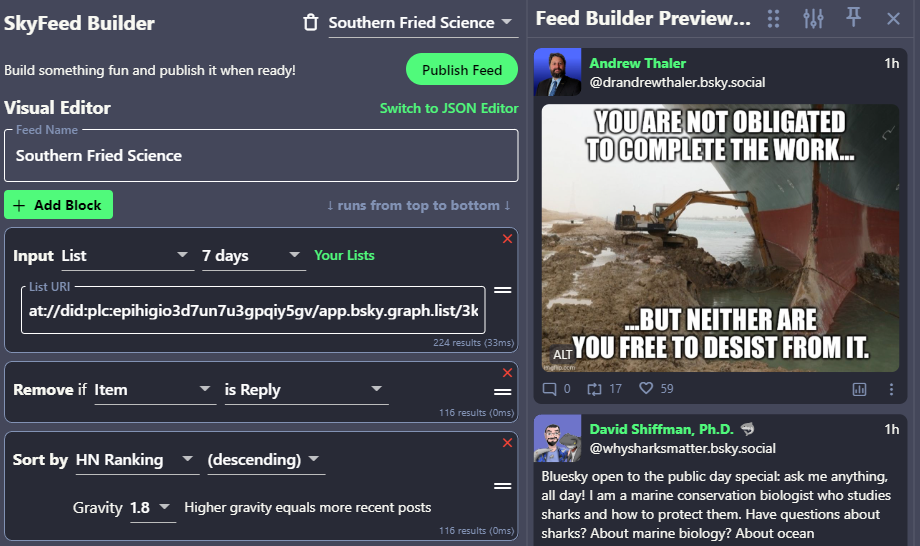
A quick and dirty guide to making custom feeds on Bluesky
So, you’ve made it! The remnants of science twitter have at last begun to coalesce around a new microblogging platformed owned by questionable individuals with inadequate content moderation t…
The promise of ATproto is social media without corporate overlords | The Web Dev Podcast Series 1
Developers building apps on ATproto, the technology behind social media apps like Bluesky and Leaflet, are promising us a future where we own our content and aren’t at the whims of a tiny handful of companies. Software engineer Zeu Capua talks to host Jason Lengstorf about the promise of social media where we can actually own our own data.

Mastodon - Decentralized social media
Learn more about Mastodon, the radically different, free and open-source decentralized social media platform.
Introducing the Micro.blog PDS: manton.org/2026/08/11/introducing-the-mi…
Okay... This looks very cool. 👏🏻👏🏻👏🏻 For researchers and reporters looking to find and collate material from across the web, imagine a search and bookmarking tool that's social. 📝📝📝 @semble.so let's you log in with your BlueSky account.

Semble
Wondering what Semble is all about and how to use it? Check out our video guides on our docs page to learn more! docs.cosmik.network/semble
Introducing Opal — a tool to convert your microblog posts to Bluesky. Import from Twitter, Mastodon, Threads, or Nostr exports. It handles facets (links, mentions, hashtags), splits long posts into threads, and publishes to your PDS via OAuth. Everything runs in your browser. opal.croft.click


