

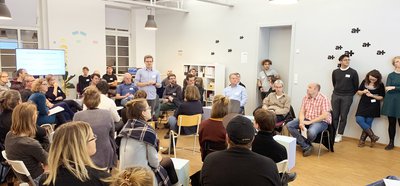
adhocracy+ is more than just a platform. With adhocracy+ digital democracy becomes easy: for everyone and everywhere. On 14 November, our guests were able to see for themselves how they can use adhocracy+ for their projects in NGOs, municipalities or politics.
adhocracy+/Participation software must be open source - a plea for democratic software
Adhocracy is open source software. This article argues that investment software must be open source and explains the reasons why we are convinced of it.

SimPolitics
For more than six decades, the public has been promised that computers will revolutionize politics, both nationally and internationally. In SimPolitics, Fenw...

Interoperable Sovereignty: The Democratic Alternative to Digital Authoritarianism
A Democratic Architecture for the Digital Age Digital sovereignty has become a central concern for governments worldwide, yet its meaning remains contested. Too often it is framed as...

Scoping report: Future challenges to democracy | CoP CC on Participatory and Deliberative Democracy
The report from the European Commission identifies 10 key challenges and emerging trends impacting European democratic systems and suggests future policy options. These challenges are structured across three interconnected levels: citizens and societal dynamics, the information and knowledge environment, and institutions and the democratic system. This framework aims to provide a comprehensive and integrated view of democracy as a connected ecosystem, emphasising how challenges in one area can affect the entire system.
Why Online Democracies Fail - Eclectic Corvine Muses
A compendium to my upcoming proposal for community infrastructure within the AT Protocol
Fractured reality
The report examines the evolving impact of digital technologies on European democracy. In an era of a global struggle to control the information space, this report offers critical insights into the fracturing of perceived realities, the rise of the ‘fantasy-industrial complex’, and the systemic risks posed by the attention economy. It exposes how platforms algorithmically prioritise engagement over accuracy, reinforcing ideological echo chambers and amplifying mis- and disinformation that erode democratic resilience. The report highlights how structural incentives and foreign control of the most important players in the information space undermine information integrity, collective knowledge and civic discourse. In response, the report presents a number of recommendations from fostering alternative public spaces and crowd-sourced knowledge systems to reforming business models, restoring user agency, and advancing EU digital sovereignty through decentralised infrastructure
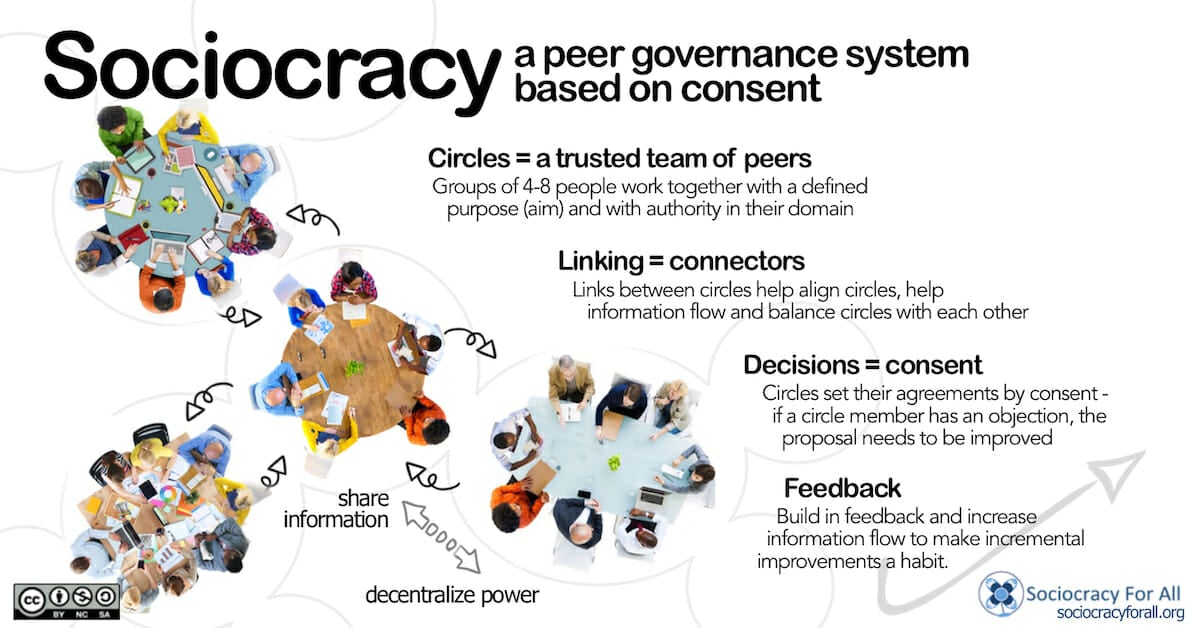
Sociocracy - basic concepts and principles
Brief overview of sociocracy: basic concepts and principles, history, its use in organizations, its limits and differences to voting, consensus and hierarchical forms of organizing.
Direct Democracy | The Paper Pilot
The Paper Pilot's digital garden of thoughts on philosophy, politics, and sociology
Towards Platform Democracy: Policymaking Beyond Corporate CEOs and Partisan Pressure
Platforms can bring challenging and divisive policy issues to a new kind of democratic process, enabling a ‘people’s mandate’ for their policies and helping mitigate corporate and partisan power.

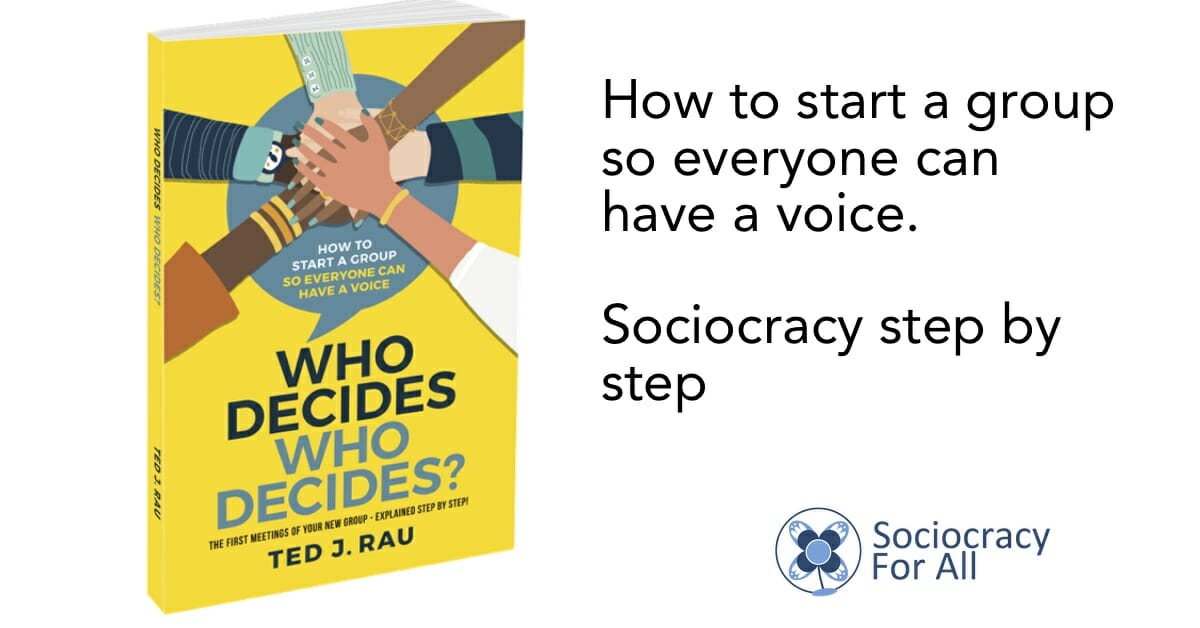
Who Decides Who Decides? - Sociocracy For All
Who Decides Who Decides is a book for starting groups with sociocracy - a guide for governance and decision-making that's clear and inclusive.
Data-owning Democracy or Digital Socialism?
This article contrasts two reform proposals articulated in recent debates about how to democratize the digital economy: data-owning democracy and digital socialism. A data-owning democracy is a political-economic regime character-ized by the
Technocracy | The Paper Pilot
The Paper Pilot's digital garden of thoughts on philosophy, politics, and sociology
Democracy x AI Cohort | Mozilla Foundation
The Democracy x AI cohort is founded on the hypothesis that, if built differently, AI could strengthen democracy rather than erode it.

Modular Politics: Toward a Governance Layer for Online Communities
Governance in online communities is an increasingly high-stakes challenge, and yet many basic features of offline governance legacies--juries, political parties, term limits, and formal debates, to name a few--are not in the feature-sets of the software most community platforms use. Drawing on the paradigm of Institutional Analysis and Development, this paper proposes a strategy for addressing this lapse by specifying basic features of a generalizable paradigm for online governance called Modular Politics. Whereas classical governance typologies tend to present a choice among wholesale ideologies, such as democracy or oligarchy, Modular Politics would enable platform operators and their users to build bottom-up governance processes from computational components that are modular and composable, highly versatile in their expressiveness, portable from one context to another, and interoperable across platforms. This kind of approach could implement pre-digital governance systems as well as accelerate innovation in uniquely digital techniques. As diverse communities share and connect their components and data, governance could occur through a ubiquitous network layer. To that end, this paper proposes the development of an open standard for networked governance.

Democracy is an epistemic discipline, it only works if truth can constrain power. Without a faster, more transparent architecture for shared reality, the arc of democracy bends away from substance, through simulation, and toward authoritarianism. Without major action, it's the inevitable end state.
It is a shame that "democratization" in software has come to mean broader access to products instead of participation in democratic processes — there is talk of LLMs democratizing software production, but I have yet to see social, collective and democratic processes govern the design of software.

