

Title abbreviation: Adv Clin Exp MedJournal Impact Factor (JIF 2025) – 2.5Journal Citation Indicator (JCI 2025) – 0.40Scopus CiteScore (2025) – 4.2Index Copernicus Value (ICV 2025) – 162.75MNiSW – 70 ptsISSN 1899–5276 (print), ISSN 2451-2680 (online)Periodicity – monthly
Agreement in Risk of Bias Assessment Between RobotReviewer and Human Reviewers: An Evaluation Study on Randomised Controlled Trials in Nursing‐Related Cochrane Reviews
Abstract Purpose RobotReviewer is a machine learning system for semi‐automated assistance in risk of bias assessment. The tools’s performance in randomized controlled trials (RCTs) in the field of nursing remains unknown. We aimed therefore to evaluate the agreement in risk of bias assessment between RobotReviewer and human reviewers. Design Evaluation study using a retrospective diagnostic design. Methods We used RobotReviewer as the index test and human reviewers’ risk of bias assessment reported in Cochrane reviews as the reference test. A convenience sample of electronically available English‐language full texts of RCTs included in Cochrane reviews with nurs* in the title were eligible for inclusion. In this context, we assessed random sequence generation, allocation concealment, and blinding (personnel or participants and assessors) corresponding to Cochrane risk of bias version 2011. Two independent research teams performed and double‐checked data extraction and analysis. We calculated sensitivity, specificity, receiver operating characteristic (ROC) curve, the area under the ROC curve, predictive values, observed percentage of agreement, and Cohen’s kappa (including confidence intervals, if applicable). Findings The selection process yielded 190 RCTs published between 1958 and 2016 in 23 Cochrane reviews published between 2000 and 2018. Missing assessments of risk of bias domains in Cochrane reviews or RobotReviewer yielded varying sample sizes per risk of bias domain. Sensitivity ranged from 0.44 to 0.88 and specificity from 0.48 to 0.95. Positive predictive value was highest for allocation concealment (0.79) and lowest for blinding assessors (0.25). Cohen’s kappa was moderate for randomization (0.52), allocation concealment (0.60), and for blinding of personnel/patients (0.43). Blinding of outcome assessors had only slight agreement (0.04). Conclusions This is the first evaluation of risk of bias assessment by RobotReviewer in RCTs included in nursing‐related Cochrane reviews. It yielded a moderate degree of agreement with human reviewers for randomization and allocation concealment, and an adequate sensitivity for detecting low risk of selection bias. Clinical Relevance Based on our results, using the RobotReviewer for risk of bias assessment in RCTs can be supportive in some risk of bias domains. However, human reviewers should supervise the semi‐automated assessment process.

AI Article Reviews Dominate Human Peer Reviews at Their Best: Evidence and Policy Choices
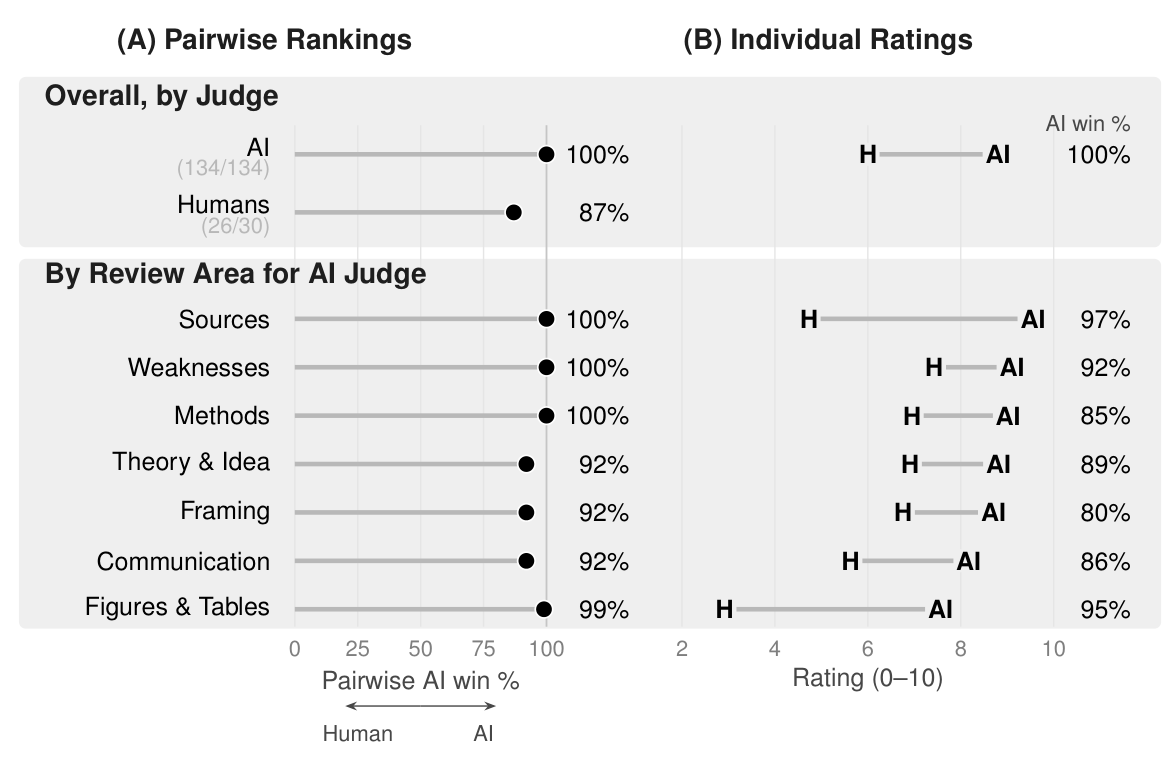
We show that AI-generated article reviews are now better, by every measure we could construct, than reviews written by well-compensated human experts and judged to be of unusually high quality by journal editors and authors. We then discuss how this result may inform journal policy choices, with concerning downsides as well as potential paths to increase publication speed and quality; reduce adversarial interactions; improve the experience of editors, reviewers, authors, and readers; and advance science.
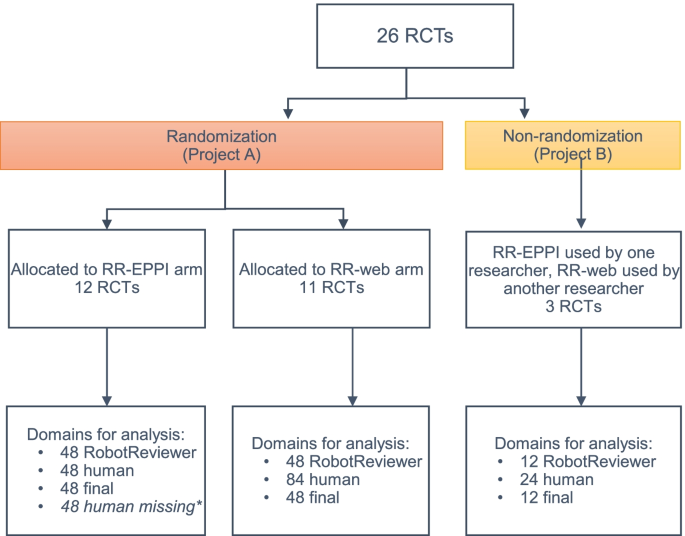
Automating risk of bias assessment in systematic reviews: a real-time mixed methods comparison of human researchers to a machine learning system
Machine learning and automation are increasingly used to make the evidence synthesis process faster and more responsive to policymakers’ needs. In systematic reviews of randomized controlled trials (RCTs), risk of bias assessment is a resource-intensive task that typically requires two trained reviewers. One function of RobotReviewer, an off-the-shelf machine learning system, is an automated risk of bias assessment.
ChatGPT for assessing risk of bias of randomized trials using the RoB 2.0 tool: A methods study
Abstract Background Internationally accepted standards for systematic reviews necessitate assessment of the risk of bias of primary studies. Assessing risk of bias, however, can be time- and resource-intensive. AI-based solutions may increase efficiency and reduce burden. Objective To evaluate the reliability of OpenAI’s ChatGPT for performing risk of bias assessments of randomized trials using the revised risk of bias tool for randomized trials (RoB 2.0). Methods We sampled recently published Cochrane systematic reviews of medical interventions (up to October 2023) that included randomized controlled trials and assessed risk of bias using the Cochrane-endorsed RoB 2.0. From each eligible review, we collected data on the risk of bias assessments for the first three reported outcomes. Using ChatGPT-4, we assessed the risk of bias for the same outcomes using three different prompts: a minimal prompt including limited instructions, a maximal prompt with extensive instructions, and an optimized prompt that was designed to yield the best risk of bias judgements. The agreement between ChatGPT’s assessments and those of Cochrane systematic reviewers was quantified using weighted kappa statistics. Results We included 34 systematic reviews with 157 unique trials. We found the agreement between ChatGPT and systematic review authors for assessment of overall risk of bias to be 0.16 (95% CI: 0.01 to 0.3) for the maximal ChatGPT prompt, 0.17 (95% CI: 0.02 to 0.32) for the optimized prompt, and 0.11 (95% CI: −0.04 to 0.27) for the minimal prompt. For the optimized prompt, agreement ranged between 0.11 (95% CI: −0.11 to 0.33) to 0.29 (95% CI: 0.14 to 0.44) across risk of bias domains, with the lowest agreement for the deviations from the intended intervention domain and the highest agreement for the missing outcome data domain. Conclusion Our results suggest that ChatGPT and systematic reviewers only have “slight” to “fair” agreement in risk of bias judgements for randomized trials. ChatGPT-4 cannot be relied upon to judge risk of bias and should not be used for this purpose. Since this study was completed, ChatGPT has advanced and OpenAI has released newer models with different capabilities. These may prove more adept at risk of bias evaluation. There may also be opportunities to use ChatGPT to streamline other aspects of systematic reviews, such as screening of search records or collection of data.
Machine learning to help researchers evaluate biases in clinical trials: a prospective, randomized user study
Assessing risks of bias in randomized controlled trials (RCTs) is an important but laborious task when conducting systematic reviews. RobotReviewer (RR), an open-source machine learning (ML) system, semi-automates bias assessments. We conducted a user study of RobotReviewer, evaluating time saved and usability of the tool.

AI linked to explosion of low-quality biomedical research papers
Analysis flags hundreds of studies that seem to follow a template, reporting correlations between complex health conditions and single variables based on publicly available data sets.

AI’s Growing Role as Scientific Peer Reviewer | Stanford HAI
Stanford computer scientist James Zou is exploring how AI can accelerate scientific research and peer review. His finding: AI excels at spotting gaps, but judgment calls still need humans.

Exploring AI’s growing role in scientific peer review
Stanford computer scientist James Zou discusses AI’s strengths at spotting errors and limitations in judging research significance.


How do authors want to use AI for review?
A survey of researchers who compared AI-generated scientific reviews with journal-agnostic human peer review reveals that they overwhelmingly prefer using AI as a self-checking tool before submission rather than as a replacement for human reviewers. It encourages an “author-centric” model in which AI helps researchers improve their manuscripts before they are reviewed by their peers.

AI Research Assistant Claude Scholar: Open Source, Free, and Citation-Verified | João Cláudio Nunes Carvalho posted on the topic | LinkedIn
🚨 Professors are going to hate this. Someone just open sourced an AI that writes research papers from idea to publication. Conference-ready. Citation-verified. Free. It's called Claude Scholar. An AI-powered research system that handles every step of the academic workflow. Idea to publication. Fully automated. No advisor at 2am. No staring at blank LaTeX files. No crying during rebuttal season. Here's what's inside this thing: → AI brainstorms research topics, reviews literature, and finds gaps nobody has explored → Runs statistical analysis on your experiments. t-tests, ANOVA, ablation studies. Publication-ready figures. → Writes your paper section by section. Abstract to conclusion. Conference-formatted. → Verifies every citation through multi-layer validation so AI never hallucinates a reference → Strips robotic AI language and adds human voice so reviewers can't tell → Self-reviews your draft with a 6-point quality checklist before you submit → Parses reviewer comments, classifies each one, and drafts your entire rebuttal Here's the wildest part: It supports NeurIPS, ICML, ICLR, ACL, AAAI, Nature, Science, Cell, and PNAS. Downloads the conference template, strips sample content, and gives you a clean LaTeX structure ready to write into. The creator says it covers 90% of the academic research lifecycle. Research assistants charge $30 to $60/hour. Conference paper consultants charge $5,000+. Graduate programs cost $50K/year. This is free. All of it. 100% Open Source.

Guest Post — Now is the Time for AI in Peer Review, and Publishing Policies Need to Recognize This - The Scholarly Kitchen
Today's post asks us to acknowledge the role of AI in peer review and ensure practical guidance and policies that help scholars respond with consistency and confidence.

Absolutely incredible figure from this journal article arguing that AI should be accepted into the publication and peer review process. #MedSky doi.org/10.1515/cclm-2025-1180
New preprint! We introduce a new benchmark, SciConBench, with 9.11k scientific questions derived from Cochrane Systematic Reviews. We find evidence that frontier AI agents **cannot** synthesize scientific conclusions well. A thread 🧵 w/ @hayoungjung.bsky.social & others!
Absolutely incredible figure from this journal article arguing that AI should be accepted into the publication and peer review process. #MedSky doi.org/10.1515/cclm-2025-1180

